Globalizing Environmental History—Again
Franz Uekoetter examines the evolution of environmental history in the context of globalization, highlighting its early global focus and the more recent trend towards specialization and nuanced narratives.
Franz Uekoetter examines the evolution of environmental history in the context of globalization, highlighting its early global focus and the more recent trend towards specialization and nuanced narratives.
Harriet Ritvo explores the intersection of environmental history and environmental concerns, emphasizing how the discipline reflects the growing awareness of global environmental challenges.
David Blackbourn highlights how environmental history reflects broader shifts in the historical discipline, such as the renewed focus on place, materiality, and “big history.”
John R. Gillis critiques the landlocked nature of environmental history, highlighting its neglect of oceans, which comprise most of Earth’s surface and are central to its ecosystems.
John R. McNeill emphasizes the need for environmental history to broaden its scope by addressing underexplored regions, eras, and themes.
Anthony Carrigan reflects on his resistance to conventional academic structures and his turn towards literature and environmental humanities.
Timothy LeCain outlines his shift from viewing technology as a departure from nature to understanding humans as materially embedded within it.
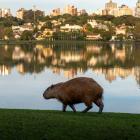
Vera Krause’s “How to Reimagine Our Doomed Futures Through Ursula K. Le Guin’s Lens: A Case Study in the Argentinian Wetlands” is a sympathetic account of a so-called capybara “invasion” in contemporary Buenos Aires, taking its cue from the anarchist fantasy of Ursula K. Le Guin to show the difference between invading and reclaiming one’s space. It was one of the two honorable mentions in the reflective essay category of the RCC environmental writing competition “Tell the Untold!”
In the fall of 2024, Amitav Ghosh visited the Rachel Carson Center for Environment and Society as part of the project “One Book—Many Worlds: Munich Reads Gun Island by Amitav Ghosh.” This exhibition emerges from the multifaceted discussion of climate change and its challenges conducted in the “One Book—Many Worlds” project and grapples with the question of the role of literary fiction in interdisciplinary academic exchange and climate communication beyond academia. Taking Amitav Ghosh’s recent writings on the global climate crisis, in particular the novel Gun Island, as a vantage point, the chapters in this exhibition engage with various aspects Gun Island from different disciplinary perspectives, drawing on storylines and narrative elements that allow a multifocal engagement with different social and ecological repercussions of climate change. Additionally, pieces from the spring 2025 taumelnd trauen, verschlungen bleiben student exhibition and winning and honorable mentions from the 2025 “Tell the Untold!” writing competition take the provocation to think creatively about the past and future of our environment and world further. Thereby, the exhibition chapters create a web of diverse thoughts on and readings of the role of storytelling for the contemporary interlinked social and environmental crises from a number of perspectives.
About This Exhibition
In an increasingly inhumane world, this article argues that socioecological justice can only be achieved by embracing human nature.
The second chapter of”Wetland Times,” “Narratives.”
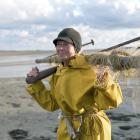
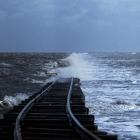
Wetlands are ecologically dynamic and vulnerable landscapes where multiple temporalities, human and nonhuman, intersect and challenge one another. This virtual exhibition explores the dynamic temporalities of wetlands and their complex relationships—the temporal imaginaries, narratives, structures, flows, (a)synchronicities, and ruptures they contain—framed by a conceptual vocabulary that reveals the role of language in understanding wetland times and temporalities. Our examples draw on case studies from three wetlands: the Wadden Sea in Northern Europe; Morecambe Bay, in the northwest of the United Kingdom; and the Dja-et-Lobo region in southern Cameroon, focusing specifically on wetland areas near settlements of the Baka People.
About the Exhibition