Tales from Coral Country
1. The Hidden City, Outer Banks (32°N, 78°W)
There are two ways most go about describing the city of Lophelia. You can expound upon the architecture, comparing the gracile, branching designs in one district to the stout, tubular columns populating another, deducing the divergent intentions behind competing schools of corallite artisans. Or else you can survey the inhabitants of Lophelia itself, observing how some go about their daily affairs bone weary and devoid of color, while others adorn themselves in hues of reds or purples or bubblegum pinks, perhaps to attract or deter their fellow denizens dwelling within the labyrinthian metropolis.
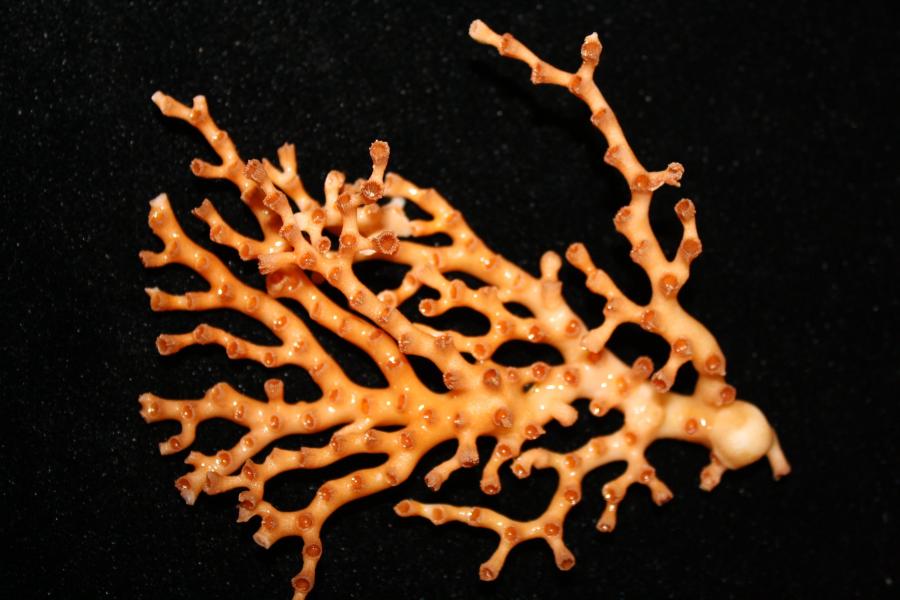
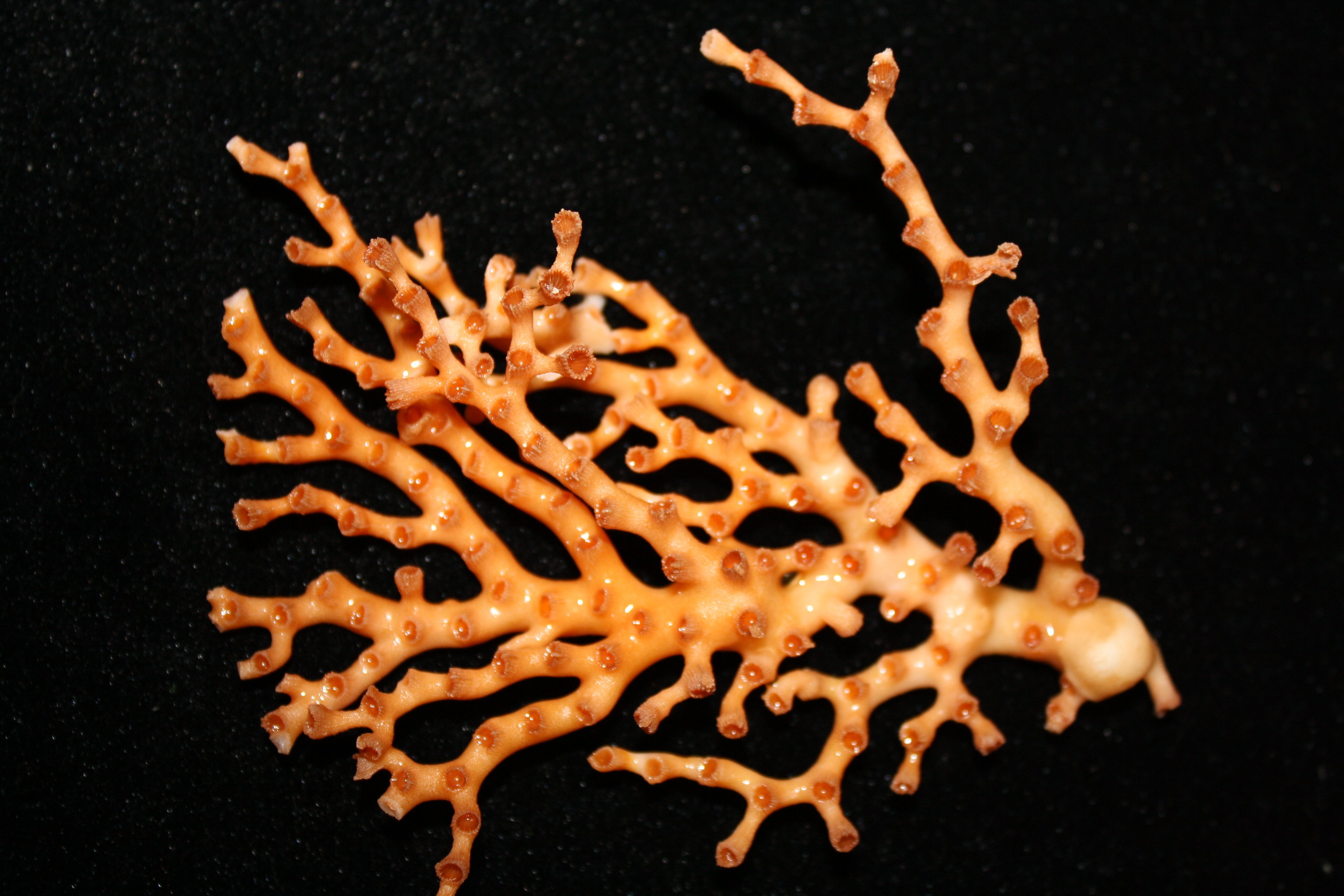
Reddish-orange Lophelia pertusa. North Atlantic. Bioluminescence 2009 Expedition, NOAA/OER.
Reddish-orange Lophelia pertusa. North Atlantic. Bioluminescence 2009 Expedition, NOAA/OER.
Courtesy of Office of Ocean Exploration Research (OER) and National Oceanic and Atmospheric Research (NOAA).
 This work is licensed under a Creative Commons Attribution 2.0 Generic License.
Along both lines of assessments you would be in error. Lophelia’s chief quality is that it invites interpretations one way or another but is in reality a third. The masons responsible for the baroque, arborescent sculptures are the same crafting the adjacent heaps of broken rubble, driven not by any specific aesthetic of form, but by an impulse to both rebel against and acquiesce to their surrounding environments. Similarly, color currencies have no standing among the city’s populace, most of whom harbor no opinion or conception of light. Here, in the city of eternal night, pigments are in reality a type of noise, mere byproducts from the formulations of chemical enterprises the sighted are blind to.
Lophelia forces you to unmoor the connections between what you see and what exists; only in rejection will you come to grasp the workings of this nether realm, where stone towers house within waiting hunters readying their harpoons to hurl into the sky, and where the seemingly sluggish and lackadaisical are active in their striving against collapse, bearing a world’s burden upon their bodies without bearing any apparent signs, aware of their lot in life amidst the constant, crushing depths, here in Lophelia, the city that hides from and in plain sight.
2. The Scalable City, Aviles Canyon (44°N, 6°W)
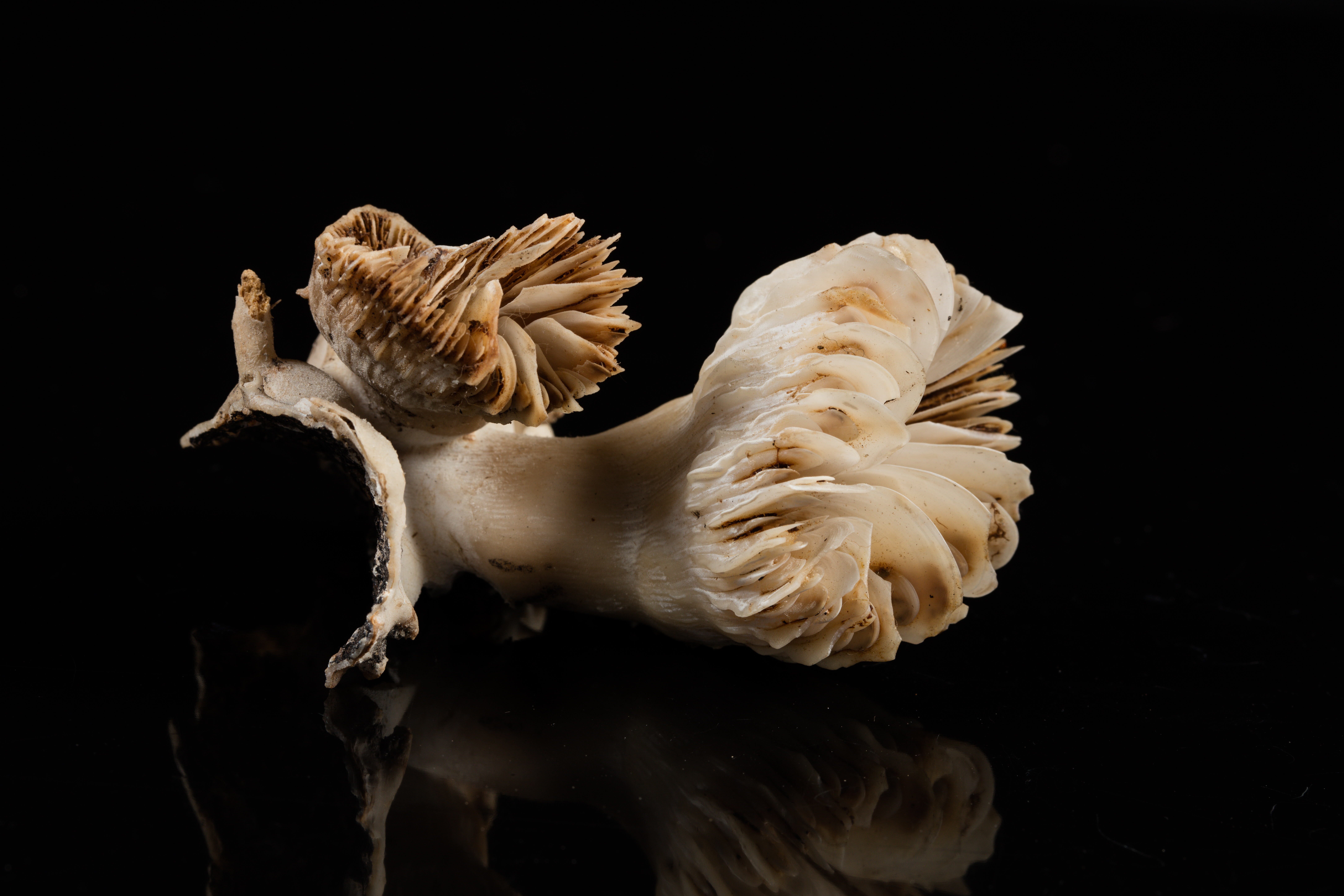
Viewed from above, Desmophyllum resembles most cities—sprawling, shapeless, indistinct. As you descend, what initially appears to be nondescript terrain begins to resolve itself; into a discrete series of mounds or a single massif, into thickets of repeating shapes or groves of fractal geometries, seeming inspired by familiar motifs from distant realms—the shy crowns of camphor trees, mushroom caps about to fruit, starbursts.

Desmophyllum cristagalli.
Desmophyllum cristagalli.
Courtesy of Auckland Museum, 2019. Click here to view source.
This work is licensed under a Creative Commons Attribution 2.0 Generic License.
As you touch down and begin traversing the city, you soon come across the municipal construction crew, housed in single domiciles along the outer periphery, planning the next stage of Desmophyllum’s expansion to grow not only outward, but skyward. Yet the rate of construction here appears slower than what you have observed in other cities, perhaps because the workers here possess scant strength, nourished by a thin soup made from cold fish scales, rotting seaweed, discarded shrimp shells, bric-a-brac.
Due to this languid pace of activity, Desmophyllum’s old center has long fallen into ruin, ceded to the local fauna that have claimed it as their own, even as current attention shifts toward newer, more promising sites. But in Desmophyllum, the rate of decay does not subtract from its measure of progress, but rather contributes to it. Accretion is the technique practiced by the city’s builders, who formulate current homes on top of formerly occupied houses, scaffolding works upon existing scaffolds, laying new carbonate foundations over crumbling ones, creating a Desmophyllum that one day will be too swollen and tenuous to support its own haphazard history.
Accepting this to be the arc of all cities, Desmophyllum’s engineers have decided not to adhere to a master plan but rather a course of action: Keep building. Toward this end the workers have banded together to form a cooperative, abandoning individual differences in an attempt to achieve a common goal. Each active member may only live long enough to contribute the smallest of beginnings, but through each other they seek fulfillment along two axes of time; one for as long as their tender cores can muster; another cemented in a legacy that can rival the span of oak trees and mountain ranges. Equipped with this faith in their dual destinies, workers toil in service of the twin lives they hope will mirror each other in trajectory but differ in sensation; in this way the city becomes them, and they become the city.
Of course, this is only one level of perceiving life and living in Desmophyllum. Should you continue to zoom in closer, you will discover other unions, other monuments, operations operating along different timelines; cells self-organizing to fulfill vital orders; genes scribing instructions to produce cell constituents; molecules interlocking into singular lattices that can only be one way and not any other. At every level, agents are at work realizing configurations uniform or novel, crafting their own versions of what can also be considered Desmophyllum—a name that itself has come together to posit a multitude of meanings, desmo-, meaning to bond, to fasten, to chain together; -phyllum, meaning a band, a tribe, a common stock from which solidarity arises.
3. The Tethered City, Kermadec Ridge (35°S, 178°E)
The traveler who happens upon Solenosmilia after wandering the hinterlands may find it a bewildering experience. The city achieves its grandeur through juxtaposition. The flat surroundings angle against the steepness of a canyon wall that towers up and out of sight. Its inhabitants dance to the city’s rhythm on precipices hanging over and facing out to the abyss. Traders amass their fortunes not through a keen discernment of worth, but by sifting the stream of excrement discarded by the more discerning. The only counter to the extremes found at Solenosmilia comes in the constant, soft dusting of snow, blanketing every surface, deepening the city’s silence.
Attempting to understand the inner workings of Solenosmilia, the traveler may be tempted to stretch strings from one part of town to another, marking residence and resident in terms of kinship, of exchange, amity, or enmity. They may observe locals for insights into favorite nurseries or public houses or fishing holes, discover through trial and error vantages from which to watch the snow fall at different times of the day; commit to memory the routes in the network of shelters from which to hide from the city’s roving gangs; discover the rivalries between factions vying for territory, characterizing each intensity with filaments of red or gold or black and white.
But with each catalogued connection the traveler will find themselves more implicated in the city’s evolving tapestry. The fondness they harbor for Astero, a wandering vagrant-turned-citizen sentry for the local neighborhood association, has demanded its own thread, marked in a unique color. The misunderstanding they had with Eunice from next door, accusing them of being a parasite and a cheat, has created another tension, registered in the tautness in a length of yarn.
Perceiving this tightening weave, the traveler chooses to leave one day before they become fully entangled, seeking to extricate themselves from the fate that has ensnared many a citizen of Solenosmilia, trapped by nets of routines and relations of their own making. But even as the traveler charts their avenue of departure—retracing their steps back out into the wastelands, summiting higher up on the canyon wall—they realize they can no longer discern the limits to the city. For there are now no borders that Solenosmilia’s influence will not transcend. The traveler can cut the strings, but the tethers remain, traces of a ubiquitous web that, once one has acquired the ability to perceive it, can no longer be unseen.
The traveler proceeds to recall how the snow that fell upon the city does not melt, how certain flakes seemed to contain within them a glint of sunlight or traces of leaf green, how in hindsight they more and more resemble segments of cut string that have been bleached white by the years, fragments that rain down from the heavens to bind the celestial with the abyssal. Solenosmilia has become part of the traveler, or perhaps it had always been a part: It has only taken a visit to the city for them to recognize it.
4. The Cyclic City, Valentine Mound (9°S, 12°E)
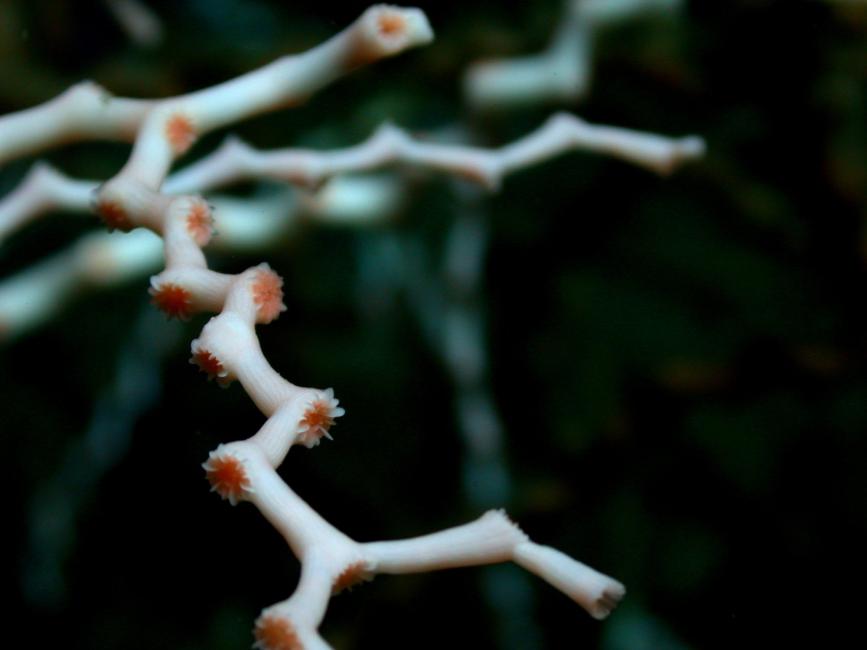
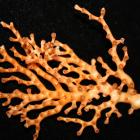
Madrepora oculata.
Madrepora oculata.
Courtesy of National Oceanic and Atmospheric Administration (NOAA), 2014. Click here to view source.
 This work is licensed under a Creative Commons Public Domain Mark 1.0 License.
The boundary between life and death is thin in the city of Madrepora, where inhabitants value their connection with their predecessors above all else. Whenever possible, they build new family expansions upon the quarters of recently deceased kin, designing living spaces adjacent to newly converted sarcophagi, constructing zigzag mausoleum complexes that visitors come from afar to marvel. Even the bodies of the dead are utilized for an essential function, sacrificed to appease the redfish, the devil squid, and the other eldritch leviathans that patrol the local waters. Thus the concept of waste does not exist in Madrepora, where every portion of the past is recycled to serve the next generation. As the Madrepora of the dead expands in number and prestige, so too does the Madrepora of the living grow in lineage and stature.
To be sure, the city experiences some rate of emigration. Some citizens, deciding that they have no desire to become part of the city’s ancestral obsessions, seek to make their mark in another potential metropolis instead of becoming facets of an existing necropolis. Those few, calling themselves the planulae, cast themselves into the beyond to seek their fortunes elsewhere. Most are swept away by currents of ill fate, but some eventually make their way to other settlements, perhaps to Lophelia in the west, or Desmophyllum to the north, or even Solenosmilia far to the southeast. Still others secure purchase in unsettled portions of the rocky frontier and stake their claims under the existing banner, never wondering if the Madrepora of their origin was indeed the original Madrepora or merely another colony, like the one they are about to found.
Recently, new agents have started moving into both the nascent and ancient cities of Madrepora. Inhabitants are unsure of what to make of these strangers, who seem to contain traits associated with both the dead and the living. Some mimic the movements of the city’s best dancers, twirling and wraithlike, robed in glossy, translucent attire. Others, long and serpentine, latch themselves onto the city’s existing infrastructure, brandishing trophies of dead monsters they have strangled for all to see. What is apparent is that these new settlers appear unwilling or unable to engage with the local community, not being sturdy enough to shoulder the duties the dead are expected to handle, not being active enough to participate in the city’s cycles as the living must. Some speculate these plastic imposters are in reality ancient spirits, buried long before the founding of the first Madrepora, subsequently exhumed and reformed as phantasmagoria to torment the world of the living. Inhabitants suspect that their ultimate aim is to disrupt the porous interface between life and death. For the first time, the specter of waste has seeped into the inner sanctum of Madrepora. For the first time, the deceased are undead and the living do not know the purpose of dying.
5. The Potential City (????)
You did not make a choice, nor had you marked a direction, but somehow, somewhere, your travels have taken you to the outskirts of Planktos, the city of chance. Fate lies at the heart of this surprise meeting and also the city’s core, presently adrift and light as a mote, containing within the blueprints for a vast crystalline realm. Whether this will come to fruition is yet to be determined. Inhabiting the world of the potential, the city has entrusted its future well-being to the presently realized. Buoyed by current circumstances, Planktos travels in the now on the world’s whim, heeding no compass or responsibilities, harboring no preset destination.
Dwelling at ease awhile within, you come to notice the subtle preparations the city has taken in contrast to its seemingly aimless ventures. You discern several of the contingent forms the drifting city may adopt in time to become a defined city. In one, it has transformed into a hamlet, perched on the side of a hardscrabble mountain, nourished by cooling updrafts. In another, it becomes a haven for scavengers and riffraff, tucked into a valley where the light does not shine. The scenario that imprints upon you most comes in the vision of a great oasis, fed by an unperishing spring, populated by sojourners weary of travel, desiring a more secure, sedentary life.
But it so happens that you must leave Planktos before any of those possible futures can be realized. Long do you desire to return, but it seems no one visits the city of chance by choice, nor can one arrive through the following of directions. Fate has seen fit to bring you together with Planktos once and once only. Accepting this destiny, you settle down after your wandering days, crafting an existence that mirrors as close as possible the life you would have liked to live in that former version of the once-drifting city, telling no one this secret in case they are disappointed to learn that your real life has always been an imitation of an imagined one.
Meanwhile, elsewhere, Planktos has been consumed by the world’s turning, erased by the fate that once afforded it its freedom, or else it has morphed into one of the myriad alternate cities you had barely begun to glean before you had to leave. Thus the faint approximation of Planktos you now inhabit has supplanted the original version of Planktos, one that remained in the past and the realm of the hypothetical or the unknown, more real and vivid now only in dreams.
Amitav Ghosh in Munich: Inspirations, Insights, and Storytelling
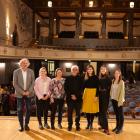
In the fall of 2024, Amitav Ghosh visited the Rachel Carson Center for Environment and Society as part of the project “One Book—Many Worlds: Munich Reads Gun Island by Amitav Ghosh.” This exhibition emerges from the multifaceted discussion of climate change and its challenges conducted in the “One Book—Many Worlds” project and grapples with the question of the role of literary fiction in interdisciplinary academic exchange and climate communication beyond academia. Taking Amitav Ghosh’s recent writings on the global climate crisis, in particular the novel Gun Island, as a vantage point, the chapters in this exhibition engage with various aspects Gun Island from different disciplinary perspectives, drawing on storylines and narrative elements that allow a multifocal engagement with different social and ecological repercussions of climate change. Additionally, pieces from the spring 2025 taumelnd trauen, verschlungen bleiben student exhibition and winning and honorable mentions from the 2025 “Tell the Untold!” writing competition take the provocation to think creatively about the past and future of our environment and world further. Thereby, the exhibition chapters create a web of diverse thoughts on and readings of the role of storytelling for the contemporary interlinked social and environmental crises from a number of perspectives.
About This ExhibitionAbout the author





.jpg)