Coda: Narrating the “Everything Crisis”
A decade has passed since Amitav Ghosh’s indictment of the novel and the wider literary market as neglecting climate change and relegating it to the realm of genre fiction (2016, 63). In the meantime, the repercussions of climatic transformation for livelihoods across the globe have moved front and center in public discourse. Fictional literature, too, has broadened its engagement with the topic, not only birthing “cli-fi” as a distinct genre in the mid-2010s, as for example Axel Goodbody and Adeline Johns-Putra’s companion attests to, but also engaging climate change in other genres, including the supposedly ignorant “serious” fiction. The long and short lists of leading literature prizes, such as the Booker Prize and the German Book Prize, have testified to this development in recent years.
Ghosh finds these efforts deficient—especially considering the mounting complexity of the “everything crisis.” I use the term “everything crisis” as a shorthand for the crisis evolving from what—according to Ghosh at the matinée event at the Literaturhaus München (2024)—Margaret Atwood referred to as “the everything change.” In his more recent nonfiction book, The Nutmeg’s Curse: Parables for a Planet in Crisis (2021), Ghosh explores the historical and contemporary implications of the nutmeg trade, examining how its demand has shaped economies, societies, and cultures. Reflecting on the environmental consequences of early colonial spice trade, the book traces the historical continuities between colonialism and globalization and presents a longue-durée history of climate change and our contemporary planetary crisis. Ghosh identifies colonial attitudes and aggression against colonized people as well as the nonhuman world as the root problem of the “everything crisis” we are facing on a global scale today.
Reducing other humans, species, and environments to unenlightened savage “brutes” was, Ghosh argues, central to colonial dominance (183–90). The concept of the brute, incapable of free will, independent action, and language/speech, allows the colonial imagination to consider the Other as a nonhuman resource: labor, food, or fuel. “Bruting” the Other, according to Ghosh, requires muting the Other (195). And the loss of voice entails the loss of history, connection/relationship, and representation. The nonhuman world, as a consequence, no longer figures as an animate entity in today’s industrialized cultures, and it rarely has agency or character in these cultures’ narratives. Acknowledging this lack, Ghosh argues that “the most important literary challenge of our time [is] restoring voice and agency to other-than-human beings” (Tokar 2022).
Consequently, literature—specifically because of its deeply humanist origin—plays a crucial role in registering, reflecting on, and shaping our understanding of the ongoing complex global crises. At the same time, it has the power to affect people emotionally, make them relate, create shifts in perspective, and potentially recognize the urgency of the challenges humanity faces. Literature is one of the places in which the “everything crisis” can be reframed as rooted in history and culture as much as in economics and technology.
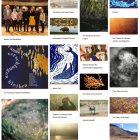
The manifold contributions to this virtual exhibition acknowledge the potential of literature. In taking Amitav Ghosh’s novel Gun Island as a vantage point, all entries interrogate how the novel’s themes and addressing them in a literary text enrich individual disciplinary perspectives. Likewise, the student-exhibition pieces that accompany most texts in this virtual exhibition attest to the generative power of Gun Island. Finally, the three texts that do not explicitly engage with the novel are based on Ghosh’s invitation to shift perspective and rethink the role of storytelling and the nonhuman: “What if the faculty of storytelling were not specifically human but rather the last remnant of our animal selves?” (Ghosh 2019, 141). As winners of the Rachel Carson Center’s writing competition “Tell the Untold!” (2025), they use this as inspiration in the creative process and imagine alternative ways of narrating the past, present, and futures.
As curators of the exhibition and the team behind the original “One Book—Many Worlds: Munich Reads Gun Island by Amitav Ghosh” project, we hoped to both capture and build on the inspiration that Ghosh’s visit to Munich provoked. In the end, the variety of pieces and engagements we gathered far surpassed our expectations. Together, these diverse forms of expression attest to a number of concerns central to the environmental humanities’ engagement with environment and society. These include, first, the acknowledgement of the many and multilayered ways in which the “everything crisis” touches us all; second, the recognition of diversity of the human experience; and, third, the profound need for multi-, inter-, and transdisciplinary conversation and exchange. Projects like these help advance understanding of our contemporary challenges not only scientifically but also culturally. They exemplify how we might create new narratives and alternative emotive engagements that move beyond the oftentimes depressing and hopeless projection for the planet’s future in public discourse, making us all a bit more hopeful.
Bibliography
Ghosh, Amitav. “Die Muskatnuss und die Planetare Krise: Matinee mit Amitav Ghosh.” Literaturhaus München, 17 November 2024.
Ghosh, Amitav. The Great Derangement: Climate Change and the Unthinkable. University of Chicago Press, 2016. doi:10.7208/chicago/9780226323176.001.0001.
Ghosh, Amitav. Gun Island. John Murray, 2019.
Ghosh, Amitav. The Nutmeg’s Curse: Parables for a Planet in Crisis. John Murray, 2021. doi:10.7208/chicago/9780226815466.001.0001.
Goodbody, Axel, and Adeline Johns-Putra. Cli-Fi: A Companion. Peter Lang, 2018. doi:10.3726/b12457.
Tokar, Sofia. “Amitav Ghosh: Geopolitics Are Key to Understanding the Climate Crisis.” University of Rochester News Center, 30 March 2022.
https://www.rochester.edu/newscenter/amitav-ghosh-geopolitics-are-key-to-understanding-the-climate-crisis-517262/.
Amitav Ghosh in Munich: Inspirations, Insights, and Storytelling
In the fall of 2024, Amitav Ghosh visited the Rachel Carson Center for Environment and Society as part of the project “One Book—Many Worlds: Munich Reads Gun Island by Amitav Ghosh.” This exhibition emerges from the multifaceted discussion of climate change and its challenges conducted in the “One Book—Many Worlds” project and grapples with the question of the role of literary fiction in interdisciplinary academic exchange and climate communication beyond academia. Taking Amitav Ghosh’s recent writings on the global climate crisis, in particular the novel Gun Island, as a vantage point, the chapters in this exhibition engage with various aspects Gun Island from different disciplinary perspectives, drawing on storylines and narrative elements that allow a multifocal engagement with different social and ecological repercussions of climate change. Additionally, pieces from the spring 2025 taumelnd trauen, verschlungen bleiben student exhibition and winning and honorable mentions from the 2025 “Tell the Untold!” writing competition take the provocation to think creatively about the past and future of our environment and world further. Thereby, the exhibition chapters create a web of diverse thoughts on and readings of the role of storytelling for the contemporary interlinked social and environmental crises from a number of perspectives.
About This ExhibitionAbout the author