The Story of Geology
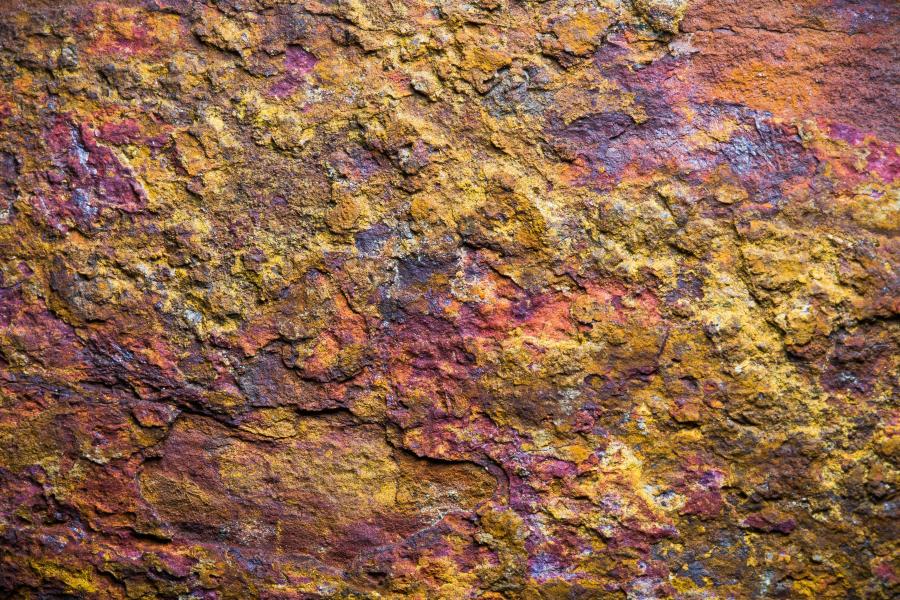
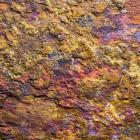
Colored rock in Tasmania photographed with a macro lens.
Colored rock in Tasmania photographed with a macro lens.
Photo by Matt Palmer, 2021. Click here to view source.
This work is licensed under the Unsplash License.
When we think of geology, literary fiction is not usually what comes to mind. As a natural science, geology is bound to scientific neutrality and is often presented as not only removed from the concerns of humans, but in opposition to all living things. Rock is said to be cold, hard, impenetrable; it does not easily lend itself to the literary imagination, which seeks relationships and storylines that can be perceived in the narrative time of human life. Yet, this couldn’t be further from the truth, and many authors situated in the relatively new, interdisciplinary field of the geohumanities have been chiselling away at the rigidity of the modern lithic imaginary.
The resurgence of interest in the geologic is, of course, partially due to the urgency of the climate crisis and the contentiously termed Anthropocene, which seeks to mark human impact on geological scales. However, the earth histories that relate the categories “human” and “geology” are also particular histories contending with racial and gendered power structures that are often forgotten or sidelined. Kathryn Yusoff’s recent work Geologic Life (2024) describes how geology and race are inseparable, both materially through extractive industries that were coterminous with systems of enslavement, genocide, indenture, and environmental destruction, and symbolically through a grammar of geology that elevates whiteness while associating Black, Brown, and Indigenous people with the underground.1 Yusoff argues that during colonialism and its aftermaths, “geology operationalized and institutionalized its statecraft as grammar, imaginary, syntax, and material praxis through the tight intimacies of the inhuman and inhumane.”2 That is, geology has always been foundationally concerned with relations between people and with privileging a particular—extractivist, colonial—narrative of the earth. Excavating the storied origins of the discipline shakes the claim of dispassionate neutrality and thereby opens a rift for multiple other stories to emerge.
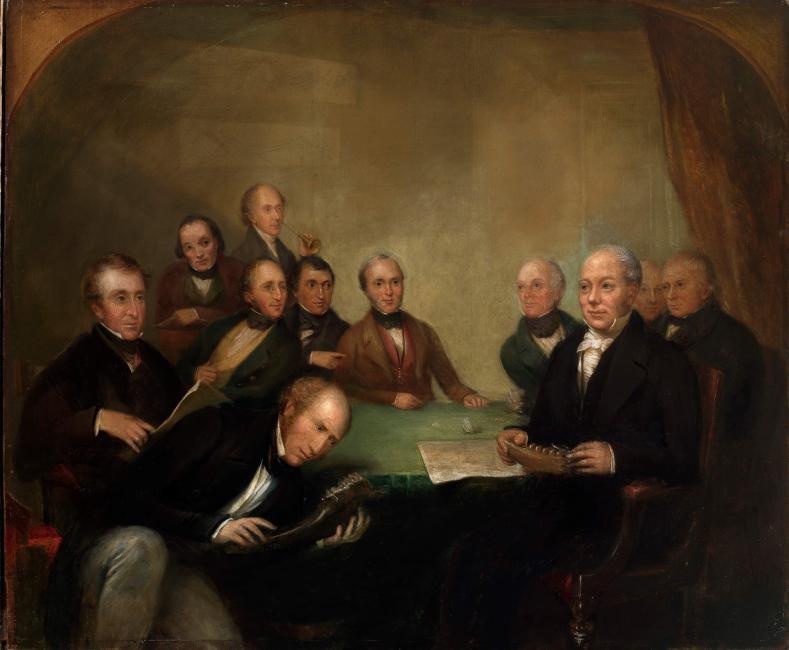
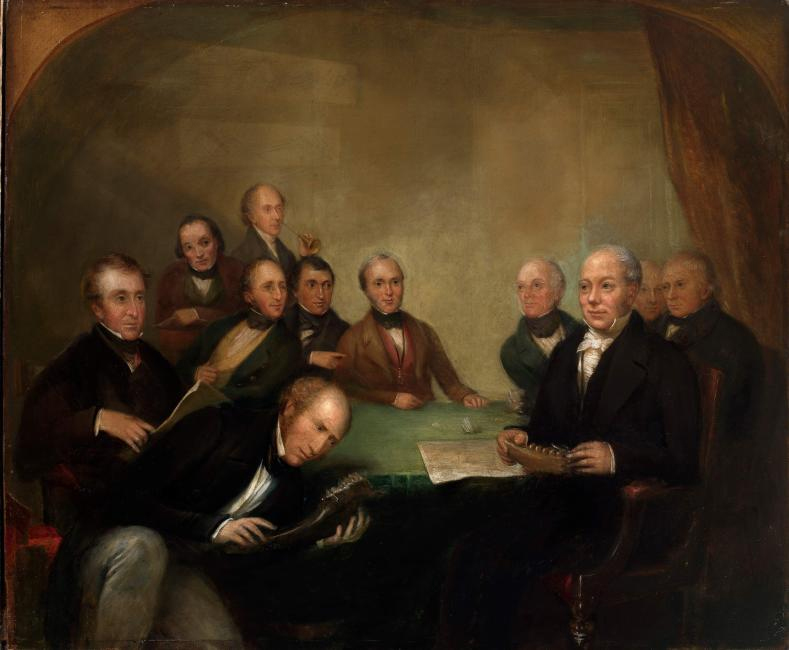
Thomas Henry Gregg, The British Association at Newcastle, oil painting, ca. 1838, GSL/POR/18.
Thomas Henry Gregg, The British Association at Newcastle, oil painting, ca. 1838, GSL/POR/18.
© Geological Society of London. Used by permission.
The copyright holder reserves, or holds for their own use, all the rights provided by copyright law, such as distribution, performance, and creation of derivative works.
The beginnings of geology in the nineteenth century developed in close proximity to novels and poetry. In Novel Science (2013), Adelene Buckland traces how geology became central to the British self-image, culture, and economy.3 While a wide range of society, from miners to ladies on seaside vacations, were involved in collecting samples, the interpretation of facts was left to white, upper-class gentlemen who gathered in exclusive clubs marked by a “rabble-rousing, all-male, collegiate identity.”4 Buckland asks what impact this might have had on knowledge production. Romance and epic poetry were specifically popular genres with which these geologists would write heroic narratives of exploration. In the era of Victorian masculinity, adventure stories were conducive to the mapping of space, and the description of minerals and people. Their writings of the earth borrowed directly from literary devices to give the stories of the past order and meaning. The argument that stories matter to the development of the discipline of geology, and thus to the accepted view of the earth, is further backed up by Jason Grove’s inquiry into the connections between German literature and mining. In his 2020 work The Geological Unconscious, he lays out how prominent nineteenth-century German-language writers studied at the first modern mining academy, which opened in Freiburg in 1756; how its theories impacted writers like Goethe; and how romantic authors, like Joseph von Eichendorff, even studied mining at university.5 Groves points out that “they inadvertently stumbled over those geological and ideological unconformities that also triggered paradigm shifts in scientific discourses.”6 For example, observations of out-of-place-looking “erratic” rocks led to theories of glacial movements, which provided insight into planetary changes on vast timescales. Taking the intimate connection between story and earth further, Adam Bobette asks, “How does the geopoetic help us think in new ways about contemporary attempts to redefine the condition of planetarity?”7 His analysis of twentieth-century geologist Johannes Umbgrove shows that geopoetics was not only central to the modern theory of plate tectonics, but that it illustrated “a mode of thinking cosmically,” that is, through vertical relation in which humans, cosmos, and earth are intrinsically linked.8 Yet, Umbgrove’s work in colonial Indonesia employed the specific grammar of geology to give scientific legitimacy to essentialize cultural identity tied to a forgotten past, which ultimately served colonial interests.
Recent literary fiction and nonfiction have taken up again the task of relating humans and earth in different ways. Turning to Stone: Discovering the Subtle Wisdom of Rocks (2024) by Marcia Bjornerud traces her life as a geologist and major shifts in the discipline over the last few decades.9 She mentions throughout that her formal training was complemented by an affinity for rocks that informs geologic inquiry: “[T]he best geologists have a subliminal connection with rocks. When one spends enough time in their company, rocks have the power to seep into one’s subconscious.”10 Another story that perceptively ties personal experience to the world of rocks is found in Robert Macfarlane’s Underland: A Deep Time Journey (2020).11 During caving in the limestone hills in Somerset, he reflects, “Down here, too, the boundaries between life and not-life are less clear … It is mineralization—the ability to convert calcium into bone—that allows us to walk upright, to be vertebrate, to fashion the skulls that shield our brains.”12 In both examples, exploration critically positions the self as part of wider ecology, rather than as mere observer.13
Beyond experiential accounts, speculative geologic fiction pushes the boundaries of the imagination even further. Following the need to break with extractive grammars of geology, contemporary speculative works use metaphor, personification, and underground worlds to ignite new thoughts of relating to the earth. N. K. Jemisin’s celebrated Broken Earth trilogy (2015–17) for example, forms a sharp critique of extractive colonialism and its aftermaths.14 The scapegoating of people who are racialized through a different language of the earth rings eerily familiar, given the destruction and demonization of ways of being that defy the logic of Western epistemology. Jemisin’s earth is revealed to be a masculine, angry sentient entity called Father Earth who remembers centuries of extractive and planetary harm. In revenge, Father Earth causes seasonal cataclysms leading to constant social upheaval. These are recorded on stone tablets, which turn out to be an archive manipulated to uphold structures that benefit the empire. It goes to show that “set in stone” does not equate to truth. In Jemisin’s world, stories of the earth are contested—there is the official Stone Lore, a sensory energetic story, the stories of century-old beings called Stone Eaters, and the deep-time memory of Earth itself. What reoccurs amongst those stories is the inevitable, hard question of justice and repair to usher in nonextractive relationships. While it may seem that speculative fiction has limited relevance to earth sciences today, I refer back to geology’s origins—namely that, as Buckland reminds, “Doing geology meant writing it too.”15
Notes
1 Kathryn Yusoff, Geologic Life: Inhuman Intimacies and the Geophysics of Race (Duke University Press, 2024), https://doi.org/10.1215/9781478059288.
2 Ibid., 11.
3 Adelene Buckland, Novel Science: Fiction and the Invention of Nineteenth-Century Geology (University of Chicago Press, 2013), https://doi.org/10.7208/chicago/9780226923635.001.0001.
4 Ibid., 13.
5 Jason Groves, The Geological Unconscious: German Literature and the Mineral Imaginary (Fordham University Press, 2020), https://doi.org/10.5422/fordham/9780823288106.001.0001.
6 Ibid., 2–3.
7 Adam Bobbette, “Geopoetics: A New Political History,” in Environmental Humanities 15, no. 3 (2023): 235–50, on 235, https://doi.org/10.1215/22011919-10746112.
8 Ibid., 236.
9 Marcia Bjornerud, Turning to Stone: Discovering the Subtle Wisdom of Rocks (Wildfire, 2024).
10 Ibid., 180–81.
11 Robert Macfarlane, Underland: A Deep Time Journey (Penguin, 2020).
12 Ibid., 37.
13 Another relevant, recent book worth mentioning is Philip Marsden, Under a Metal Sky: A Journey through Minerals, Greed and Wonder (Granta, 2025).
14 Nora K. Jemisin, The Fifth Season (Orbit, 2015); The Obelisk Gate (Orbit, 2016); The Stone Sky (Orbit, 2017).
15 Buckland, Novel Science, 13.
Amitav Ghosh in Munich: Inspirations, Insights, and Storytelling
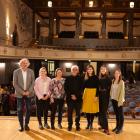
In the fall of 2024, Amitav Ghosh visited the Rachel Carson Center for Environment and Society as part of the project “One Book—Many Worlds: Munich Reads Gun Island by Amitav Ghosh.” This exhibition emerges from the multifaceted discussion of climate change and its challenges conducted in the “One Book—Many Worlds” project and grapples with the question of the role of literary fiction in interdisciplinary academic exchange and climate communication beyond academia. Taking Amitav Ghosh’s recent writings on the global climate crisis, in particular the novel Gun Island, as a vantage point, the chapters in this exhibition engage with various aspects Gun Island from different disciplinary perspectives, drawing on storylines and narrative elements that allow a multifocal engagement with different social and ecological repercussions of climate change. Additionally, pieces from the spring 2025 taumelnd trauen, verschlungen bleiben student exhibition and winning and honorable mentions from the 2025 “Tell the Untold!” writing competition take the provocation to think creatively about the past and future of our environment and world further. Thereby, the exhibition chapters create a web of diverse thoughts on and readings of the role of storytelling for the contemporary interlinked social and environmental crises from a number of perspectives.
About This ExhibitionAbout the author