Using Climate Fiction for Community Engagement: The Role of Narratives and Storytelling
Allow me to start with an academic positioning—or rather un-positioning. From a disciplinary perspective, my interest in narrative(s) is promiscuous. As a cultural scholar, I ask how everything we do (or do not do) reflects our view of the world and our place in it. My linguistic and my literary backgrounds prompt me to look at how societies use language, spoken and written, quotidian and highbrow, to negotiate what matters, to whom, and why. While in the past, I have focused my analyses on comics and graphic novels, I am branching out now to include a wide array of expressive formats. Important is not the medium, in my view, but the things it allows us to imagine, discuss, contest.
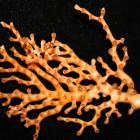
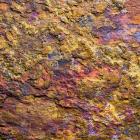
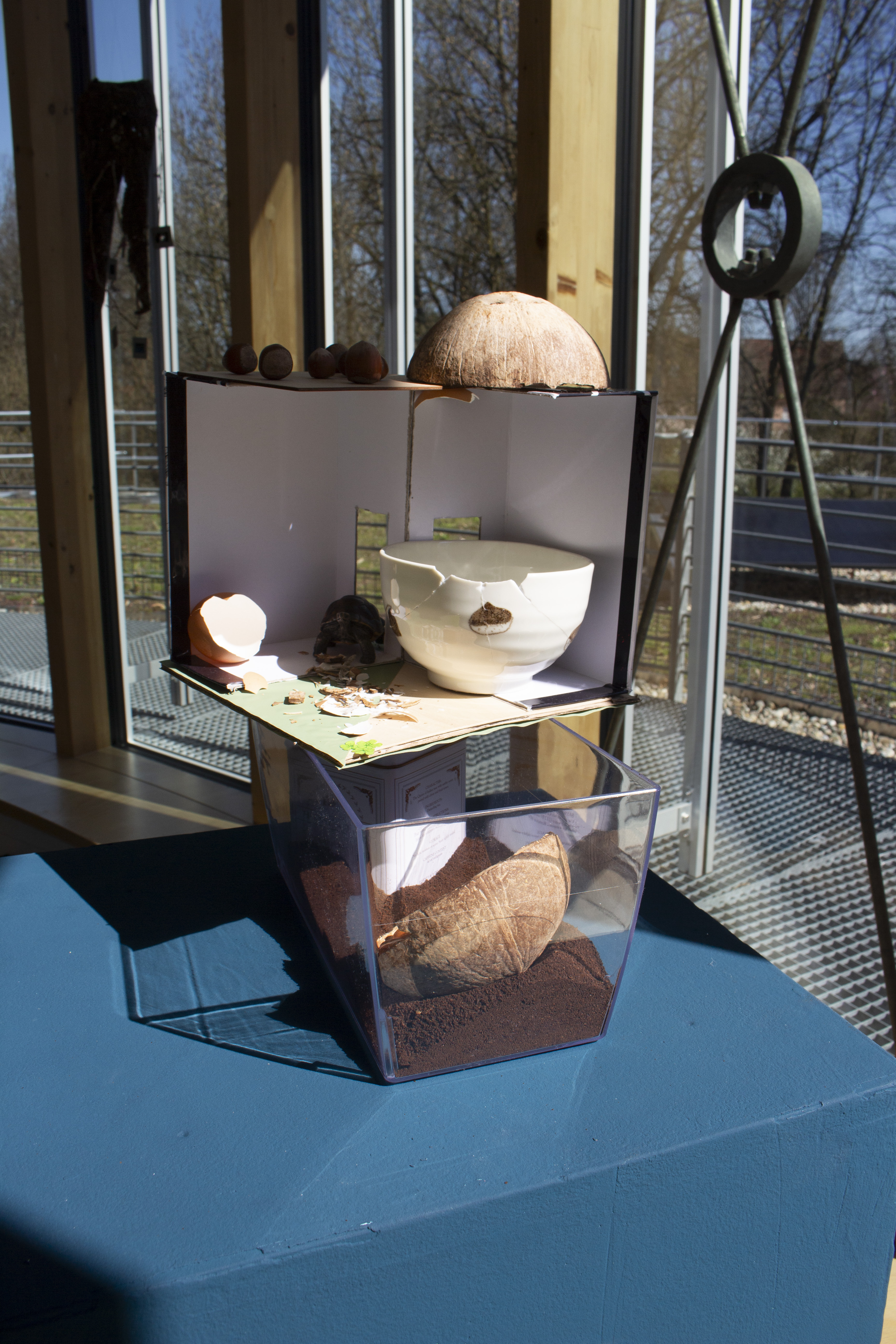
Wu Xinnan, The Shell,
2025, miscellaneous objects.
Shells are both shelter and barrier, cradle and debris. Shells provide comfort, vigour, affluence, violence, destruction, regeneration. Shells wait and witness; travel and trespass.
We live on, and live in the shell. What will it take when a shell breaks? What emerges, and what remains?
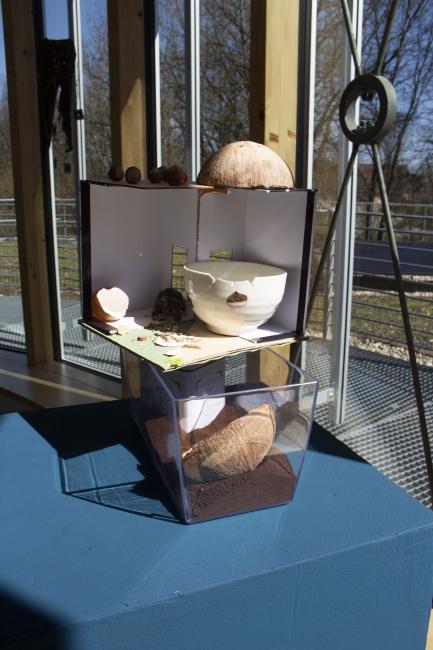
Wu Xinnan, The Shell,
2025, miscellaneous objects.
Shells are both shelter and barrier, cradle and debris. Shells provide comfort, vigour, affluence, violence, destruction, regeneration. Shells wait and witness; travel and trespass.
We live on, and live in the shell. What will it take when a shell breaks? What emerges, and what remains?
Artwork © Wu Xinnan. All rights reserved. Photo © Malte Sattig. Used by permission.
The copyright holder reserves, or holds for their own use, all the rights provided by copyright law, such as distribution, performance, and creation of derivative works. https://rightsstatements.org/page/InC/1.0/?language=en.
Recently and fueled by my stay at the Rachel Carson Center in 2024–25, I am becoming more interested in storytelling as a tool for climate communication and community building. I see this, the intersection between societies and the stories they tell, as a site where the humanities will help us understand and address our ecological crises. I have made first forays into applied territory by teaching community-engaged classes in my Pennsylvania hometown, matching students with environmental organizations and guiding them as they reflect on their experiences through a humanistic lens. It is with these two “arms,” one culturally grounded and one pedagogical, that I embraced the invitation to comment on Amitav Ghosh’s Gun Island.
My road into (and out of) this novel was both practical and speculative. A practical approach to Ghosh’s book—like any book, really—consists in illuminating what effect it has on readers. Empirical ecocriticism puts to the test a claim many literary scholars embrace, namely that reading fiction about ecological disasters and/or solutions engages us emotionally and possibly continues to move readers, long after they have put down the book. The idea that readerly imagination can lead to empathy and, ideally, real-world political action is crucial to many ecocritical analyses, but the empirical evidence for that is mixed. Hence, an avenue one could follow with regards to Ghosh’s book is to trace its readerly uptake, for example by studying publicly available reviews or through long-term impact studies of readers’ mindsets. A book such as Ghosh’s, that has gained an international readership, also invites comparative studies. I wonder, for instance, if it sparks systematically different reactions in readers who encounter it in the Indian Sundarbans, in Venice, or in locations unaffiliated with the novel’s settings.
My next observations are doubly speculative. They are speculative in the sense that I have not tested the following ideas with students or community members. They are also speculative because they work with creative speculation, leading participants in a visioning exercise for ecologically sound futures. I would like to venture into communities in workshops or semester-long projects, much like I have done with students. Inspired by place-based pedagogy, I envision a format in which Ghosh’s book serves as a springboard for discussion and collective storytelling. Inspired by Gun Island, we could discuss (and/or write creatively about) what local lore exists in our area and why. Is there an equivalent to the lure of snake goddess, and if so, what does it tell us about this area and its inhabitants? Using the Sundarbans as a model, local ecosystems come into focus. (How) Do we experience climate-induced changes in our environments, whether that be the English Garden in Munich, the Spreewald in Germany’s northeast, or the Great Lakes, where my college is located? Lastly, how do global streams of goods, people, signs show in our lives? What are the costs of these streams, and who is paying them?
Jan Szesny, Zones of Comfort, Borders of Bliss,
2025, soundrecordings from freesound.org. CC BY-NC-ND 4.0.
While the looming threat of climate catastrophe and tipping points inevitably enters our lives, we as Europeans can choose our way of dealing with it; for some, this means anxiety-induced paralysis, for some, radical climate activism, for others, it might mean denial. In the Sundarbans and many other precarious regions of the Global South, there is no looming threat, the climate catastrophe is already here, destroying millions of livelihoods. Likewise, there is no choice but escaping toward our zones of comfort, toward our borders of bliss, where we as Europeans still have choices to make, but are being ignorant toward the privilege of doing so. This soundscape is an attempt to pervade and challenge our zones of comfort, in the way climate migration does. It is an auditive representation of a climate migration journey, speaking to the loss of place, the warping of distance and memory, the surrendering of autonomy, the interwoven hardships endured to reach Fortress Europe.
While individual storytelling is the go-to approach in most creative-writing settings, I am becoming convinced that the Anthropocene frontier is to tell stories together. What does it take, I wonder, to craft a vision multiple people (let alone whole communities) cocreate? How do we ensure we get the voices of those who don’t usually contribute? And what setup (and setbacks) would we likely face when attempting to imagine futures together? What long seemed impractical to me is becoming increasingly intriguing to me. Scholars like Hanna Musiol, Julia Bentz, and other creative minds are experimenting with collective storytelling formats, and finding smart ways to include nonnative speakers, refugees, etc. Dr. Musiol, for example, shared with me how she instructs participants in the Norwegian city of Tromsø to create stories like a wave, each participant adding only a small portion to a scenario before handing the work on to the next peer. Dr. Bentz, in turn, has organized summer schools in Lisbon that connect collective storytelling with dance improvisations, drawing, and architectural urban (re)planning visions.
Because I see how these pioneers employ multiple forms of expression and because I have seen the pedagogical appeal of comics, it occurs to me that any collective-visioning process should offer diverse modes and media, including text, photo, video. Beyond the theoretical enthusiasm, such projects would have to accomplish a lot: reaching the usual and the unusual subjects; how, for example, can we engage people with family duties, tight schedules, or tight wallets? How do we manage to appeal to climate-agnostic individuals or groups? Who would pay for projects that go beyond the university borders? And how to bridge fundamental differences in how participants imagine a good future? Do we even have to bridge these differences? How much heterogeneity can a community (vision) take before it fractures? I hope that I will have the chance to facilitate such a collective learning and storytelling format, even if it means to appreciate its challenges, reconsider, and try again.
Further Readings
Bentz, Julia. Creative Approaches to Climate and Peace Education: An Educator’s Guide to Using Storytelling and Art. Leibniz Institute for Educational Media/Georg Eckert Institute, 2023.
Bentz, Julia. “Learning About Climate Change In, With and Through Art.” Climatic Change 162 (2020), 1595–1612. doi:10.1007/s10584-020-02804-4.
Curnow, Joe, Tanner Vea, and Andrew Kohan. “Introduction: Learning to Engage.” Sequentials 2, no. 1 (2021). https://www.sequentialsjournal.net/issues/issue2.1/edintro.html.
James, Erin. “Afterword: Econarratology Then, Now, and Later.” Substance 50, no. 3 (2021): 150–61. doi:10.1353/sub.2021.0033.
James, Erin, and Eric Morel, eds. Environment and Narrative: New Directions in Econarratology. Ohio State University Press, 2020. doi:10.26818/9780814214206.
Lakoff, George. “Why It Matters How We Frame the Environment.” Environmental Communication 4, no. 1 (2010): 70–81. doi:10.1080/17524030903529749.
Ludewig, Julia, and Büke Schwarz. “In the Nature of Comics? Environmental Humanities and Ecological Literacy in Sequential Art.” Sequentials (forthcoming).
Musiol, Hanna Marta. “Urban Lifewor(l)ds: Footsteps, Futures, and Narrative Repair.” Footprint 18, no. 1 (2024): 9–24. doi:10.59490/footprint.18.1.6932.
Musiol, Hanna Marta, and Pablo DeSoto. “Place by Co-Design: Industry, Postcolony, and Environmental Storytelling.” Journal of the Association for the Study of the Arts of the Present (2022). https://asapjournal.com/node/becoming-undisciplined-place-by-co-design-industry-postcolony-and-environmental-storytelling-hanna-musiol-and-pablo-desoto/.
Musunoori, Sankar, and Ratna Shiela Man Koppula. “Theory and Practice of Econarratology: An Overview.” IUP Journal of English Studies 18, no. 3 (2023).
Penz, Hermine, and Alwin Fill. “Ecolinguistics: History, Today, and Tomorrow.” Journal of World Languages 8, no. 2 (2022): 232–53. doi:10.1515/jwl-2022-0008.
Schneider-Mayerson, Matthew, Alexa Weik von Mossner, W. P. Malecki, and Frank Hakemulder. Empirical Ecocriticism: Environmental Narratives for Social Change. University of Minnesota Press, 2023.
Stibbe, Arran. Ecolinguistics: Language, Ecology and the Stories We Live By. Routledge, 2021. doi:10.4324/9780367855512.
Stibbe, Arran. Econarrative: Ethics, Ecology and the Search for New Narratives to Live By. Bloomsbury Academic, 2023. doi:10.5040/9781350263154.
Trajković Ristić, Jelena, and Julia Bentz, eds. Creative Methods Toolkit for Imagining, Designing and Teaching Regenerative Futures. Zenodo, 2024. doi:10.5281/zenodo.14000111.
Amitav Ghosh in Munich: Inspirations, Insights, and Storytelling
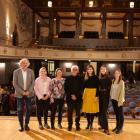
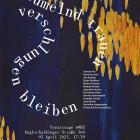
In the fall of 2024, Amitav Ghosh visited the Rachel Carson Center for Environment and Society as part of the project “One Book—Many Worlds: Munich Reads Gun Island by Amitav Ghosh.” This exhibition emerges from the multifaceted discussion of climate change and its challenges conducted in the “One Book—Many Worlds” project and grapples with the question of the role of literary fiction in interdisciplinary academic exchange and climate communication beyond academia. Taking Amitav Ghosh’s recent writings on the global climate crisis, in particular the novel Gun Island, as a vantage point, the chapters in this exhibition engage with various aspects Gun Island from different disciplinary perspectives, drawing on storylines and narrative elements that allow a multifocal engagement with different social and ecological repercussions of climate change. Additionally, pieces from the spring 2025 taumelnd trauen, verschlungen bleiben student exhibition and winning and honorable mentions from the 2025 “Tell the Untold!” writing competition take the provocation to think creatively about the past and future of our environment and world further. Thereby, the exhibition chapters create a web of diverse thoughts on and readings of the role of storytelling for the contemporary interlinked social and environmental crises from a number of perspectives.
About This ExhibitionAbout the author