The Mangrove Doesn’t Forget
The boat nudges against a half-drowned jetty, its wooden planks swollen and soft from the rains. Mira hesitates before stepping off. The tide is low, but the brackish water creeps across what used to be a footpath, licking at the roots of trees that have grown taller, thicker, hungrier.
The house is still there. Or rather, what remains of it.
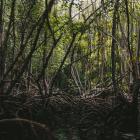
Perched at the edge of the mangrove forest, the stilted wooden home leans ever so slightly to one side, as if tired. One half is veiled in vines, the other wrapped in the knuckled grip of mangrove roots that have pushed their way through the veranda, curling like fingers through old floorboards. A fig tree sprouts from the roof. The entire house hums faintly, as if it’s breathing.
She hasn’t been back in nearly fifteen years—not since her grandmother’s funeral. When the news came that a recent flood had left much of the old village underwater, Mira felt something shift inside her, as if part of her spine had remembered where it began. She booked the ferry that same evening, packed light, and told no one.
The air here smells of salt and rot and something sweeter—guava, maybe, or overripe mango. The sky is slate grey, heavy with another storm. Her boots sink slightly into the mud as she makes her way up to the house. Every step feels like a question: Why? Why return? Why now? At the base of the stairs, she pauses. The wooden steps are worn smooth by time, and something else—there are patterns in the wood along the edges, small indents as if animals have been pacing back and forth. She climbs anyway.
Inside it’s quiet. No birdsong, no creaking, only the muffled rush of distant water. Dust has settled thickly on the windowsills. A broken mirror leans against the wall, its surface fogged over. But the space is not entirely abandoned by life. In one corner, a potted plant has survived—half-dead but still clinging to the cracked wall, its leaves trailing towards the light.
Then she sees it: a root, thick and dark, splitting the floor in the centre of the room. It has burst through the boards as if claiming the house from beneath. Her breath catches.
Outside, the mangrove forest rustles—no breeze, yet the leaves tremble. Mira steps closer to the root and crouches. She touches it gently. It’s warm.
And then, faintly, she hears it.
A whisper. Not in any language she knows, but rhythmic. Like the tide pulling memory from mud.
***
She moves through the house slowly, like someone walking through a museum where the artefacts are her own. The shutters creak when touched, and cobwebs brush against her arms, fine as silk. The walls, once painted a faded blue, are now weathered grey, streaked with salt and mould. Yet despite it all, there’s no feeling of abandonment. The air inside doesn’t carry the chill of long silence—it feels watchful.
Mira pauses by the old kitchen. Her grandmother’s enamel teapot still rests on the stove, lid missing, rust curled along the rim. A tin of dried cloves lies toppled, the scent ghosting through the room. She touches the countertop, worn smooth in the exact spot where her grandmother used to roll dough for kuih. The grooves of memory are still here, embedded in wood.
In the living area, a low cabinet remains untouched by the passing of time. Mira kneels and opens it. Inside is a small brass trunk—one she hasn’t seen since childhood. The lock is rusted, and it yields with a soft snap. Inside, everything is wrapped in plastic and old newspaper. She lifts the layers carefully.
First, a faded batik sarong, neatly folded. The smell of it startles her: lemongrass, sweat, and age. Then a glass oil lamp, its wick coiled and blackened. A stack of black-and-white photographs tied with string—most featuring faces Mira doesn’t recognise, though one woman wears the same pendant her grandmother never took off. At the very bottom, wrapped in yellowing parchment, is the same pendant. The chain is broken. The back bears an engraving: “S.R. / Langkawi / 1943.”
Mira frowns. Those initials mean nothing to her.
She hears it again—the whispering. Faint, coaxing. Like a hand on her shoulder. She turns sharply. Nothing. But the sound doesn’t stop. It rustles through the floorboards. Through the roots.
The main room has changed. The floor now tilts ever so slightly, bowing towards the mangrove. The thick root she touched earlier has split into several limbs, creeping under the wooden walls like veins. She realises then: The house isn’t resisting the mangrove’s grip—it’s merging with it. The timber seems softer near the roots, less human-made, more bark than beam.
And in the middle of the room, a hairline crack has formed where there once was none.
She remembers being six years old, crouched at the river’s edge after tossing leftover rice into the water. Her grandmother’s voice behind her—stern, almost afraid: “Don’t waste food near the trees, girl. They don’t forget.”
She hadn’t understood it then.
Now, the truth comes back like a tide.
***
That night, Mira can’t sleep.
The air hangs heavy with humidity, and the windows won’t shut properly. Insects drone outside in a chorus that never quite settles into a cadence. She lies on the floor in her grandmother’s room, beneath a net full of small holes, watching shadows shift across the ceiling. The root in the main room creaks as the tide rises, as if the house is sighing in its sleep.
Just past midnight, the whispers return. Softer than before, but unmistakable.
She rises and walks barefoot to the door. The wooden planks beneath her feet feel warmer now, as if the earth itself is running a fever. Outside, the night is blue black. The mangrove trees shimmer faintly under the moonlight, their prop roots casting long, spindly shadows. Mira steps into the grove.
Each step squelches. The ground is slick with brine and fallen leaves, yet the path through the trees opens naturally, as if it’s waiting for her. She moves without a torch. The moon is enough. Insects pause as she passes. Even the wind stills.
Then it comes—the voice.
It’s her grandmother’s. But not quite. It sounds older, rounder. Less human. As though the forest has learnt to imitate her speech.
“Child…”
The voice rolls out low and slowly, like the lapping of water against stone.
She freezes.
“Who’s there?” she whispers.
The leaves tremble. The voice returns—not in sentences this time, but in fragments: “salt . . . land . . . taken . . . forgotten . . .”
Images flash through her mind like old film reels: a small canoe drifting near limestone cliffs, a pair of hands planting a sapling beside a shrine, a man in colonial khaki pointing at a map. Then the sound of trees being cut—violently, steadily—like a heartbeat, cracking open. She grips the nearest trunk for balance. Its bark pulses under her palm.
The voice continues—not as narrative, but as sensation. Regret. Rage. Grief carried through mud.
Her grandmother’s stories had always stopped just before the truth. There were gaps Mira was never allowed to question. “Too complicated,” they’d said. “Too long ago.” But here in the mangrove, the pieces rearrange themselves. A broken story trying to tell itself.
She drops to her knees and lets her hand trail along the ground. The earth is warm and wet, and something below is shifting—like breath.
A new phrase rises from the canopy.
“The trees remember what people choose to forget.”
Mira blinks back tears. Not from fear—but recognition.
The story is still alive. And it wants her to listen.
***
The next morning, Mira wakes to the sound of dripping water. The tide has receded, but puddles gleam in the corners of the house like forgotten mirrors. The root in the main room has swollen overnight, splitting a wider crack in the floorboards. A small crab skitters past her feet before disappearing into the dark.
She doesn’t speak. There’s no need. The house is awake now.
Mira kneels by the split and peels back the broken boards. Beneath them, instead of soil or stone, she finds packed layers of earth and cloth—fabric so old it crumbles at her touch.
Carefully, she lifts what remains. Hidden beneath: a rusted tin box wrapped in plastic and string.
Her fingers tremble as she unties the knot.
Inside are several items:
- a folded map, browned at the edges, with red lines drawn in a hand she doesn’t recognise
- letters written in English and Malay, some stamped with official seals, others unsigned
- a yellowed land deed, bearing her family’s surname and dated 1946, witnessed with a British officer’s signature
- a smaller note, handwritten in Jawi script, barely legible but sealed with wax
She reads slowly, piecing together the fragments. The land had once been tended by a coastal Indigenous community. Her great-grandfather, it seemed, had struck a deal—trading access rights in exchange for “development assistance,” only to sign the land fully away in English, while the community was told otherwise in Malay. The British administration had sealed the transaction. Her family prospered. The others vanished.
She sits back, the paper wilting in her damp hands.
Her grandmother had tried to return the land decades later—there are letters in the box, returned and unsent, addressed to lawyers, ministries, even the local imam. None of the envelopes include replies. The last letter is different. It simply reads:
“If no one will listen, the forest will.”
A soft groan runs through the walls.
Mira stands and looks around. The house is no longer just wood and nail. The mangrove has taken it in—sap staining walls, vines curling through cracks, the scent of brine thickening the air. It’s not a home anymore.
It’s an altar.
She kneels again, this time with reverence. In silence, she places the deed back into the tin, folds the wax-sealed letter beside it, and presses them into the hollow beneath the floor.
Then, for the first time, she speaks aloud:
“I hear you.”
And the mangrove exhales—deep, slow, forgiving.
***
That night, the storm returns. Not with the fury of the last flood, but a quieter, more deliberate rain—steady, soaking. Mira lies in her grandmother’s bed beneath the sagging mosquito net, her clothes damp, her thoughts knotted. The deed, the letters, the voice in the trees—they circle in her mind like birds too restless to roost.
She doesn’t sleep. Not in the usual way.
Instead, she slips into something deeper.
In the dream, the house is gone. In its place stands a grove, young and wild. A girl—her grandmother when young—moves barefoot through water, planting saplings with mud-
stained hands. There’s laughter. The tide is low. The community gathers around a fire, voices interwoven like pandan mats.
Then, time shifts.
She sees boats arrive. White shirts. Shiny shoes. Hands pointing at maps. Words in English.
Men shake hands. Women watch from doorways. The laughter fades.
Another shift.
The trees fall—slow, like surrender. The girl becomes a woman, then older still, her back bent but her voice strong. She holds a deed in one hand and a broken necklace in the other. She stands at the water’s edge, speaking to no one—and to everything.
“This was never ours,” she says.
The tide takes her words.
Mira wakes with a start. The air smells of seaweed and ash. She sits up, heart pounding, unsure what was dream and what was memory inherited. Outside, the rain still falls. A branch taps against the window like a knuckle.
She rises and steps out onto the veranda. The mangroves glisten in the half-light, silvered by rain. The house behind her creaks—not in warning, but in rhythm.
She walks barefoot to the edge of the grove and kneels. In her palm is the broken pendant. She doesn’t speak a prayer. She doesn’t have to. The act is enough.
She presses it into the earth, into the hollow where the water pools after each rain. Over it, she places her hand.
The bark beneath her fingers feels like skin.
From somewhere deeper than roots, the voice returns—not loud, not urgent, but certain.
“You listened.”
It is not absolution. It is something more ancient.
Witness.
***
By morning, the rain has stopped.
Mira walks through the grove barefoot, mud clinging to her ankles, hair damp with salt. The air is thick but quiet, as if the forest is resting after speaking too long. The roots glisten under a grey sky. Crabs scuttle across her path. The tide is rising again, but she’s not in a hurry.
She could leave. Take the next boat back to the mainland. Seal the house. Walk away. That’s what everyone expects—an efficient clearing-out, a signature or two, and the end of a story. Instead, she returns to the house with a bucket of water and a cloth. She begins to clean.
Not everything—just enough. She scrubs the mould from the windowsills, wipes the mirror that hasn’t reflected anyone in years. She lays out the sarong on the veranda railing to let it breathe. The photos remain in the trunk, wrapped again in paper and care. The oil lamp she fills with what little kerosene she finds in the kitchen cupboard, and lights it as dusk begins to fall.
It is not restoration. It is remembrance.
She doesn’t sleep inside anymore. At night, she lays a mat on the veranda and listens to the sounds of the mangrove—roots shifting, leaves rustling, water rising and falling like breath. She begins to speak aloud: stories she remembers from childhood, names she was never taught to pronounce properly, memories that don’t solely belong to her.
Each morning, she clears weeds from mangrove roots. She picks up litter washed in by the tide. She leaves offerings of rice and cut fruit under the tree where she buried the pendant. Small gestures. Rituals without instruction.
The villagers are gone, but not completely. She sees them in flashes—an old woman fishing knee-deep in mud, a boy gathering shells, someone metrically hammering tin. Not ghosts. Imprints.
Some days Mira writes. She scribbles lines onto fallen leaves, presses words into bark softened by the tide, and tucks messages gently between roots—offerings the forest might one day answer. She doesn’t yet know what she’s writing for. Only that something needs to be said.
On the seventh night, the tide comes in higher than before. The water brushes the first step of the house.
Mira stands on the veranda and watches it rise. The roots do not resist. They hold.
The house does not sink. It bends, breathes, and settles.
And somewhere, beneath the roots and rot, her grandmother’s voice rests.
Still telling.
Amitav Ghosh in Munich: Inspirations, Insights, and Storytelling
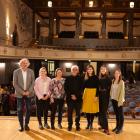
In the fall of 2024, Amitav Ghosh visited the Rachel Carson Center for Environment and Society as part of the project “One Book—Many Worlds: Munich Reads Gun Island by Amitav Ghosh.” This exhibition emerges from the multifaceted discussion of climate change and its challenges conducted in the “One Book—Many Worlds” project and grapples with the question of the role of literary fiction in interdisciplinary academic exchange and climate communication beyond academia. Taking Amitav Ghosh’s recent writings on the global climate crisis, in particular the novel Gun Island, as a vantage point, the chapters in this exhibition engage with various aspects Gun Island from different disciplinary perspectives, drawing on storylines and narrative elements that allow a multifocal engagement with different social and ecological repercussions of climate change. Additionally, pieces from the spring 2025 taumelnd trauen, verschlungen bleiben student exhibition and winning and honorable mentions from the 2025 “Tell the Untold!” writing competition take the provocation to think creatively about the past and future of our environment and world further. Thereby, the exhibition chapters create a web of diverse thoughts on and readings of the role of storytelling for the contemporary interlinked social and environmental crises from a number of perspectives.
About This ExhibitionAbout the author