

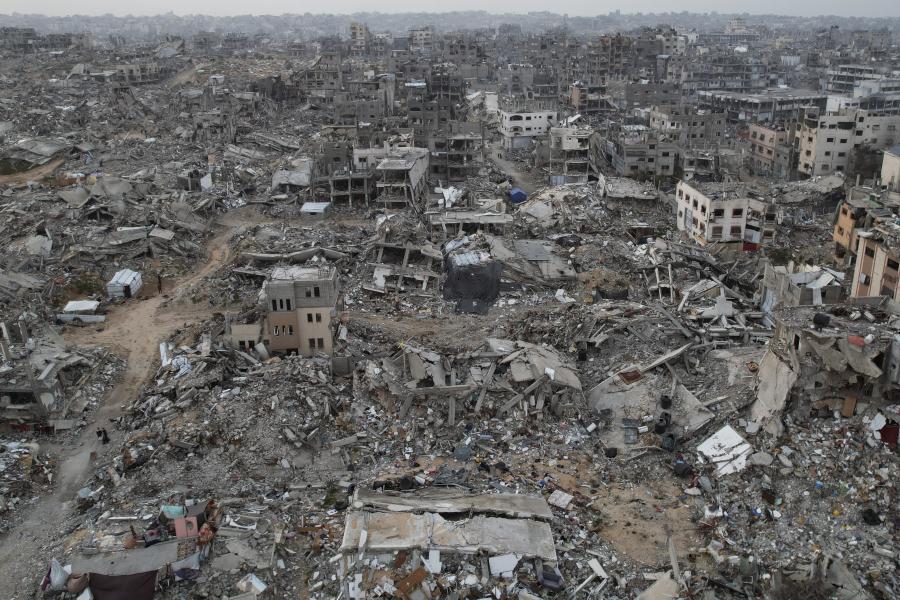
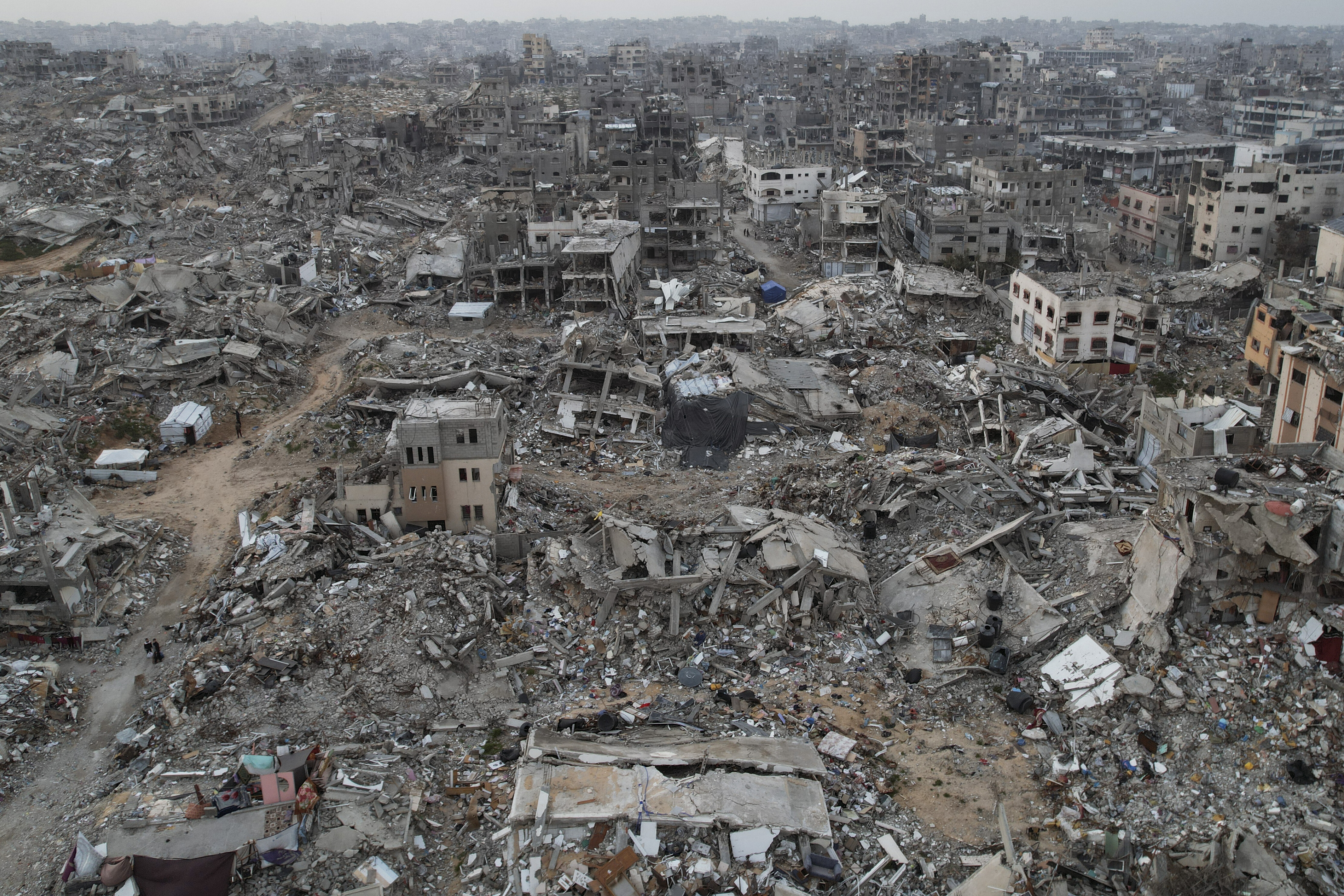
The destruction caused by the Israeli air and ground offensive in Jabalia, 16 February 2025. No longer a human environment, much of Gaza has been both dehumanized and depopulated.
The destruction caused by the Israeli air and ground offensive in Jabalia, 16 February 2025. No longer a human environment, much of Gaza has been both dehumanized and depopulated.
© picture alliance / ASSOCIATED PRESS | Mohammad Abu Samra. Used by permission.
The copyright holder reserves, or holds for their own use, all the rights provided by copyright law, such as distribution, performance, and creation of derivative works.
Palmblad, Jonatan. “The Inhuman Condition: Rethinking Anthropocentrism.” Springs: The Rachel Carson Center Review, no. 9 (February 2026). https://doi.org/10.5282/rcc-springs-19654.
One might “lose faith” in our species when looking at the ecological consequences of industrial society, but I think there is something deeply awry in the rejection of humanity and humanism at a time also characterized by intense dehumanization. While a selfish Homo sapiens makes for a compelling narrative, a brief look around the globe tells a different story: Human beings subject each other to maiming, murder, torture, and starvation, and the world we have built to ourselves has also brought about unprecedented evils, like abject poverty, overdose epidemics, and widespread mental illness.
What is more, the environmental sacrifices made in the name of humanity do not benefit us humans as a species. Ecological destruction is ostensibly justified by human development, but waste and pollution return as microplastics, heavy metals, “forever chemicals,” and other toxic substances permeating and poisoning our natural bodies. Rather than conquering nature, is it not more accurate to say that modernity, its many benefits notwithstanding, is turning the human condition into an increasingly inhuman one? And so I ask: If we actually and truly cared for humanity in all its diversity—if we cared for the welfare of all human beings, present and future—would we then not have to care also for the planet on which we all depend?
This article was originally published in Springs: The Rachel Carson Center Review. Springs is an online publication featuring peer-reviewed articles, creative nonfiction, and artistic contributions that showcase the work of the Rachel Carson Center and its community across the world.
2026 Jonatan Palmblad

This work is licensed under a Creative Commons Attribution 4.0 International License.
This license refers only to the text and does not include any image rights.
Please see captions in the PDF for individual licenses.