On Opium and Imperialism: The Flag Under Which the Empire Sails May No Longer Be the Union Jack
Drawing on Amitav Ghosh’s histories of opium (2023) and Andreas Malm’s critiques of fossil capitalism (2024), this account traces how drugs and steamships, empire and extraction became entangled in ways that still shape our present. What begins with poppies in India and tea in China soon expands into a global story of war, trade, and climate crisis—threads that bind nineteenth-century empire to today’s genocidal wars.
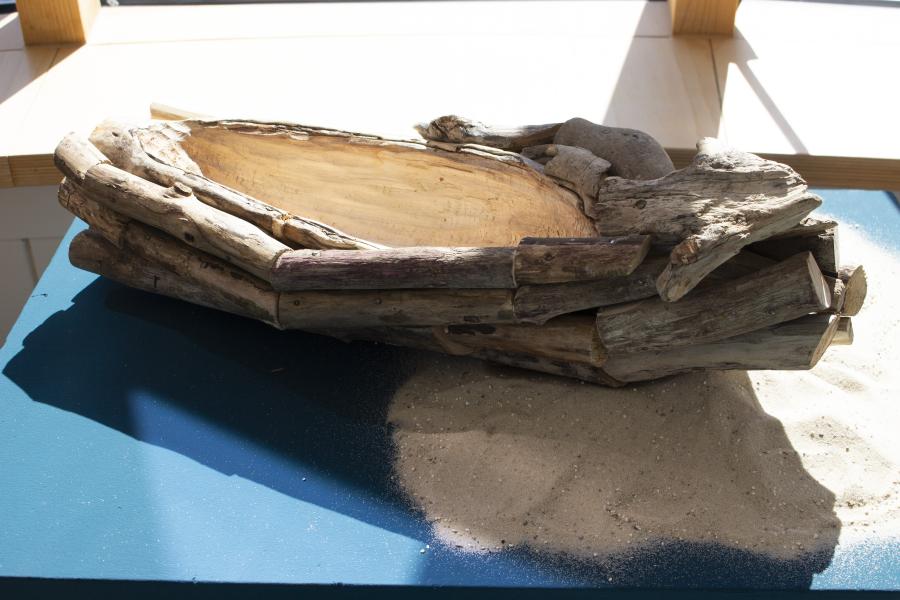
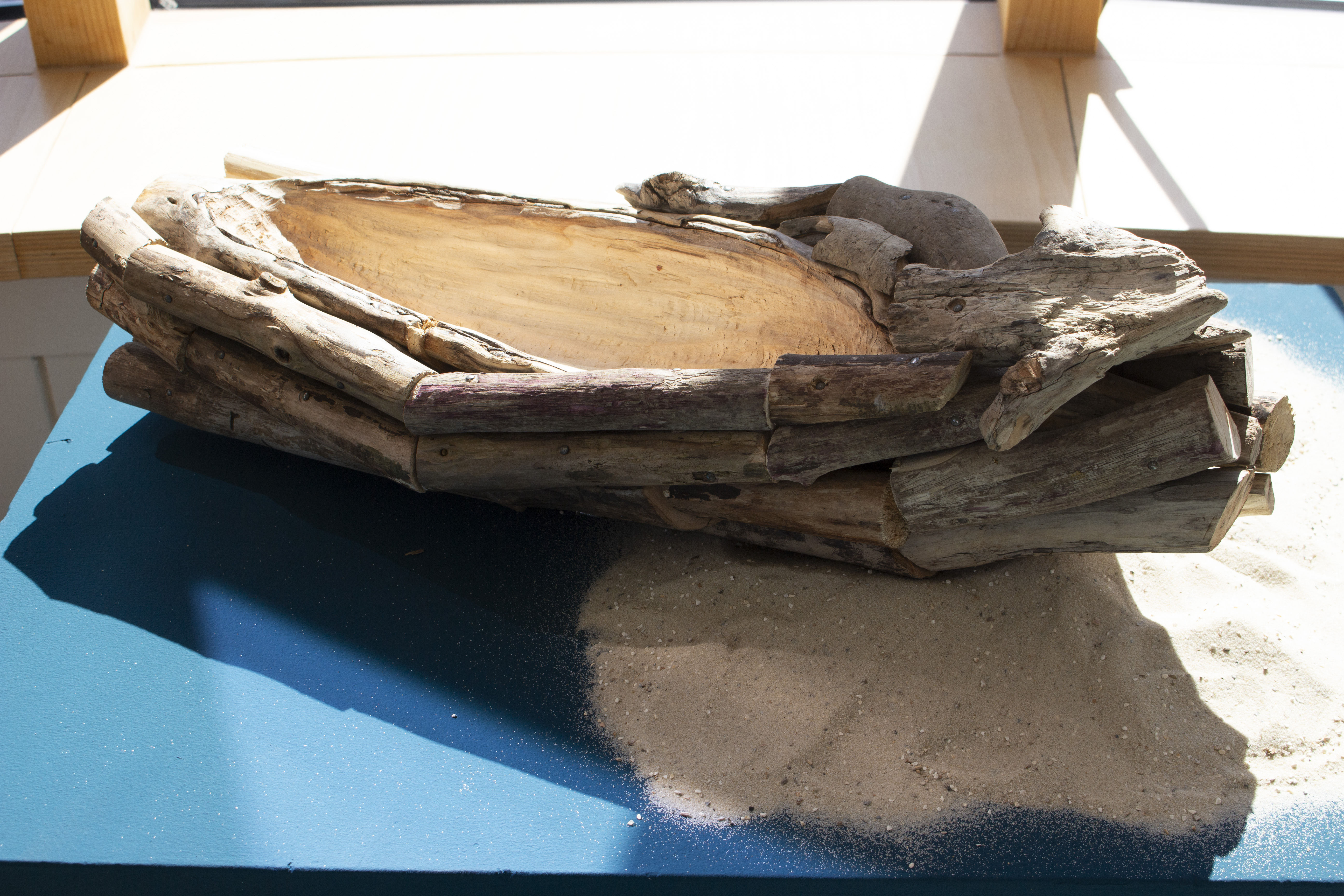
Manas Roshan, Ark,
2025, driftwood and nails.
Our oldest stories begin with a journey, a crossing from one shore to another, a journey of hope and survival. Escaping war, flood, and drought, the small boat journeys into the unknown, like driftwood. Floating across an uncaring sea and tossed by the winds of history, it searches for a safe harbor. Distant shores appear on the horizon. Will it make the passage?
Manas Roshan, Ark,
2025, driftwood and nails.
Our oldest stories begin with a journey, a crossing from one shore to another, a journey of hope and survival. Escaping war, flood, and drought, the small boat journeys into the unknown, like driftwood. Floating across an uncaring sea and tossed by the winds of history, it searches for a safe harbor. Distant shores appear on the horizon. Will it make the passage?
Artwork © Manas Roshan. All rights reserved. Photo © Malte Sattig. Used by permission.
The copyright holder reserves, or holds for their own use, all the rights provided by copyright law, such as distribution, performance, and creation of derivative works.
Autumn 1839. Guangzhou, romanized as Canton, located on the Pearl River Delta, was a major port terminus and the only port open to foreign commerce, as all foreign trade with China was confined to Canton. Foreign traders were restricted to a riverside enclave outside the city walls, where their 13 warehouses, or “factories,” were located (Ghosh 2023, 146). Tensions in these enclaves had risen since the appointment of the new commissioner, Lin Zexu, whose explicit aim was to end the illegal opium smuggling. The lion’s share of this smuggling was conducted by the East India Company in pursuit of sustaining its powerful economic and geopolitical position despite a severe misbalance in trade.
Chinese tea was the East India Company’s principal revenue source, much of which financed British colonial expansion. The problem with Britain’s voracious thirst for tea was that Britain had little to offer China in return; the Chinese had little interest in, and no need for, most Western trading goods. This created a persistent balance-of-trade problem. The East India Company responded by expanding exports from its Indian colonies. Cotton was one commodity, but opium was far more lucrative. And so, the East India Company, “a dangerously unregulated private company, headquartered in a small office, five windows wide, in London” (Dalrymple 2025), began seizing large parts of India in the mid-eighteenth century. Its private army, grown to nearly 260,000 men by 1803 (Ibid.), eventually occupied the entire subcontinent of Bengal, controlling the hinterlands where most opium was produced.
The Company established a system of surveillance and an atmosphere of terror to force farmers and peasants to grow more opium. This opium was processed in Ghazipur and Patna factories, where it was loaded onto heavily guarded fleets and sent to Calcutta, then onward to Canton, where the drug was sold to Chinese smugglers. Openly defying Chinese law and founded entirely on smuggling, this so-called triangular trade, on which the British Empire’s fortunes were built, was one in which Indian opium was exchanged for Chinese tea with bills on British banks.
The increasing opium influx debilitated Chinese society. The Chinese emperor tried repeatedly to prohibit the opium trade and crack down on traffickers. And thus, in 1839, he sent Commissioner Lin to Guangzhou with “special powers” to end the opium smuggling. He ordered the cessation of the opium trade and demanded that foreign merchants surrender all opium stocks. More than a million kilograms of opium were seized and destroyed. In Britain, opium merchants and members of Parliament—many of whom were East India Company shareholders—lobbied for war, arguing that China’s actions violated the exalted principles of free trade. The destruction of merchants’ property and their losses became the casus belli for war (Ghosh 2023, 76).
The Royal Navy launched its assault on China in the autumn of 1840 under Lord Palmerston, initiating the first Opium War. Coal-powered steamers sailing into Chinese waters gave the British fleet an immense advantage over the Chinese fleet. This fossil-fueled warmaking by the British Empire, in the interests of drug traffickers and opium smugglers, was cloaked under the principles of protecting capitalism and free trade—principles taken to be natural, quasi-divine laws. This fossil-fueled warmaking marked the beginning of an era that casts its long shadow on our contemporary geopolitical and planetary crises (Ghosh 2023, 276–7).
Not only did the Western colonizers extract immeasurable wealth from Asia using opium, but they succeeded in obscuring their own role by arguing it had existed since time immemorial because nonwhite people were naturally prone to addiction and depravity (Ghosh 2023, 284).
As the steamers sailed into the Pearl River Delta in autumn 1840, Royal Navy steamers were also deployed in the eastern Mediterranean. In Palestine and Lebanon, Britain—under the same Lord Palmerston—went to war against Muhammad Ali, the Pasha of Egypt. Ali was nominally under the Ottoman Sultan but practically led his own Arab proto-empire. His rise threatened the Ottoman Empire, whose stability and integrity Britain regarded as strategic, particularly the free-trade agreement it had entered with the Ottomans. Britain regarded Ali’s industrialization of Egypt, his insistence on import-substitution policies, and the dynamically growing cotton-textile industry as a threat. Britain despised this, and Lord Palmerston yearned for Ali to “destroy all his manufactures and throw his machinery into the Nile” (Rodkey 1929, 112).
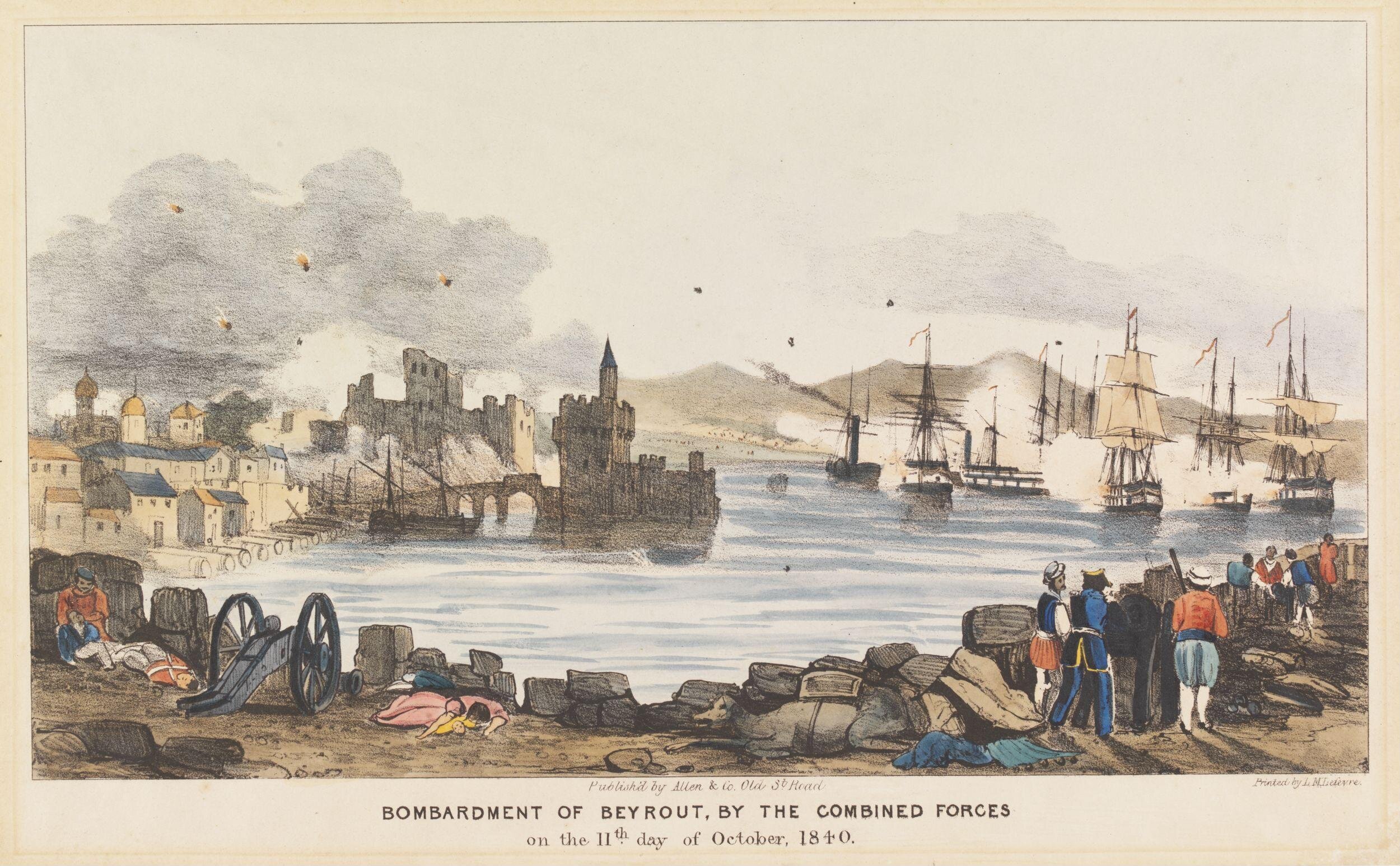
Once again, in parallel to the situation in Canton, the refusal to accept free trade under British conditions was taken as casus belli. Under Admiral Charles Napier, “the most energetic champion of steam in the Royal Navy” (Malm), Britain began bombing Palestinian and Lebanese ports and coastal towns, among them Beirut and Akka.
Akka, a Palestinian town with a thriving civilian population that had held out for six months against Napoleon in 1799, was where the decisive engagement stood. In a matter of hours, the town was reduced to rubble. Napier, in his official war account, admitted: “Nothing could be more shocking than to see the miserable wretches, sick and wounded, in all parts of this devoted town, which was almost entirely pulverized” (Napier 1842, 211).

Unknown artist, Bombardment of Beyrout, by the Combined Forces, ca. 1840, lithograph, 18.9 x 33.6 cm, V&A South Kensington.
Unknown artist, Bombardment of Beyrout, by the Combined Forces, ca. 1840, lithograph, 18.9 x 33.6 cm, V&A South Kensington.
Click here to view source.
 This work is licensed under a Creative Commons Attribution 4.0 International License.
When we look at painted depictions and read about these historical events, it is hard not to draw parallels to what is happening in Palestine and Lebanon today and how history keeps repeating itself.

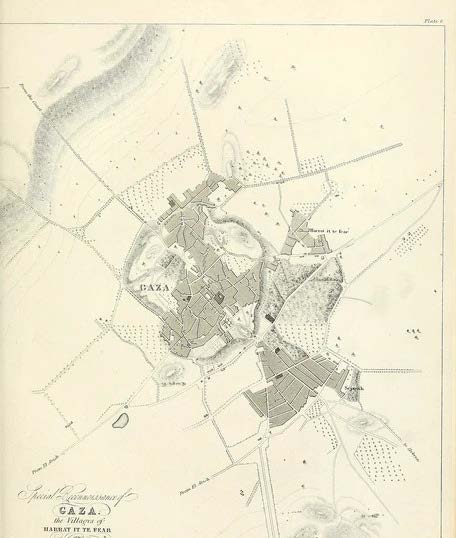
1840–41 Royal Engineers map of Gaza.
1840–41 Royal Engineers map of Gaza.
Wikimedia Commons. Click here to view source.
 This work is licensed under a Creative Commons Public Domain Mark 1.0 License.
To ensure that the retreating forces of the Pasha were not left with any food or war provisions, in January 1841 British-led forces briefly occupied Gaza, which stood en route to Alexandria. This is the map the Royal Engineers produced of Gaza during that brief occupation in 1841. Not much of this urban fabric remains today.
What contemporary relevance does this story have? As Amitav Ghosh argues, “The truth is that human beings have never been more dependent on the earth’s provisions—botanical matter, most of all—than they are today.” (2025) Poppies as much as fossilized carboniferous plants present us with botanical, ecological, and geopolitical histories that highlight their continuous relevance in a (once?) imperial project. The flag under which the Empire sails may no longer be the Union Jack, but the structures of Western imperial dominance—held up by fossil-fueled warmaking—continue to pull us deeper into planetary crises that threaten the way of life in the imperial core.
Swantje Furtak, Let Me Tell You a Story,
2025, sound recordings in Venice. © Swantje Furtak. All rights reserved.
Stories are alive. We here might be used to capture stories in books, give them one permanent form and disseminate them in that. But what happens when we allow stories to live again? What happens when I start to tell Amitav Ghosh’s story? In different places? In different languages? In different lengths? Does the story change? Does it stagger? Does it dare something new? Do I interweave it with the place where and time when I am telling it? These audio sequences are an attempt to see and respect the story Gun Island as a living being. Who does the story become when you retell it?
Bibliography
Dalrymple, William. “The East India Company: The Original Corporate Raiders.” The Guardian, 4 March 2025. https://www.theguardian.com/world/2015/mar/04/east-india-company-original-corporate-raiders.
Ghosh, Amitav. “The Nutmeg’s Curse.” Springs: The Rachel Carson Center Review, no. 7 (May 2025). doi:10.5282/rcc-springs-14636.
Ghosh, Amitav. Smoke and Ashes: A Writer’s Journey Through Opium’s Hidden Histories. Harper Collins, 2023.
Malm, Andreas. The Destruction of Palestine Is the Destruction of the Earth. Verso Books, 2024.
Napier, Charles. The War in Syria. Vol. 1. John W. Parker, 1842.
Rodkey, F. S. “Colonel Campbell’s Report on Egypt in 1840, with Lord Palmerston’s Comments.” Cambridge Historical Journal 3, no. 1 (1929): 102–14. doi:10.1017/S1474691300002146.
Amitav Ghosh in Munich: Inspirations, Insights, and Storytelling
In the fall of 2024, Amitav Ghosh visited the Rachel Carson Center for Environment and Society as part of the project “One Book—Many Worlds: Munich Reads Gun Island by Amitav Ghosh.” This exhibition emerges from the multifaceted discussion of climate change and its challenges conducted in the “One Book—Many Worlds” project and grapples with the question of the role of literary fiction in interdisciplinary academic exchange and climate communication beyond academia. Taking Amitav Ghosh’s recent writings on the global climate crisis, in particular the novel Gun Island, as a vantage point, the chapters in this exhibition engage with various aspects Gun Island from different disciplinary perspectives, drawing on storylines and narrative elements that allow a multifocal engagement with different social and ecological repercussions of climate change. Additionally, pieces from the spring 2025 taumelnd trauen, verschlungen bleiben student exhibition and winning and honorable mentions from the 2025 “Tell the Untold!” writing competition take the provocation to think creatively about the past and future of our environment and world further. Thereby, the exhibition chapters create a web of diverse thoughts on and readings of the role of storytelling for the contemporary interlinked social and environmental crises from a number of perspectives.
About This ExhibitionAbout the author