Ten Theses on Climate Justice and Migration: Reading Amitav Ghosh’s Gun Island from a Christian Social-Ethics Perspective
Inspired by Amitav Ghosh’s treatment of climate change and climate-induced migration in his novel Gun Island, this chapter proposes 10 theses for an ethical engagement with the socioecological effects of climate change and resulting migration phenomena. These theses are proposed from a Christian social-ethics perspective.
1) Narratives Are Crucial for Ethics and Politics
In his fiction and nonfiction, Amitav Ghosh frequently treats climate change as a crucial topic for understanding life, social transformation, and the global conflicts of our time. In his essay The Great Derangement: Climate Change and the Unthinkable, he accuses our civilization of largely neglecting the social impact of climate change. As a theologian, I find his central thesis particularly interesting: We need to rediscover nature as something magical and defying rationality.1
The novel Gun Island is exemplary in this regard, as it turns to the Hindu-Bengali myth of the snake goddess to illustrate the mysterious powers of nature. Ghosh consequently argues that we cannot understand nature with the help of the natural sciences alone (2017); we also need myths, religion, literature, rites, and culture. He thus links ecological, social, cultural, and economic aspects in a highly compelling way. This linkage is also central to the environmental humanities, of which ethics are a central component. It is striking—and in my perspective somewhat irrational—that thousands of scientists study empirical data on climate change, while only relatively few examine its specific ethical and cultural dimensions. Yet these dimensions are of profound importance for the acceptance of climate policy and the resilience of societies as they adapt to climate change. For an ethics that aims to be relevant to everyday life, narrative illustration is crucial. In view of the climate crisis, in which traditional narratives of progress, prosperity, and rationality are no longer credible, we need new narratives that give meaning (Vogt 2025).
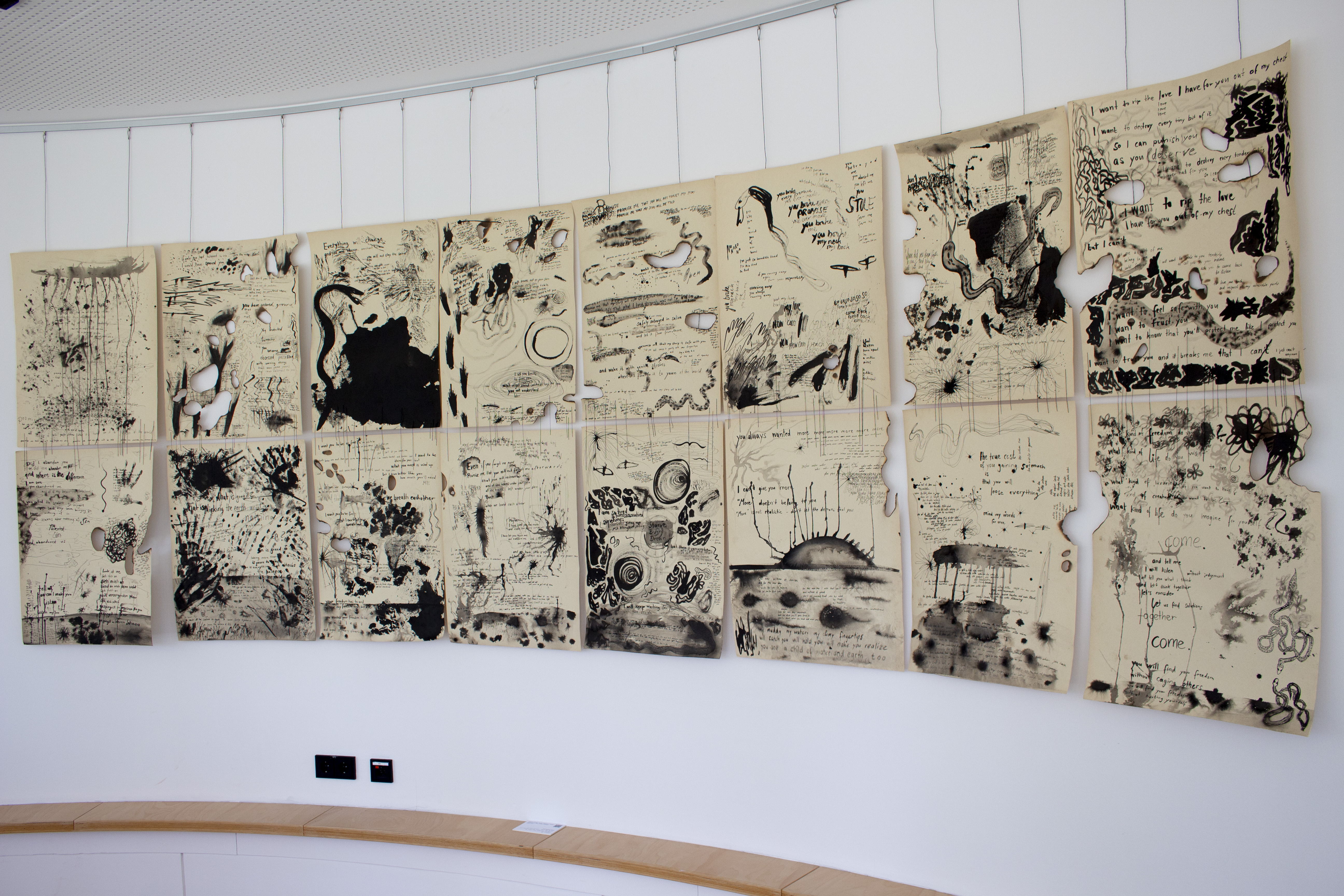
Florentine Illner, Promise Me That You Will My Story,
2025, ink, water, fire, and thread on paper.
This work is an attempt to imagine and embody the perspective of Manasa Devi, the snake goddess, in her search for the gun merchant. What is behind her search, what is her motivation, her perspective? If she were to write letters to the merchant—or to us—what story would they tell? Her fragile words become partly unreadable under the influence of fire and water—invoking the impact of the ongoing environmental crisis.
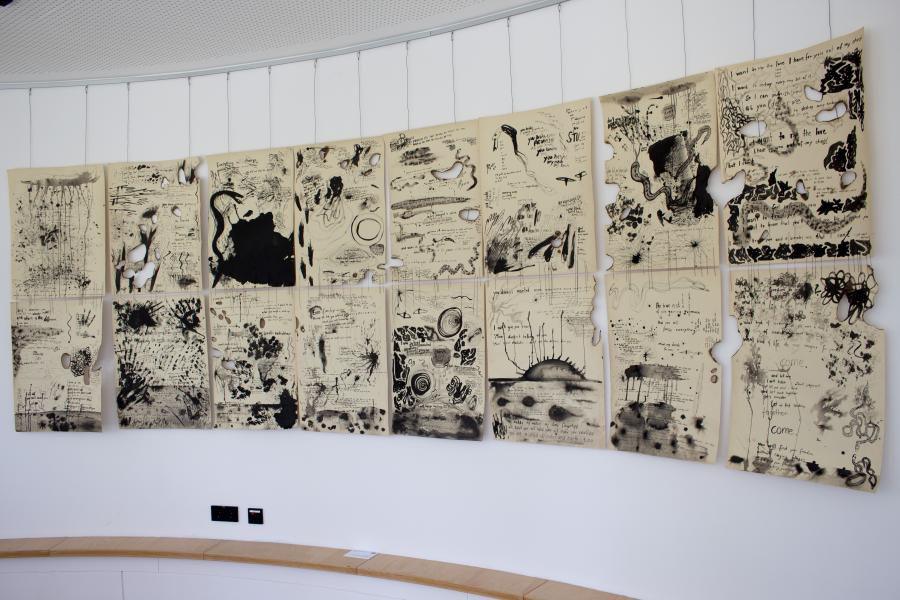
Florentine Illner, Promise Me That You Will My Story,
2025, ink, water, fire, and thread on paper.
This work is an attempt to imagine and embody the perspective of Manasa Devi, the snake goddess, in her search for the gun merchant. What is behind her search, what is her motivation, her perspective? If she were to write letters to the merchant—or to us—what story would they tell? Her fragile words become partly unreadable under the influence of fire and water—invoking the impact of the ongoing environmental crisis.
Artwork © Florentine Illner. All rights reserved. Photo © Malte Sattig. Used by permission.
The copyright holder reserves, or holds for their own use, all the rights provided by copyright law, such as distribution, performance, and creation of derivative works.
2) In the Twenty-First Century, Justice Is Incomprehensible Without Considering Climate Change
Already two decades ago, in 2006, the Working Group on Ecological Issues of the Commission for Society and Social Affairs of the German Bishops’ Conference remarked that climate change is a “focal point of global, intergenerational, and ecological justice.” The global poor, particularly in the Global South, are largely not responsible for the drivers of climate change, yet they are disproportionately affected by its consequences. Faced with persistent droughts and heat waves, they often have no choice but to flee or migrate. Against this backdrop, the lifestyle prevalent in industrialized countries and our economic system have been described as constituting an “ecological aggression” (Klaus Töpfer), an “imperial way of living” (Ulrich Brand) of the “externalization society” (Stefan Lessenich), and a “normatively untenable state of affairs, because it endangers the stability of the climate system and thus the livelihoods of future generation” (Schnellhuber et al. 2011, 1). Therefore, from an ethical perspective, the transformation toward “climate compatible development” is morally as imperative as the abolition of slavery and the outlawing of child labor (Mitchell and Maxwell, 2010). Climate justice is central for development, peace, and the future of humankind. It includes a fundamental new idea of social contract and global cooperation.
3) The SDGs Need to Strengthen the Cultural Aspects of Development in Order to Serve as a Suitable Global Normative Road Map
The goal of keeping global warming well below two degrees Celsius is necessary for human-rights reasons. The United Nations’ Sustainable Development Goals (SDGs) and the climate treaty, which the international community adopted in New York and Paris in 2015 as a normative road map for global development until 2030, are the guiding and decisive bases for climate justice. Due to the lack of sanction options, there is no meaningful alternative to the model of voluntary reporting of national reduction targets. Nevertheless, a profound dilemma arises: The window of opportunity for achieving this is closing, we are far from the proposed target, and we lack institutions that could ensure binding enforcement.
In 2024, we reached 1.6 degrees Celsius of global warming. In the SDGs, the fundamental tension between development policy and ecological goals has not been clarified—development to date has followed the Western model of prosperity and progress, which exceeds Earth’s capacities.
Against this backdrop, we need a shift toward more realistic interpretations of climate justice and an adjustment of the climate treaty and SGD framework. We must allow the two-degree target to be exceeded and then address it with “negative emissions,” i.e., CO2 sequestration in natural sinks and through carbon-capture methods. However, it is even more important to take greater account of the cultural factor in development and to strengthen Indigenous, social, and religious potential for self-organization in societies of the Global South, rather than disempowering it through Western-influenced ideas of technology and prosperity (Vogt 2022).
4) Confusing Hope with Utopian Optimism Distracts from the Need for Transformation
In the face of increasing hopelessness and frequent invocations of the world’s end, we are in dire need of hope.
For theology, the tension between the claim to deliver a “good news” (the gospel) and the growing frustration caused by multiple crises is especially striking. According to US environmental scientist and theologian David Elliott, the virtue of hope has long been neglected in Christian theology and needs to be reconsidered and put into practice today in view of the existential challenges posed by the climate crisis. In his book Christian Hope and Climate Change, Floyd Richard describes this practice as “down to earth”: a necessary grounding, contextualization, and testing of Christian hope. Hope is not a prediction of the future, but rather the confidence that what we do, no matter how small, is meaningful—as stated by renowned British philosopher Terry Eagleton in his 2015 book Hope Without Optimism. Optimism, like pessimism but with the opposite sign, is associated with a distorted perception of reality. Hope, on the other hand, is a much stronger concept than optimism, as it is not blind to reality but changes reality. It is not the conviction that something will turn out well, but the certainty that something makes sense regardless of how it turns out. It begins with getting to work because it needs to be done (Pelluchron 2024).
How can hope today gain new psychological, cultural, social, and political vitality? How can it become an effective way of life beyond false illusions?
Pope Francis’ memoir Hope: The Autobiography (2025) emphasizes hope through support for the poor. Christian hope is not optimism, but rather addresses the question of how one should speak of hope in the current situation. It includes aspects like resistance and revolt as well as a transition through emotions like fear, despair, and grief. These emotions also have their rightful place and must be acknowledged appropriately. As a consequence, “climate feelings” have now become an independent field of inquiry in psychology, sociology, literature, ethics, and theology (Van Bronswijk 2022; Doh and Schulze 2022).
5) Learning to Deal with Collapse Phenomena Is Crucial in Times of Climate Change and Migration
In complex systems, collapse phenomena are to be expected (Bardi 2017). Collapse, however, does not arrive as a single event, but as a process that is usually prepared in many small steps, which often go unnoticed and are only discovered when it is too late. It is important to learn how to deal in a forward-looking manner with these hidden phenomena in order to avoid losing control. Sometimes collapse phenomena can be used to bring about change and new chances. In times of climate change and migration, it is important to learn how to shape such processes in the spirit of triage management and resilience (Ibid.).
In our globalized world, collapse phenomena include increased migration flows. Bangladesh serves as a prime example for the convergence of climate-change repercussions, climate-induced migration, and resilience (Aßheuer 2014).
The ethical and political consequences of collapse phenomena, like inundations of slums in megacities such as Dhaka, are at the heart of adaptation assistance, which needs to be pursued alongside mitigation efforts. I am convinced that CO2 taxes or CO2 certificates could be an important instrument for financing climate adaptation in societies of the Global South, helping them avoid collapse phenomena.
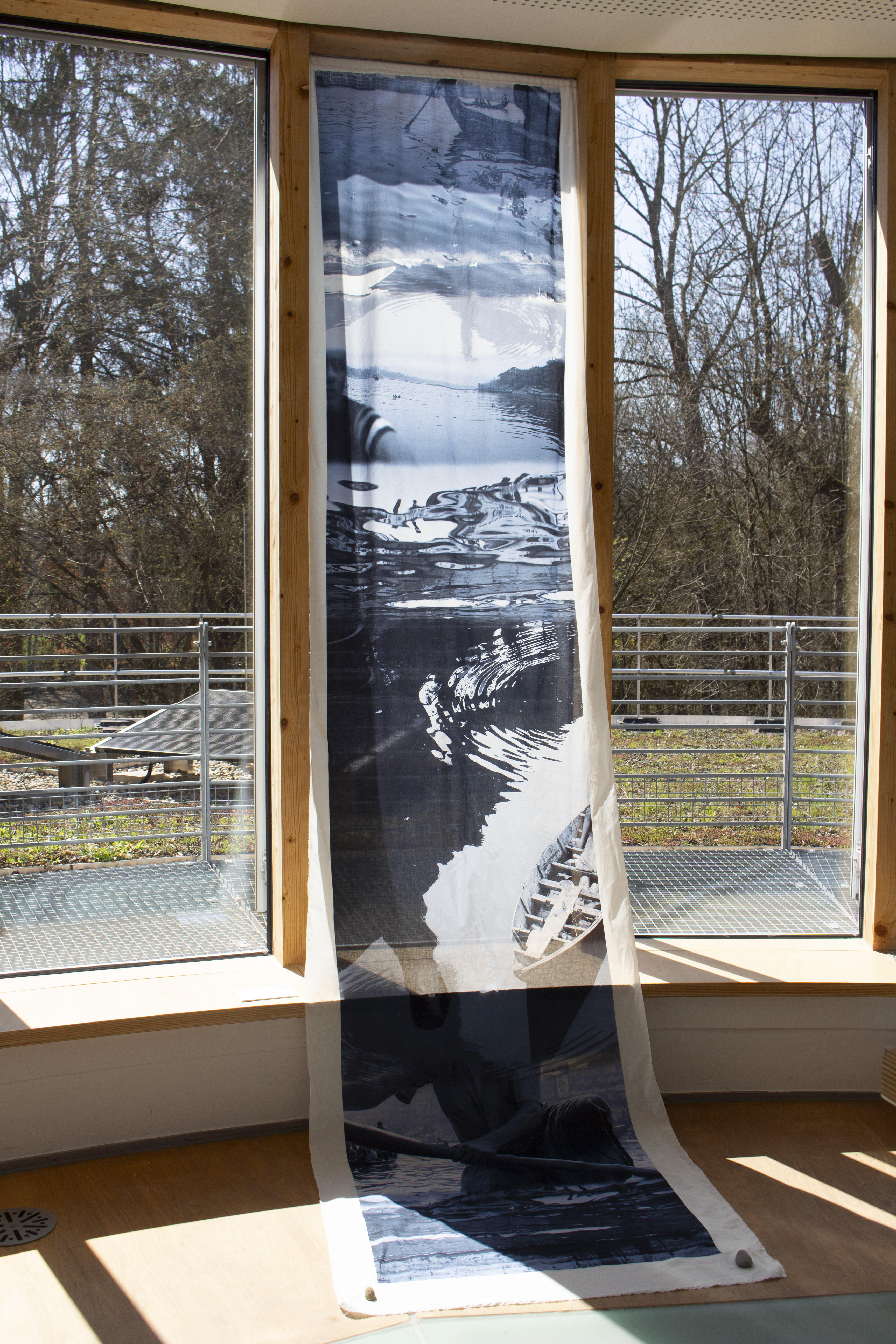
Maleah Moore, Waters Between—unde aqua inde salus,
2025, photo collage on textile.
I am interested in the phrase, “from the origin salvation comes,” thinking against the idea that salvation is a complete crossing, or a leaving behind. Following from Ghoshs’ description of the migrants’ journey, I convey that there is constant movement between the (home)land and new land. As the Buriganga’s water mix and move, all journeys contain the mirage of memory, and an ongoing flow between here and there.
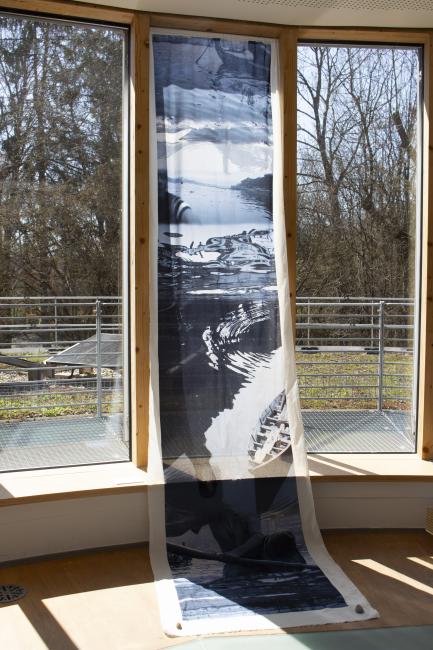
Maleah Moore, Waters Between—unde aqua inde salus,
2025, photo collage on textile.
I am interested in the phrase, “from the origin salvation comes,” thinking against the idea that salvation is a complete crossing, or a leaving behind. Following from Ghoshs’ description of the migrants’ journey, I convey that there is constant movement between the (home)land and new land. As the Buriganga’s water mix and move, all journeys contain the mirage of memory, and an ongoing flow between here and there.
Artwork © Maleah Moore. All rights reserved. Photo © Malte Sattig. Used by permission.
The copyright holder reserves, or holds for their own use, all the rights provided by copyright law, such as distribution, performance, and creation of derivative works.
6) “Climate Refugee” Must Become a Legal Category
Climate change is likely to render significant parts of Earth temporarily or permanently uninhabitable. Forecasts for the number of climate refugees vary widely.2 A figure of several hundred million by mid-century is possible but controversial (it might be higher), because displacement is rarely caused by climate change alone; it typically results from a combination of factors.
“Climate refugee” should be a recognized legal status in the Geneva Convention, as Pope Francis urges in Laudato si’ (2015). However, ethically, this poses a central dilemma: While there are valid reasons to include climate migration as a basis for asylum, it is anticipated that the integration capacity and willingness of affluent Western countries to host climate refugees would be heavily strained.
To enable ethically justifiable decisions that can gain broad political support, we must reexamine how we treat borders in the context of the paradoxical tension between processes of boundary dissolution and boundary demarcation in normative, legal, political, economic, cultural, and theological terms. It is crucial to address the very different ideas and levels of responsibility involved; in particular, as climate-related displacement reflects structural violence that compels migration. And a precise definition is needed that takes heed of the multiple factors that typically influence voluntary and involuntary migration (e.g, poor governance, ethnic, social, and political conflicts, inadequate agricultural and nutrition systems, unemployment, megacity disintegration, population growth, etc.). In legal theory, there is debate about whether expanding the Geneva Convention would dilute the protection it guarantees due to expected high numbers, suggesting that a separate convention might be more expedient to avoid thematic dilution.
7) Indigenous Knowledge Is a Key Factor of Climate Resilience
Climate-induced migration presents itself largely as internal migration, with most migrants remaining in their regional environment. Many countries in Africa and the Middle East address this phenomenon and support local resilience. The neglect and reduction of aid by the global community/industrialized countries—for example, to Syria, where the refugee wave was also triggered by a prolonged drought—was politically and ethically unwise and negligent. The resilience of many societies in the Global South is at risk. Providing smart, targeted financial, technological, and social support that strengthens a people’s and culture’s resilience should be a priority for preventive refugee policy. The support of local agricultural practices and the acknowledgement of the crucial role of Indigenous knowledge plays a key role here. This aligns with the ethical principle of subsidiarity and with Amartya Sen’s concept of justice as empowerment (Chijioke 2024).
8) Climate Protection That Is Compatible with Democracy Requires a New Understanding of Liberalism
Fear of refugees is a central trigger for why support for ethical universalism in European and North American societies has become fragile. Competition between democratically liberal and authoritarian-nationalist social models shapes the political agenda (Trump, Erdoğan, Putin, etc.). This leads to social divisions. The Christian values of peaceful coexistence are called into question. The possibility of responsible climate policy is undermined. A deeper and more nuanced engagement with liberalism is essential, also with regard to global climate and refugee responsibility (Deneen 2018; Sandel 2020). Defending a liberalism and universalism based on Christian and human-rights foundations can only succeed if it distinguishes itself more clearly from market liberalism.
Although there are close links between political and economic liberalism, there is a need for ethical clarification of these relationships. The conflict in this field will shape the coming decades and be decisive for all opportunities of global climate protection as well as for the acceptance of universalist, human-rights-based ethics, which underpins this. However, we must not fall back into an anti-capitalist model as discussed by Naomi Klein in This Changes Everything: Capitalism vs. the Climate (2015). Instead, we need market-based solutions.
9) Emission Trading Is an Indispensable Element of Climate Justice
Regarding the basic decisions of a legally viable and globally consensus-capable model of climate justice, the general conditions are relatively clear: We need a globally coordinated process on the way to zero emissions by 2050 (Vogt 2024). In order to achieve these goals as efficiently as possible, we need emission trading and “flexible mechanisms,” technology transfer, and transition periods (Ekhardt 2014). In terms of an accompanying justice theory, the classic “triangle” should be used as a starting point: satisfaction of basic needs (distributive justice, minimum human rights standards), just procedures (legal justice with a particular emphasis on fighting corruption and participation/procedural justice), and fair trade opportunities (exchange justice, especially with regard to resources). Thus, just emission trading becomes the most important instrument of a liberal concept of climate justice.
10) Without a New Approach to Spirituality in the Sense of “Inner Development Goals,” Ecological Transformation Is Unlikely to Succeed

Sonja Steffens, Simultaneousness,
2025, gouache and paper collage on cardboard.
The socioecological crisis that we are experiencing at the moment, described by Ghosh in Gun Island, mirrors humanity’s sense of separateness from the rest of the world. This crisis is a wake-up call to acknowledge the fragility, resilience, interwovenness, and beauty of this world. I see vulnerability as both a source for pain and transformation. It hurts to see what we stand to lose, yet reminds us of our place in a community of beings. What Ghosh points to is not a fiction, it is real.
Sonja Steffens, Simultaneousness,
2025, gouache and paper collage on cardboard.
The socioecological crisis that we are experiencing at the moment, described by Ghosh in Gun Island, mirrors humanity’s sense of separateness from the rest of the world. This crisis is a wake-up call to acknowledge the fragility, resilience, interwovenness, and beauty of this world. I see vulnerability as both a source for pain and transformation. It hurts to see what we stand to lose, yet reminds us of our place in a community of beings. What Ghosh points to is not a fiction, it is real.
Artwork © Sonja Steffens. All rights reserved. Photo © Malte Sattig. Used by permission.
The copyright holder reserves, or holds for their own use, all the rights provided by copyright law, such as distribution, performance, and creation of derivative works.
The churches have a significant responsibility here, as they offer ethical orientation and a global, intergenerational learning community for exchanging experiences; they have practiced global thinking and local action through the subsidiarity principle; they possess decades of experience in poverty and refugee relief and can “put a face” to the plight by uniting and reaching different social groups; and they have substantial institutional opportunities for action in education and international lobbying. Until 2025, we had a pope whose credibility in refugee and climate policy received worldwide recognition. Additionally, the Christian faith is designed to overcome fear, embrace an open future, and practice solidarity. Spirituality can be a source for a “return to life” in the search for a postfossil, sustainable lifestyle (Evangelische Kirche im Rheinland). Every Christian has a shared responsibility and opportunity for action here. The German Bishops’ Conference asserts that since there is no solid historical evidence for the decoupling of growth from resource consumption, the growth model for the Global North must be abandoned (Wallacher 2018). Given that Western economic and consumption models have global impacts, the stalled German energy transition should be revived as a priority of future policy. Wir Sind Dran (It’s our turn), the title of the book written by Ernst Ulrich von Weizsäcker, the Club of Rome’s long-term copresident, aptly sums up the diagnosis of the current situation. The global movement of “Inner Development Goals” innovatively combines ethical, spiritual, social, and political discourses.
Based on all these observations, I do see a shift in the mental infrastructure regarding our relationship to nature. And I read Amitav Ghosh’s novel Gun Island as a groundbreaking contribution to this shift.
Notes
1 Mystical and rational approaches should respect and complement each other, not be treated as absolute truths (Dinzelbacher 2009; Taylor 2009; Vogt 2024, esp. pp. 3–39 and 253–336).
2 Gaia Vince (2022) anticipates the possibility of three billion refugees in the second half of our century, including four hundred million refugees in India alone due to the possible end of the monsoon rains and the associated impact on rice production. David Wallace (2017) has already spoken very dramatically about this. If we do not stop the expansive use of fossil fuels and the loss of biodiversity and natural CO2 sinks, this could apply to significant parts of Earth near the equator in just a few decades.
Bibliography
Aßheuer, Tibor. Klimawandel und Resilienz in Bangladesch: Die Bewältigung von Überschwemmungen in den Slums von Dhaka, Franz Steiner Verlag, 2014.
Bardi, Ugo. The Seneca Effect: Why Growth is Slow but Collapse is Rapid. Springer, 2017. doi:10.1007/978-3-319-57207-9.
Deneen, Patrick. Why Liberalism Failed. Yale University Press, 2018. doi:10.12987/yale/9780300223446.001.0001.
Dinzelbacher, Peter. Mystik und Natur: Zur Geschichte ihres Verhältnisses vom Altertum bis zur Gegenwart. De Gruyter, 2009.
Dohm, Lea, and Mareike Schulze. Klimagefühle: Wie wir an der Umweltkrise wachsen, statt zu verzweifeln. Knaur, 2022.
Eagleton, Terry. Hope Without Optimism. Yale University Press, 2019. doi:10.12987/9780300220254.
Ekhardt, Felix. “Climate Change, Justice, and Sustainability: The Right to Freedom, Protection Rights, and Balancing.” Archiv für Rechts- und Sozialphilosophie 100, no. 2 (2014): 187–200. doi:10.25162/arsp-2014-0014.
Evangelische Kirche im Rheinland. “Ökumenischer Prozess ‘Umkehr zum Leben – den Wandel gestalten.’” Accessed September 2025. https://oeko.ekir.de/inhalt/oekumenischer-prozess-umkehr-zum-leben-den-wandel-gestalten/.
Ghosh, Amitav. The Great Derangement: Climate Change and the Unthinkable. University of Chicago Press, 2017. doi:10.7208/chicago/9780226323176.001.0001.
Inner Development Goals. “Inner Development Goals: Transformational Skills for Sustainable Development.” Accessed September 2025. https://innerdevelopmentgoals.org/.
Klein, Naomi. This Changes Everything: Capitalism vs. the Climate. Simon & Schuster, 2014.
Mitchell, Tom, and Simon Maxwell. “CDKN Policy Brief: Defining Climate Compatible Development.” Climate & Development Knowledge Network, 2010. https://cdkn.org/sites/default/files/files/CDKN-CCD-Planning_english.pdf.
Nwosu, Chijioke Francis. Systemic Remediation: Approaching Sustainable Development Narratives from the Nigerian Afro-Igbo Mmadụ Perspective. Springer, 2024. doi:10.1007/978-3-031-61909-0.
Pelluchron, Corinne. Die Durchquerung des Unmöglichen: Hoffnung in Zeiten der Klimakatastrophe. C. H. Beck, 2024. doi:10.17104/9783406807558.
Pope Francis. “Laudato si’. Encyclical Letter of the Holy Father on Care for Our Common Home (Given in Rome at Saint Peter’s, 24 May 2015).” Vatican Press, 2015. https://www.vatican.va/content/francesco/en/encyclicals/documents/papa-francesco_20150524_enciclica-laudato-si.html.
Sandel, Michael J. The Tyranny of Merit: What’s Become of the Common Good? Farrar, Straus and Giroux, 2020.
Schnellhuber, Hans Joachim, Dirk Messner, Claus Leggewie, Reinhold Leinfelder, Nebojsa Nakicenovic, Stefan Rahmstorf, Sabine Schlacke, Jürgen Schmid, and Renate Schubert. “World in Transition—A Social Contract for Sustainability.” German Advisory Council on Global Change, 2011. https://doi.org/https://doi.org/10.3929/ethz-b-000044092.
Taylor, Bron. Dark Green Religion: Nature Spirituality and the Planetary Future. University of California Press, 2009. https://doi.org/10.1525/9780520944459.
Van Bronswijk, Katharina, ed. Klima im Kopf. Angst, Wut, Hoffnung. Was die ökologische Krise mit uns macht. Oekom, 2022. https://doi.org/10.14512/9783962389383.
Vince, Gaia. Nomad Century: How to Survive the Climate Upheaval. Allen Lane, 2022.
Vogt, Markus. Christian Environmental Ethics: Foundations and Central Challenges. Brill, 2024. https://doi.org/10.30965/9783657790807.
Vogt, Markus. “Development Postcolonial: A Critical Approach to Understanding SDGs in the Perspective of Christian Social Ethics.” Global Sustainability 5 (2022): e4. https://doi.org/10.1017/sus.2021.31.
Vogt, Markus. “Geerdete Hoffnung. Sinnerzählungen in der Krise.” Stimmen der Zeit 150 (2025): 243–54.
Vogt, Markus. “Modelle der Klimagerechtigkeit.” In Nachhaltigkeit: Theologische Perspektiven, edited by Jörg Ernesti, Martin M. Linter, and Markus Moling. Verlag A. Wegner, 2024.
von Weizsäcker, Ernst Ulrich, and Anders Wijkman. Wir sind dran. Was wir ändern müssen, wenn wir bleiben wollen—Eine neue Aufklärung für eine volle Welt. Club of Rome: Der große Bericht. Club of Rome, 2017.
Wallace, David. The Uninhabitable World: A Story of the Future. Allen Lane, 2017.
Wallacher, Johannes. “Opting Out of the Growth Society? A Socio-Ethical Analysis and Assessment of Post-Growth Strategies (Research Results of a Study by the Global Economy and Social Ethics Expert Panel, no. 21).” Wissenschaftliche Arbeitsgruppe für weltkirchliche Aufgaben der Deutschen Bischofskonferenz, 2018.
Working Group on Ecological Issues of the Commission for Society and Social Affairs of the German Bishops’ Conference. “Climate Change: A Focal Point of Global, Intergenerational and Ecological Justice (An Expert Report on the Challenge of Global Climate Change).” Secretariat of the German Bishops’ Conference, Commission for Society and Social Affairs/Commission for International Church Affairs, September 2006. https://www.sjweb.info/documents/sjs/docs/dbk_climatechange.pdf.
Jula Eberth, I Don’t Care for Your Scenic View,
2025, driftwood and nails. CC BY-NC-ND 4.0.
This work seeks to cultivate care for soiled, oiled humannatures. They are the natures I see-smell-hear-feel-taste every day: thrash-riddled patches of grass, overgrown industrial sites, pigeons constructing nests with plastic wire. In natures undeniably shaped unearthed weirded by human touch there is humannature storytelling, evidence of our mutual entanglements, dependencies, cares. By focusing on these human–nature intersections that have been disregarded within our notions of what “conservable nature” looks like, I Don’t Care for Your Scenic View offers fragmented images of a care for nature that extends toward bodies, landscapes, matters saturated and soiled by human material and stories.
Amitav Ghosh in Munich: Inspirations, Insights, and Storytelling
In the fall of 2024, Amitav Ghosh visited the Rachel Carson Center for Environment and Society as part of the project “One Book—Many Worlds: Munich Reads Gun Island by Amitav Ghosh.” This exhibition emerges from the multifaceted discussion of climate change and its challenges conducted in the “One Book—Many Worlds” project and grapples with the question of the role of literary fiction in interdisciplinary academic exchange and climate communication beyond academia. Taking Amitav Ghosh’s recent writings on the global climate crisis, in particular the novel Gun Island, as a vantage point, the chapters in this exhibition engage with various aspects Gun Island from different disciplinary perspectives, drawing on storylines and narrative elements that allow a multifocal engagement with different social and ecological repercussions of climate change. Additionally, pieces from the spring 2025 taumelnd trauen, verschlungen bleiben student exhibition and winning and honorable mentions from the 2025 “Tell the Untold!” writing competition take the provocation to think creatively about the past and future of our environment and world further. Thereby, the exhibition chapters create a web of diverse thoughts on and readings of the role of storytelling for the contemporary interlinked social and environmental crises from a number of perspectives.
About This ExhibitionAbout the author