A Few Hazy Anthropocenes
“[A]ll the stories are too big and too small.”
—Donna Haraway
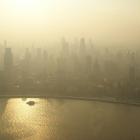
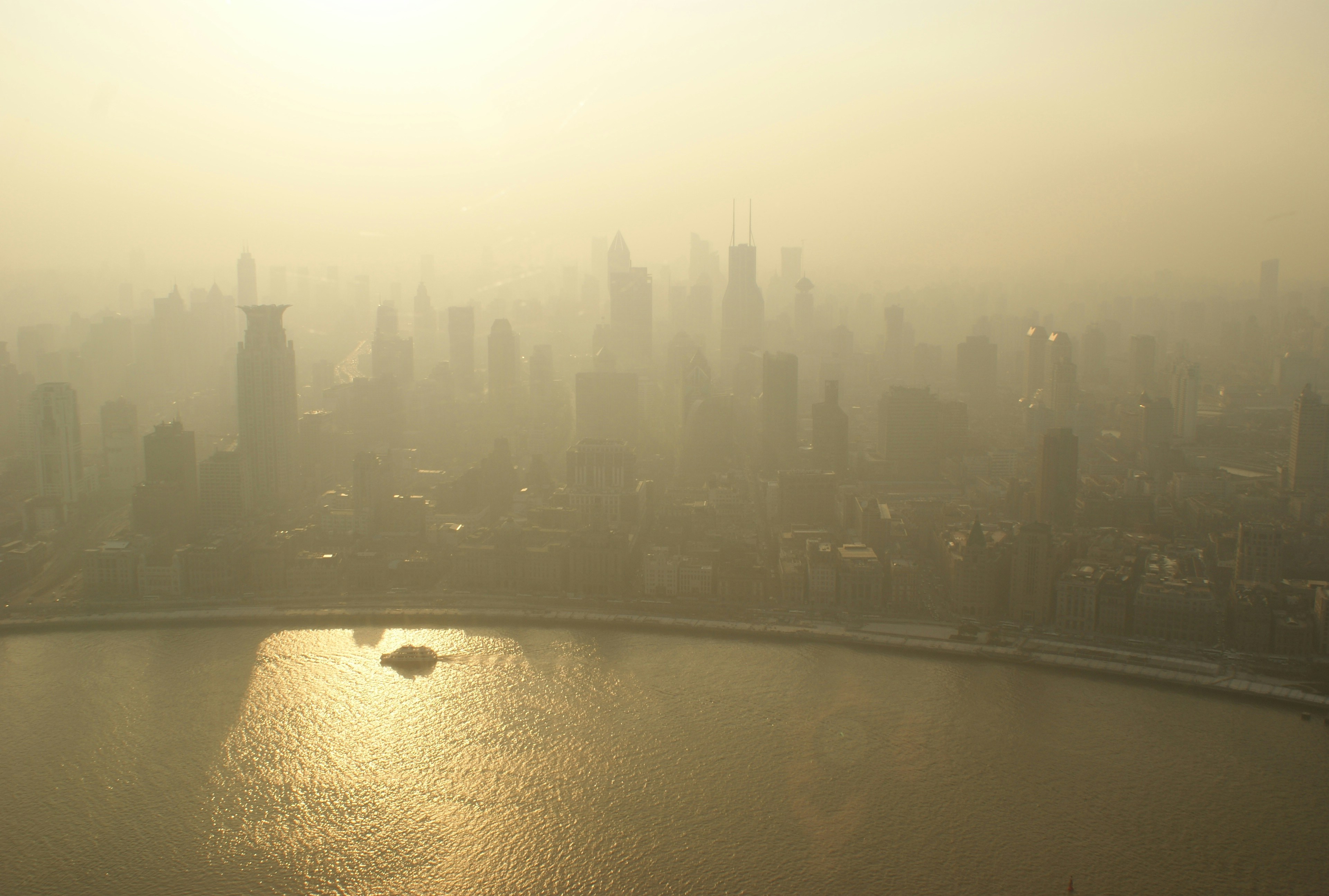
I often find myself doing the scholarly equivalent of doomscrolling. One particularly profitable disaster dive yields the “Asian Brown Cloud,” a 1999 moniker for the haze that climate scientists discovered floating ominously over the vast Indian Ocean. Anglophone newspapers touted the cloud as “menacing,” a sign that increasing pollution from industrializing countries like India and China was crossing a critical threshold. The environment, it seemed, was keeping score. Strangely, even perversely, I read these panicked reports with nostalgia, not fear. Haze was so ubiquitous in my memories of the South Asian winter that it brought me back home. As I parsed scientific accounts of cloud chemistry that played out on the planetary scale of earth-systems science, my mind wandered to stories of haze more intimate and playful, not entirely pockmarked with the certainty of disaster.
In what follows, I juxtapose accounts of Indian Ocean haze at the turn of the millennium with my personal encounters with haze growing up in north India. Materializations of haze at different levels––molecular, bodily, atmospheric––are not just occlusions but also portals into the scale-bending relations of humans with their environments. Without letting go of the stark reality of life on a climate-changed planet, often narrated in scientific and political registers, I began to hold space for the fuzziness of haze, its ambivalent relation to the future. Its different valences, I found, were too affectively rich to be collapsed into anything singular. Haze taught me that the opposite of catastrophe doesn’t always have to be unbridled joy. Sometimes, hope takes the form of uncertainty, an insistence that the future is not foregone but still in the making, unfolding hazily in the distance.
Scene 1: Sensing
Indian Ocean haze, composed largely of polluting aerosols like sulfates, nitrates, and soot from biomass burning in South and East Asia, first became legible to climate scientists through a massive field expedition. In 1994, Veerabhadran Ramanathan, an atmospheric chemist at the Scripps Institution of Oceanography in La Jolla, California, was awarded a multimillion-dollar grant to understand the role played by clouds in global warming. Ramanathan set up a Center for Clouds, Chemistry and Climate at Scripps, where he launched an ambitious research program to conduct “airborne and shipbased measurements, global model studies, and analyses of satellite data” to better understand the role aerosols and clouds might play in atmospheric dynamics. These experiments would reveal that conventional atmospheric theories, constructed around data from the Global North with its cooler oceans and atmospheres, were being upended by data from the warmer Global South.
Picture this sensory assemblage at work. Lidar sensors aboard aircrafts shot pulses of ultraviolet or near-infrared lasers at clouds and measured the polarization of photons in the rays reflected back. A mass spectrometer analyzed samples of polluted air in situ. Present in surface stations, a-sea on ships, and aloft in aircrafts, it sucked in billions of polluted air molecules at a time, and heated the trapped aerosols, forcing them to release ions. In this ionic frenzy, the machine was able to discern the differences between heavier and lighter aerosol molecules, giving a real-time picture of the air’s chemical composition. On top of this, orbiting satellites whooshed over the Indian Ocean several times a day, capturing “true color” photographs of clouds to provide perspective on the molecular-scale analyses.
Mere days after the conclusion of the field experiment in March 1999, scientists announced they were “surprised to find that a dense brownish pollution haze extended from the ocean surface to 1-to-3-km altitude. The haze layer covered much of the research area almost constantly during the 6-week intensive experiment.”
***
Sensing haze is a game you play with friends. Gwen and I are going to Sikkim. We’re sitting at the back of a Suzuki Dzire that’s speeding along a circuitous road wrapped around the Indian Himalayas. Soon we’ll cross the Bengal state border and enter south Sikkim via the Chicken’s Neck, a skinny piece of Indian territory sandwiched between Nepal and Bhutan. I’m tired and keep falling in and out of sleep. As we gain elevation, a thick blanket of mist washes over our path. The car slows down, and I lose reception. It’s about to rain, and we’ll barely make it to Gangtok before sunset.
By the time we check into our hotel, it starts to rain, which briefly lifts the veil of haze and gray mountains conjure themselves before us in the fleeting dusk light. We’re ecstatic! I’m relieved that Gwen likes it since it’s their first time here. In the evening, we’re making our way down to a karaoke bar when the light goes out. It’s pitch dark, and we turn on the flashlight on our phones. I catch a brief glimpse of Gwen’s windbreaker in the headlights of cars that whoosh past us. The footpath forks into two, and we take the stairs that snake down the sides of the road. We spot the bar easily. It’s the only house on this street lit by a neon sign, which radiates a ghostly glow. Inside, I take my jacket off, and it feels damp to the touch. We’d been wading through the haze.
The next morning, I’m at the Ramka Monastery, ensconced by towering deodar trees on all sides. It’s 9 a.m., and I seem to be the only person here. I get distracted on my way to the main temple by a rainbow-colored barbet, which flies off into a cloud of mist when I try to take a photo. The air is sweet with the smell of cedar and gum trees. I check the air quality on my phone, and for the first time in a while, it’s “Good.” Knowing this metric reframes my sense of the air. What had earlier felt like abundant, ambient air now feels like a precious resource.
On our flight back to Lucknow, Gwen and I look out the window to see Mount Everest and Kangchenjunga, which had been impossible in Sikkim because of hazy conditions. I notice, as always, the air changes color as our plane exits the Himalayan foothills and enters the northern plains. It’s morning, and the brown clouds make it difficult to catch sight of land. Somewhere below this haze is my grandpa taking the metro home and my mom driving to the airport to pick us up once we land.
Scene 2: Accretion
Haze accretes. It gathers and falls apart slowly, laboriously, precariously. Unlike air, the symbol for a weightless substance that can flow unimpeded, haze is more freighted, it has greater gravity. The weightlessness of air is one of the reasons why, as the feminist philosopher Luce Irigaray observes, air is “always there, it allows itself to be forgotten.” But haze is not weightless. On an elemental level, haze and haziness are the results of small particles accreting close together. All fog is a type of haze, but not all haze is fog. This ontological haziness sparked much debate among atmospheric chemists studying the “Asian brown cloud” over the Indian Ocean.
In their 2002 report to the United Nations, scientists noted that the brown color of the “cloud” resulted from the high content of black carbon. Given black carbon’s origins in relatively inefficient modes of producing energy by burning coal in many parts of South Asia, observers in the West viewed it as a regional phenomenon. One observer concluded, “Developing nations in Asia, Africa and South America are beginning to contribute in major ways to the aerosol problem, particularly [black carbon] from inefficient combustion technology and biomass burning.”
A group of Indian meteorologists, however, objected to the nomenclature of the “Asian brown cloud.” To them, its Asian-ness lent a false sense of regionalism to what was really a global problem. If anything,” they added, “aerosols like black carbon would probably have less of an impact on the global climate than greenhouse gases, which stay in the atmosphere for a much longer period of time but produce hazy clouds of a much lighter color. More, they objected that “clouds may have been used to suggest that it is much denser than a haze … to give an impression of the Asian region choking under a thick and permanent blanket of dirty atmosphere.” A lot was at stake in the hazy materiality of atmospheric haze.
***
I call my mom to ask about haze and struggle to find a word for it. In Hindi/Urdu, fog is dhundh and smoke is dhua and dust is dhul. All stem from the Proto-Indo-European root “dheu,” which refers equally to mist, vapor, smoke, and fume. Where is haze in this motley crew of words? It is evanescent, defying language’s efforts to pin it down in some kind of a one-to-one correspondence with some physical phenomenon out there. The word exceeds the world. I try to trace the etymology of “haze” and it stops in the sixteenth century. One unnamed linguist thinks the English came up with the word to distinguish between the different kinds of mists and fogs, what they call “an effect of the English climate on the English language.”
For my mom, I stick to dhundhlapan, a condition of obscuring or translucence that doesn’t commit to any particular meteorological state. Memories can be dhundhli or hazy, as can ink on paper. She tells me things are better now, the air feels less “stuffy” because she is away from Lucknow, the state capital. She used to work in a government hospital where she saw patients six days a week for over twenty years, and now, two years before she will retire, she has been moved to a clinic in the countryside.
It’s easier to breathe here, she tells me. A lot more open space, greenery, and fewer cars. In Lucknow, the air feels suffocating. The air—considered to be the most ethereal and fluid of the elements—is turning graver, heavier. It sticks and stays, especially in the winters where due to a phenomenon known as thermal inversion, cooler polluted air “sinks” into the plains of northern India, as opposed to making its way to the ocean.
My mom likes it there because she likes the water. She wakes up at the crack of dawn and heads to the ghats, steps that descend to the river. The banks are enveloped in a haze of mist and incense, which reminds her of her childhood days hopping and skipping around these parts with her cousins. It’s a good kind of haze, one that blurs the difference between past and present, here and there. She’ll drive back to Lucknow in the evening, from where she will call to tell me about this early morning haze, and I will struggle to find a word for it.
Scene 3: Memory
Haze over the Indian Ocean, made of discard and remnants of fires on Earth, was not like other weather phenomena. It was not brief, a blip in the earth system, but haze that persisted for so long that it had forged a history for/of itself. Talk of haze drew my attention to this notion of memory, of a planet on which human beings are leaving inscriptions of their lives and actions. As the literary-studies scholar Melody Jue puts it, the planet in the Anthropocene is becoming a form of media, a kind of record-keeping device that is being encoded with the footprint of human actions.
Of course, this shift in the way one might think of pristine oceans and seas did not start with the Indian Ocean haze. Rachel Carson, in her magisterial The Sea Around Us, similarly noted that nuclear waste was registering an imprint on the vast oceans: “Although man’s record as a steward of the natural resources of the earth has been a discouraging one, there has been a certain comfort in the belief that the sea, at least, was inviolate, beyond man’s ability to change and to despoil. But this belief unfortunately has proved to be naïve.”
The sea, and the planet by extension, were thought to be so immense and so distanced from the control of human beings that they have stood in for the figure of the “sublime” in Western cultural history, what Immanuel Kant referred to as an enormity and greatness that defies all human efforts to contain and fully apprehend. However, waste, toxins, discards, and junk—the anthropogenic constituents of haze—have upset this notion. The majesty of oceans seems tarnished by the discovery of persistent grime and muck, underscoring the slime that hides within the sublime.
***
My memories of haze are in flux. This is the first time I have been home in over a year. It’s winter, and we wear sweaters indoor. In the evening, the decision is made to bring out the angithi, a brazier with red- and white-hot coal. Warmth and smoke fill the house, and I recall an orange glow on my grandma’s face. I will remember this moment and her whenever I look at her photo I took that day. At night, we wear cozy cotswool pajamas and go to bed with a hot water bottle.
My body wakes me up at around two in the morning. I’ve been sneezing nonstop, first in my dream, and then, I realize, in real life. My throat is on fire and my eyes sore from constant rubbing. I’m confused and spend a long time feeling in a daze/haze awake against my will. I spend hours of the night looking out from my window onto the smog-filled streets where street dogs commune under a thick blanket of haze.
I do some research and recommend that we buy an air purifier for the house. We buy two. It’s a clunky machine that flashes colors to indicate ambient air quality: green for good, yellow for moderate, and red for poor. We turn it on, and it consistently shines a red light, which we find amusing. We laugh about how the poor machine might be under stress from all this filtering and wonder if we should turn it off and give it a break. Sometimes, when the purifier has been on for several hours and the door to the room is closed to prevent bad air from coming in, the light switches ever so briefly to yellow and then quickly back to red. Whoever catches this little machinic sigh of relief has a good laugh.
Years later, while walking past a lot with trash ablaze, the acrid smoke wafts over and plunges me in the throes of homesickness for the northern Indian winter. A winter when my mom and I would joke about how many tissues I use for my sneezing fit, when a walk in the park in the evening would be freighted with the thrill of breathing too much of the outside air, when I would wake up hours before sunrise and spend some time lying in my bed, exhausted, but enamored with the way the silver haze glimmered in the moonlight.
Amitav Ghosh in Munich: Inspirations, Insights, and Storytelling
In the fall of 2024, Amitav Ghosh visited the Rachel Carson Center for Environment and Society as part of the project “One Book—Many Worlds: Munich Reads Gun Island by Amitav Ghosh.” This exhibition emerges from the multifaceted discussion of climate change and its challenges conducted in the “One Book—Many Worlds” project and grapples with the question of the role of literary fiction in interdisciplinary academic exchange and climate communication beyond academia. Taking Amitav Ghosh’s recent writings on the global climate crisis, in particular the novel Gun Island, as a vantage point, the chapters in this exhibition engage with various aspects Gun Island from different disciplinary perspectives, drawing on storylines and narrative elements that allow a multifocal engagement with different social and ecological repercussions of climate change. Additionally, pieces from the spring 2025 taumelnd trauen, verschlungen bleiben student exhibition and winning and honorable mentions from the 2025 “Tell the Untold!” writing competition take the provocation to think creatively about the past and future of our environment and world further. Thereby, the exhibition chapters create a web of diverse thoughts on and readings of the role of storytelling for the contemporary interlinked social and environmental crises from a number of perspectives.
About This ExhibitionAbout the author