How to Reimagine Our Doomed Futures Through Ursula K. Le Guin’s Lens: A Case Study in the Argentinian Wetlands
A Case Study in the Argentinian Wetlands
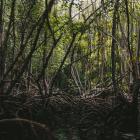
I visited my hometown Buenos Aires in December last year for a little break from the dark German winter. Summers in the Argentinian capital are typically hot and humid, with an occasional mosquito invasion here and an occasional torrential storm there. The Río Luján, which runs alongside the northern suburbs of the city, is home to many native plant and animal species—and also witness to social segregation and land dispute. The riverbank—composed of a mosaic of islands and wetlands—has endured decades of pollution and environmental degradation. During the 1990s, real-estate developments boomed and gated communities began to spread across these ecosystems. Nordelta is currently home to around 45,000 residents who live in more than 24 different gated communities. These private enclaves emerged as a “lifestyle choice” for middle- to upper-class families and quickly evolved into their own independent territories, blocking the outside world through concrete walls, wire, and high-definition surveillance cameras. These highly exclusive gardens of Eden flourish among pristine water bodies, palm trees, and even extensive golf fields and tennis courts.
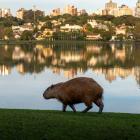
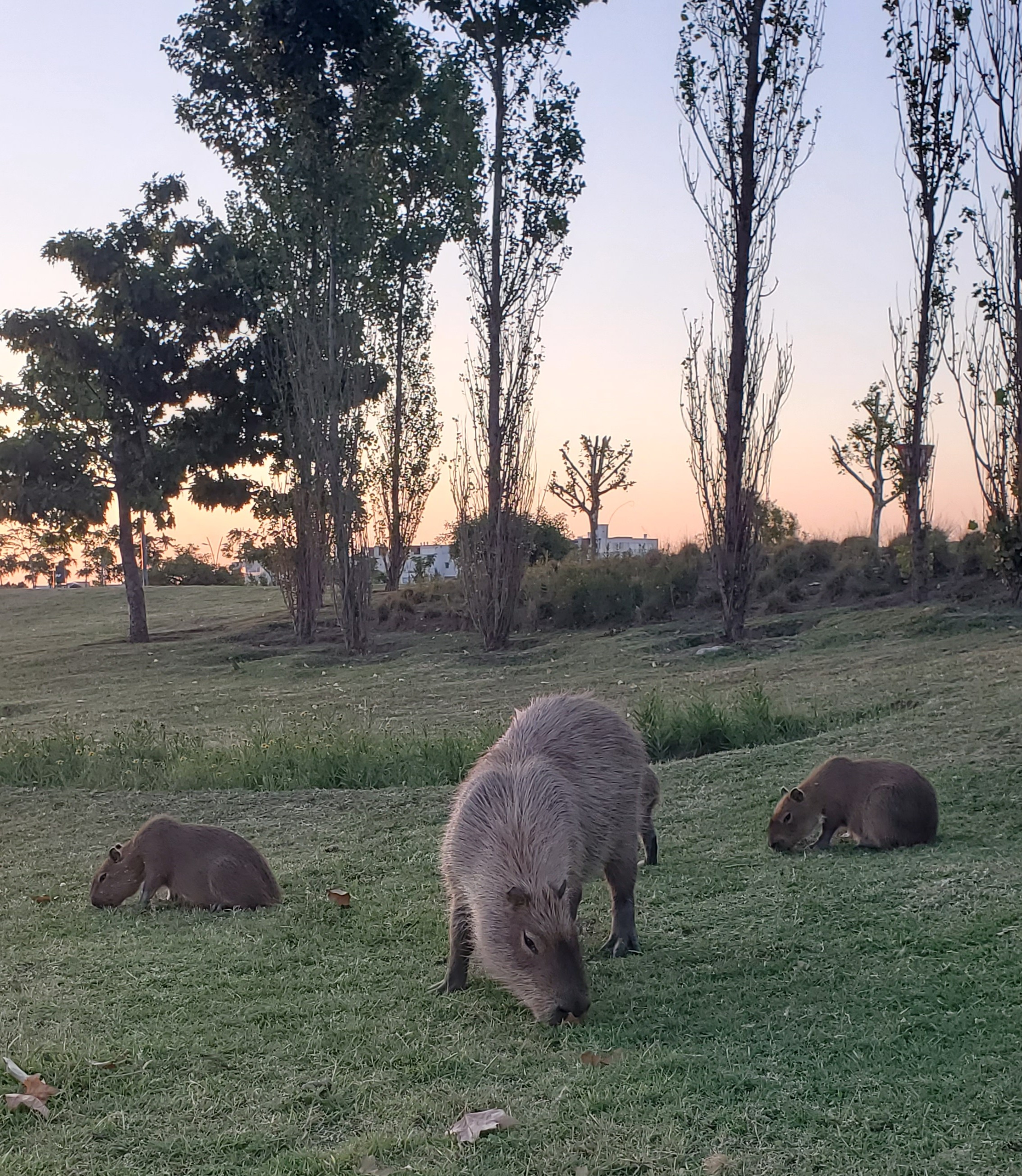
One hot afternoon, I ended up having dinner in one of these gated communities. It was, of course, not my idea, and I felt reluctant to show my ID at the security gate—as if I had to prove my right to be there. Sure, the restaurant had a beautiful panoramic view, facing a pond surrounded by riparian vegetation and ducks gliding across the water. Here, one could easily forget the chaos of a city that holds 35 percent of the country’s population and is known for being the noisiest in Latin America. We left the place at dusk and right after stumbled upon a whole family of capybaras foraging plants. I was amazed—it was my first time seeing them—yet they completely ignored us and continued their quiet march in search of food. On the way back, the conversation shifted into a paranoid tone—how the capybaras were destroying houses (they weren’t), attacking dogs (they weren’t), and even causing occasional traffic jams (they might). In short, a capybara invasion!
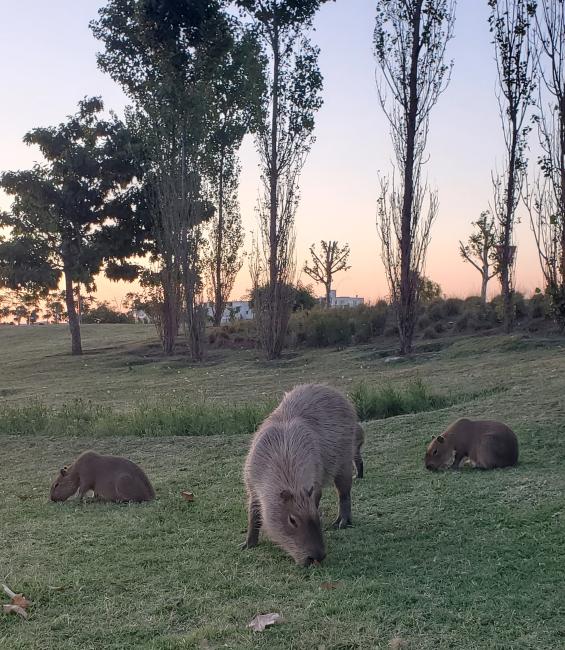
But can one really invade their own territory? Capybaras—locally known as carpinchos—are herbivores native to South American wetlands. Amidst a very strict lockdown in 2020, neighbors in Nordelta started noticing the presence of groups of capybaras sleeping in the shade under the trees or taking a refreshing bath in their sterile swimming pools. Taking advantage of these deserted open spaces, the rodents—defiers of private property—skipped any possible security control and found themselves in an idyllic scenario: abundant vegetation, clean lakes, and streams. Though regarded by some residents as a menace and feared as invaders, these animals were in fact returning to a land they had been pushed out of decades earlier. What appeared to be an “invasion” was a quiet act of reclamation.
On my way home, I tried to imagine what this landscape might have looked like decades ago. I pictured groups of hungry capybaras resting peacefully on some of the most expensive square meters in the country, completely oblivious to wealth hierarchies (just beyond the walls live many low-income families who suffer frequent flooding). I thought about how these mighty rodents have become a modern internet icon—either as a threat, a viral meme, or cute stuffed animals. But do people really know the story of this river basin? What happened to the other species that lived here 30 years ago? Have they gone extinct? Have they been displaced? I thought of all this too when I first read Ursula K. Le Guin’s novel The Dispossessed.
Published in 1974, the novel follows Shevek, an ambitious physicist from the moon Anarres, an isolated anarchist society that broke away two hundred years ago from the capitalist planet Urras. Despite Anarres’ ideals of equality and communal living, Shevek experiences a sense of resignation amid social conformity and cultural stagnation. Driven by the desire to complete his revolutionary theory of time, he travels to Urras, hoping to collaborate with other scientists and reunite the two planets, which have been divided by centuries of hatred and distrust. Although at first he is astonished by Urras’ exuberant nature and prosperity, he soon witnesses economic marginalization, gender inequality, and political oppression masked by consumerism and ostentation.
Le Guin explores the contrast between these two antagonistic planets with remarkable depth. Inspired by natural scientist and anarchist thinker Peter Kropotkin—mainly his field observations on cooperation and altruism in animal behavior—she presents Anarres as what would seem at first glance an ideal egalitarian society: one with no government nor economic exploitation, where “no law but the single principle of mutual aid between individuals” prevails. Yet Anarres is also portrayed as a planet facing severe drought, where all trees and animals have long since perished and only “dull and dreary towns” remain. In such a dust-like setting, individuals are expected to abandon personal ambitions in favor of solution-oriented labor aimed at ensuring collective survival.
Oppressed by an overly pragmatic social organism that dismisses his pursuit of new ideas, Shevek escapes Anarres for the capitalist planet Urras. There, he encounters forests, valleys, birds, farmlands, lakes, and fragrant, mild air. He also finds a highly stratified society with “splendid machines of bizarre elegance,” automated factories, and interstellar spaceships. Nevertheless, behind this facade of opulence, he soon unveils marginalization: the unemployed, the beggars, those whose “hostile stare of weariness” reveals systemic neglect. Shevek realizes, with disillusionment, that to be a scientist on Urras is to “serve not society, not mankind, not the truth but the State.” Rejected by his own anarchist society and afraid that the completed time theory could be weaponized by Urras, he ultimately decides to share his revolutionary work with all planets—becoming, in a sense, some sort of Robin Hood of knowledge.
Le Guin invents new forms of humanity that are strange yet familiar. In her essay The Carrier Bag of Theory of Fiction, published in 1988, she invites us to question the dominant structures of narrative, which are often linear and conflict driven. Instead, she develops “carrier bag” stories that hold and collect voices and experiences rather than conquer, that focus on the complexity of interrelations rather than isolated individuals. Science fiction becomes her experimental lab where she dismantles the complexity of human morality, escaping the binarism of (unquestioned) good and (unexamined) evil. In Le Guin’s books, one rarely finds heroes or battles. Instead, the reader is invited to follow conflicted, idealistic characters as they confront injustice, betrayal, and disappointment. Le Guin examines failure as an inevitable condition of the human existence and how people learn to live in these dark places—the shadows of our rational culture of success. In doing so, she challenges us to rethink storytelling, uncovering the narrative appropriations that have long shaped our expectations of what a story should be:
One relationship among elements in the novel may well be that of conflict, but the reduction of narrative to conflict is absurd. Conflict, competition, stress, struggle, etc., within the narrative conceived as carrier bag/belly/box/house/medicine bundle, may be seen as necessary elements of a whole which itself cannot be characterized either as conflict or as a harmony, since its purpose is neither resolution nor stasis but continuing process.
Storytelling has always existed in the history of humankind, either as myths, folktales, jokes, or novels. Science fiction, especially in the form of dystopias, often portrays scenarios sunk in despair—planets invaded by evil forces, threatened by autonomous machines, or dominated by a high-tech central power with a passive periphery of citizens. But Le Guin’s style challenges this apocalyptic view—her work delves into the erosion of technology, her imaginary worlds thrive in these errors and glitches. Le Guin’s stories are like roots breaking through the cracks of abandoned walls, unveiling the impermanent nature of what seems to be indestructible concrete structures of segregation. She says she writes science fiction but insists that “science fiction is not about the future”: Fiction is not a tool for prediction, but rather a form of methodical observation and introspection—a pathway into complex psychological and social realities.
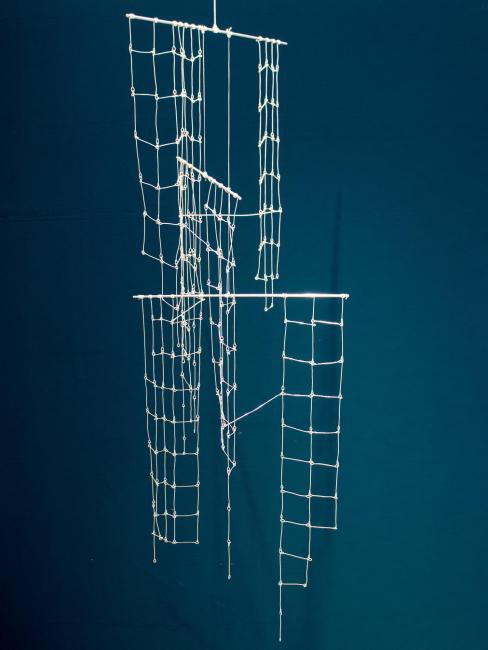
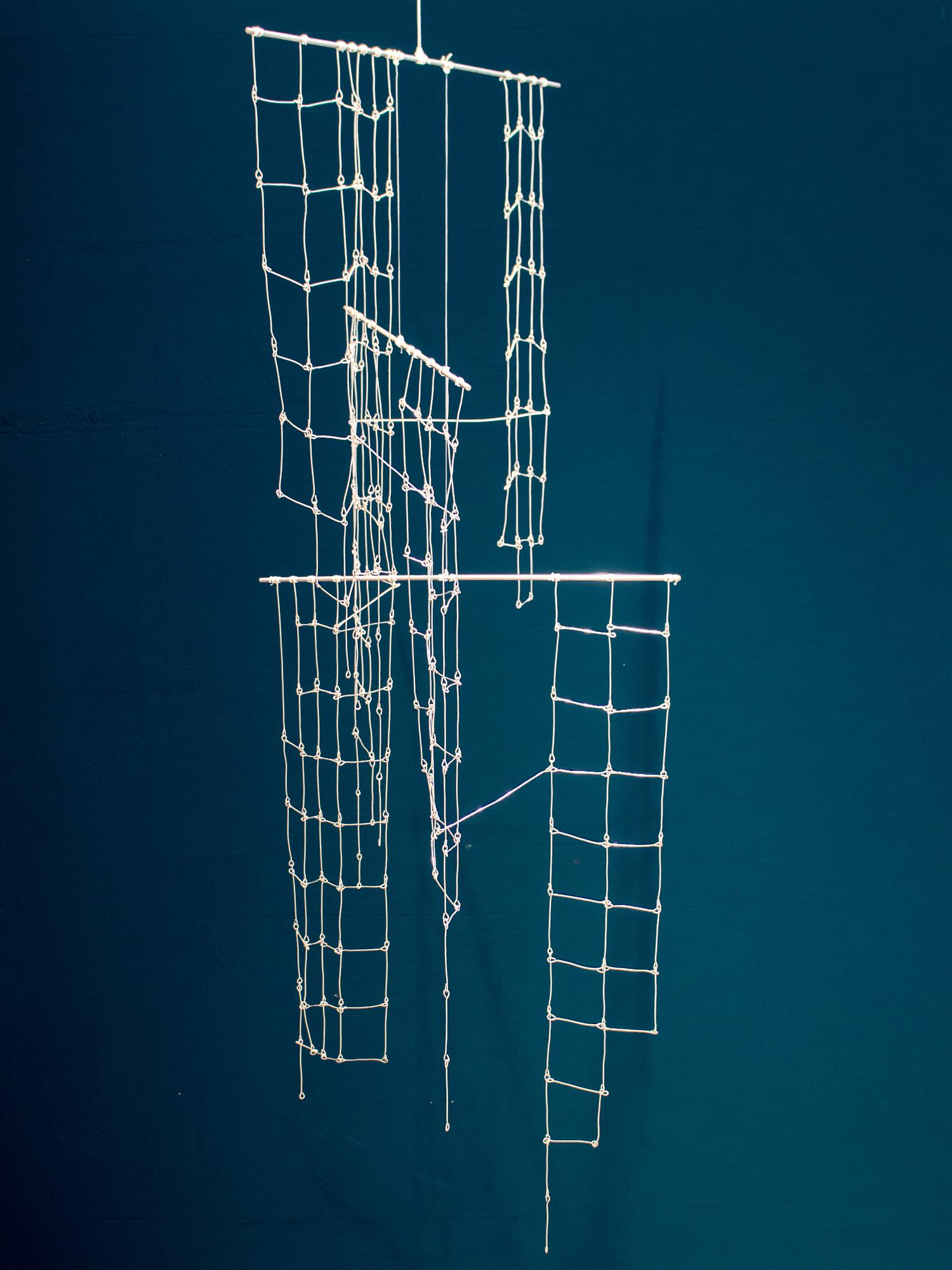
Namika Hamahashi, Weighing up to Grasp,
2025, wire.
Imagination of the future that casts light to the present or blurs our sense of standing on the terrain at this very moment. Precarity, chaos, and confusions that remain after finding a balance. The act of scaling. Floating around to carry on.
Namika Hamahashi, Weighing up to Grasp,
2025, wire.
Imagination of the future that casts light to the present or blurs our sense of standing on the terrain at this very moment. Precarity, chaos, and confusions that remain after finding a balance. The act of scaling. Floating around to carry on.
Artwork © Namika Hamahashi. All rights reserved. Photo © Malte Sattig. Used by permission.
The copyright holder reserves, or holds for their own use, all the rights provided by copyright law, such as distribution, performance, and creation of derivative works.
This tension between utopia and domination becomes visible in the return of the capybaras, the dispossessed of the wetlands. The local government is approaching this “outbreak” in the most Anarresti, utilitarian way: In response to the growing population of these giant rodents—which has tripled in recent years—the Nordelta Neighborhood Association recently launched a contraceptive vaccination program to sterilize 250 adult capybaras. However, this mechanistic approach may be overlooking underlying questions: Why did the capybaras leave in the first place? What exactly are these gated communities trying to exclude? Some residents have opposed these widely approved control measures: They have protested in the streets, taken legal action against developers, and gathered signatures for an online petition to protect capybaras. Such contradictions gradually emerge as the dominant narrative breaks down. It is through these fractures that we are compelled to reflect on how we can tell stories that not only reexamine our present, but also shape more just and possible futures. As Le Guin taught us, we must keep telling the “other story, the untold one, the life story.”
The future is dark, but aren’t these knowledge gaps like refuges—starting points for venturing into the unknown? According to nonequilibrium ecology and resilience theory, disturbances can create opportunities for some species to thrive. These frameworks have transformed ecology by challenging the traditional assumptions of stability and linear successional dynamics. The massive urbanization of the Argentinian wetlands led to significant habitat loss and fragmentation, displacing many native species of birds, mammals, and fish. And yet, it is this very disruption that decades later created the perfect niche for capybaras—absence of predators and availability of food. There is no such thing in nature as perfect equilibrium. Ecological systems are dynamic—and so are we. Fiction allows us to explore these niches and develop new patterns of cooperation. It is highly unlikely—if not impossible—to return to a predisturbance scenario. But, in line with Le Guin’s vision, ecological resilience has proven that many alternative stable systems are possible by embracing uncertainty and ongoing change.
“It Is Strange Realism, But It Is a Strange Reality”
Those like me who were born in the 90s have witnessed many doomsday-like events in our short lifespan that not even the most dystopian authors could have imagined: a global financial crisis, a pandemic costing the lives of millions, surveillance states powered by algorithms, and genocides broadcast live on social media. It is indeed a strange reality! No one could have predicted that in March 2020 we would find ourselves alienated in our homes, drowning in paranoia and fearing an invisible virus—allegedly originating from a bat—while at the same time being monitored to ensure that everyone quarantined. Can you imagine how strange it must have been for the residents of these controlled environments of Nordelta, locked in their fancy two-story homes, to look out the window and see a herd of capybaras walking undisturbed through their neat gardens?
In The Dispossessed, Shevek returns to the planet his people abandoned centuries earlier in self exile, seeking to “unbuild walls.” His journey is a search for understanding and cooperation with the people of Urras, the “propertarians,” the Otherness. Similarly, although not self-exiled but forcibly evicted by bulldozers, capybaras have returned after decades to reinhabit their land. Perhaps this return is an urgent call to find pathways of mutual aid. Collective adaptation is less a solitary struggle for survival than a process of cultivating symbiotic relationships. In times where artificial intelligence expands at an unprecedented pace, sustaining ourselves means reaffirming our role as political agents of empathy and care.
Reframing the future—one that is often presented as inevitable and catastrophic—does not mean rejecting technological development. It does not imply a nostalgic retreat to the past either. The paths to coexistence are many and stories can help us entangle diverse voices and perspectives. In this data-saturated era, where it seems hard to distinguish between reality and fiction, the future becomes an open space (“The future is a metaphor”). Through the creation of galaxies, languages, and creatures, Le Guin reminds us that storytelling is not merely an act of invention but a means of asking what kind of present we inhabit and what kind of worlds we might still create. Fiction invites us to reclaim our—essential yet neglected—capacity for imagination:
Imaginative literature continues to question what heroism is, to examine the roots of power, and to offer moral alternatives. Imagination is the instrument of ethics. There are many metaphors beside battle, many choices besides war, and most ways of doing good do not, in fact, involve killing anybody. Fantasy is good at thinking about those other ways. Could we assume that it does so?
Bibliography
Briske, David D., Andrew W. Illius, and J. Marty Anderies. “Nonequilibrium Ecology and Resilience Theory.” In Rangeland Systems: Processes, Management and Challenges, edited by David D. Briske. Springer, 2017. https://doi.org/10.1007/978-3-319-46709-2.
Kropotkin, Peter. Mutual Aid: A Factor of Evolution. McClure, Phillips & Co., 1902.
Le Guin, Ursula K. The Dispossessed. Harper & Row, 1974.
Le Guin, Ursula K. The Carrier Bag Theory of Fiction. Grove Press, 1988.
Le Guin, Ursula K. “Some Assumptions About Fantasy.” Speech, Children’s Literature Breakfast, BookExpo America, Chicago, IL, 4 June 2004.
Amitav Ghosh in Munich: Inspirations, Insights, and Storytelling
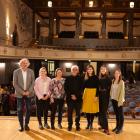
In the fall of 2024, Amitav Ghosh visited the Rachel Carson Center for Environment and Society as part of the project “One Book—Many Worlds: Munich Reads Gun Island by Amitav Ghosh.” This exhibition emerges from the multifaceted discussion of climate change and its challenges conducted in the “One Book—Many Worlds” project and grapples with the question of the role of literary fiction in interdisciplinary academic exchange and climate communication beyond academia. Taking Amitav Ghosh’s recent writings on the global climate crisis, in particular the novel Gun Island, as a vantage point, the chapters in this exhibition engage with various aspects Gun Island from different disciplinary perspectives, drawing on storylines and narrative elements that allow a multifocal engagement with different social and ecological repercussions of climate change. Additionally, pieces from the spring 2025 taumelnd trauen, verschlungen bleiben student exhibition and winning and honorable mentions from the 2025 “Tell the Untold!” writing competition take the provocation to think creatively about the past and future of our environment and world further. Thereby, the exhibition chapters create a web of diverse thoughts on and readings of the role of storytelling for the contemporary interlinked social and environmental crises from a number of perspectives.
About This ExhibitionAbout the author