Time After the Hero—Or, in Proposing the Age of the Anthropoiescene
Anthropo—forming terms relating to humanity or human beings; of multiple origins, borrowing from Latin, anthrōpo, and Greek, anthrōpos, “man; human being,” as opposed to the gods.
Poiesis—from Ancient Greek: ποίησις; the activity in which a person brings something into being that did not exist before. A making. A forming. A creation. A genesis. The process of production; creativity; culture.
Cene—forming adjectives designating epochs and strata of the Tertiary and Quaternary periods, and nouns denoting such epochs.
Anthropoiescene: You are here.
If our species does not survive the ecological crisis, it will probably be due to our failure to imagine and work out new ways to live with the earth, to rework ourselves and our high energy, high consumption, and hyper- instrumental societies adaptively … We will go onwards in a different mode of humanity, or not at all.
—Val Plumwood (2007, 1)
So. Here we are. Faltering on the cusp of extinction. Living in a world profoundly shaped by colonialism, by capitalism, by empire and its disparities (Ghosh 2016, 146). Living in an epoch neither caused nor experienced equally by all humans. A time in which a minor elite has sought success at the expense of Earth’s vitality with calculated and deliberate acts of cultural and environmental aggression (DeMocker and Moore 2021; James 2022, 130), while others are, functionally, barely more than witness to the ecological and sociopolitical violence that such agency has produced (James 2022,130). From 1751 until now, it has been 90 corporations, primarily oil and coal companies, that have produced two-thirds of anthropogenic carbon emissions (Ibid., 130). Research conducted by the Stockholm Environment Institute and Oxfam notes that over the past 20 to 30 years, it has been the richest 10 percent of the world’s population who have been responsible for 52 percent of the cumulative carbon emissions, while the poorest 50 percent of the global population contributed only 7 percent of total emissions. Furthermore, the world’s richest 1 percent alone were responsible for 15 percent of the cumulative carbon emissions (Kartha et al. 2022). Or, to put it differently, the 63 million people who hold the most wealth are responsible for more than double the cumulative emissions than the 3.1 billion people who hold the least wealth. “The two groups that suffer most from this injustice are those least responsible for the climate crisis: poorer and marginalized people already struggling with climate impacts today, and future generations” (Gore et al. 2020).
However, despite the inequity of causal responsibility, this crisis affects us all, and it affects more than just us humans. Life on Earth may continue, but if humans do not continue with it, we will take countless species with us as we go.
… and just like that there were rivers and streams, and the medium-size god smiled, and all the animals clapped. And then the smallest god scattered rocks and boulders around the place and squeezed waterfalls into the rivers and squished up the mud into volcanos, just for fun. You don’t want it to be boring, do you? the smallest god asked, and the animals shrugged and mumbled that boredom was kinda nice too, and definitely easier, but sure, if the smallest god thinks that “fun” is needed, then sure, make things fun. Go ahead. And the biggest god added flowers for a bit of colour and gaiety, and trees all along the land, for climbing and swinging and stuff, and the animals shuffled their feet and nodded, a little bemused perhaps, but no one complained. And when the gods stuck their heads together and muttered under their breath and waved their godly hands around and around and made humans, the animals peered at the humans, and one or two snickered, and the rest circled the humans and sniffed, and all of them quietly questioned the distinct lack of mattering that these humans possessed. They don’t even have flippers for swimming, the frogs commented, and the biggest god said, Sure, but they’ll watch you and learn. They don’t even have feathers for flying, the birds noted, and the medium-sized god said, Yeah, but you know, they’ll make do coz their hands have these opposable thumb thingies—see?—so they’ll figure something out. And the wolves and bears and foxes and rabbits said, But they don’t even have fur to keep them warm! They won’t survive the winter! And the gods looked at each other a little guiltily but didn’t say anything at all. Are you sure we want these in our world? the bees questioned, and the rest of the animals agreed. I mean the forests and the mountains and rocks and all that, okay, we’ll manage, but them? Are you sure they aren’t going to be a problem? And the three gods shook their heads, and, Don’t worry, they said. You guys will get on like a house on fire. There was a pause. And then the ducks said, What’s a house? Oh, it’s a thing that some humans will live in, the biggest god said. Like a nest, or a burrow. Ohhhhh, the animals all said. And what’s fire? the dolphins asked. Oh. That, the medium sized god said. Yeah, that’s a land thing. We probably should have mentioned it before. It’s like a great big hungry greedy burning sun-hot wave that eats wood and, you know,
forestsandanimalsandotherstuffanditburnsitallupsothereisnothingleftbutsm okeandash . . .
What’s that now? the gopher asked. The animals shuffled and cast sideways glances at each other. But, the smallest god added, the rain will stop it getting too big and travelling too far. And when it has gone, new things will be born from the ash. You’ll see. It’s all very Zen. The squirrels fluffed themselves up a little and shrugged. You win some; you lose some; and, Ahhhh, the pigs mumbled, it’s all about Balance. We get it now. Deep. And then the animals thought a little more about what the gods had said. About how humans and animals would get on like … a house on fire. And, Um, the dodo raised his little dodo claw, just checking, he said, in that house and fire scenario, which exactly are we?
Oh yes. We are all in this together, and those of us who are able have a responsibility to protect those populations—both living now and in the future; both human and more-than-human—most vulnerable to its effects.
The responsibility of the human as a collective has evolved as a key attribute to conceptualising the Anthropocene (James 2022, 127), but perhaps it is not so much the results of a human collective worth of damage that should be guiding how we live, but the power of a human collective worth of imagination instead. “Life,” Merlin Sheldrake writes,
is a story of collaboration and interdependence: a shimmering tale of community and interrelation from which we are inseparable, and in which we belong. The social and environmental challenges that swirl together at this complex moment invite us to pay attention to new patterns, connections and relationships. Our imaginations are essential (Sheldrake 2021, 95).
Yes. We are standing on the cusp. Living in the Edge Times. Teetering on the cliff. Things have to change. But the future is still ours to create. “Now” is always liminal. From the first dust of star that grew this little planet, We—and I am using the biggest We I can here, the We of everything that has ever come—have been creating futures. We are made of our ancestors just as we are making those yet to come and the very world that will hold us. And the stories we choose to tell now are vital to our success. “We are at a critical point,” Kathleen Dean Moore says:
We have a very narrow window of opportunity to get it right, and to get it right, we first have to imagine a new world, story by story … stories to describe who we are in relation to the land, to honour what’s been lost, to help us understand our kinships, to affirm what we care about, to explore the difference between right and wrong, moral and immoral (DeMocker and Dean Moore).
And it is this act of deliberate creation, of imagination, of fiercely playful exploration of collaborative idea formation within deep time, that the term Anthropoiescene seeks to invite. Seeks to drip from tongues and lurk in murked pools of mud. Swamplands where the human and not-so-human more-than-human once-may -have-been-human dwell. For the more we are connected to our communities—both here and now, then and there, when and always—the more those systems of power that refuse to acknowledge such connections are revealed as inadequate—their ancestoring called into question.
The Anthropoiescene is a term that acknowledges the mythic task ahead of us and recognises the mythopoetic power of imagination and storytelling as a means of self-understanding, both individually and collectively, insisting on truths beyond populations and data—it is a term born from recognition of collaboration, from stories, from tellings, from noticings, and attendings. The time we are in requires arts of reimagination to transform the imaginaries of culture to ones that embrace collaborative and sympoietic tanglings with the ghosts of deep time, both past and future, both human and more-than-human.
The Anthropoiescene celebrates the re-cognition that when the first human painted the first image onto the rock of a cave, it was the rock of the cave that lured that image into being and promised its survival. It was the animal bones ground into paint that enabled the animal to be brought again into being. The shuddering light that allowed the animal to once again run, and the dark that led the future into hearing the story retold. That image is not the story of the human but the story of the human existing within a more-than-human community of being, and a telling that presupposes the future. A telling given to the future. A telling of the future. A way of being, permeated with the presence of ancestral spirits and the weaving together of the living, the dead, and the not-yet-born into a unified temporal fabric (Bjornerud 2018, 162). The Anthropoiescene demands approaches that offer alter-tales that engender curiosity, that twist and trouble many dominant narratives and understandings. It is a term that above all recognises the vital importance of poiesis—a process of creation, consciously evoked, bringing something into being that did not exist before. A threshold moment when something moves away from its standing as one thing to become another. We are all balanced on the threshold. The only question that remains is, what will we become?
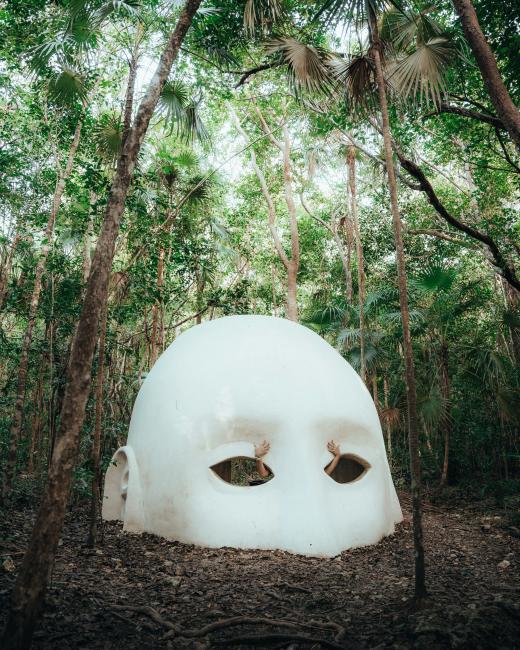
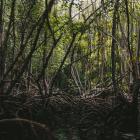
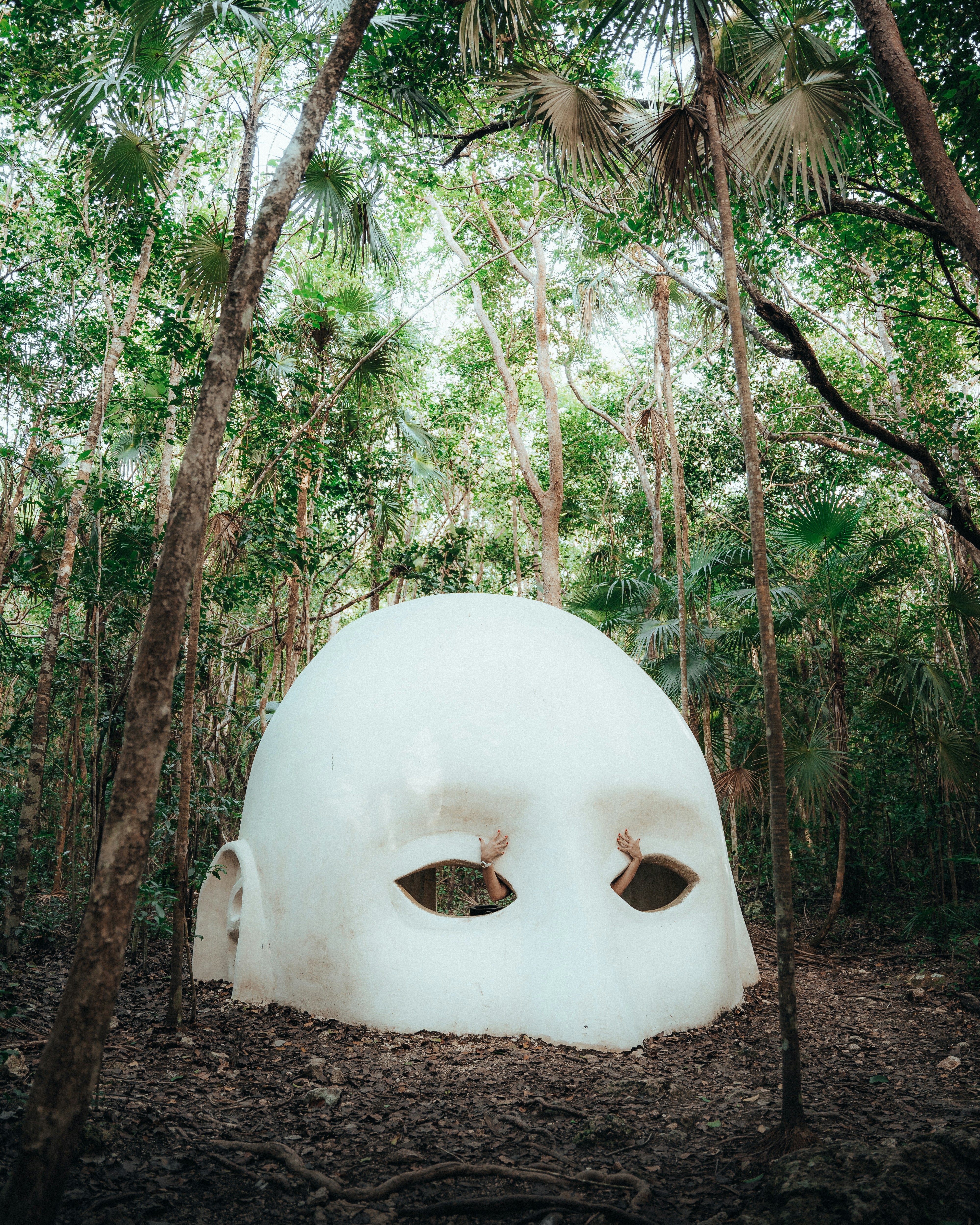
Photo by Chris Turgeon, 2022. Click here to view source.
This work is licensed under the Unsplash License.
The “anthro” is not used here to stress our species exceptionalism but rather to trouble the distinctions and binaries between human histories and those of the natural world by reminding those of us who need reminding of how deeply entangled humans are within the geologic, just as the geologic is utterly knotted through with us.
It is an invitation to see the world, and our place within it, with a deep-time gaze. To relish those more-than-human connections and those hauntings from the pasts, and to see ourselves as delightfully situated in the “space-time-matter of the planet” (Pratt 2017, 171). Living in the Anthropoiescene then becomes a time of intentional and deliberate transformation, of recognising our entangled actantcy in a creation of worlds and futures that honour, reinforce, and celebrate the agency and creativity of the more-than-human world, and the infinite ways of being, of knowing, of living that emerge within an entangled deep-time geologic existence. It is a time of turning towards others, of reaching towards others with a willingness to be changed (Rose 2013, 208). It is a term that seeks to speak to the depth of kin-making entanglements and temporal imagination that swirls pasts, presents, and futures in an entangled multispecies web of cocreation. It is to acknowledge the ruptures that some humans have caused, and to recognise that the world was here long before humans—we are the ones who must adapt, who must actively seek change, vital to the continued survival of many more species than just our own.
This time we are entering is a time of earthly worlding and unworlding (Haraway 2017, 44-45), in which we need to make that which is often invisible visible through our imaginative and creative responses to the voices and ghosts of those that have come before, and to those yet to come. It is a time to scatter germs of ideas so they may take root and grow (Gibson et al. 2015, viii). The Anthropoiescene invites and demands us to cultivate wonder, to be led and bound by our curiosities rather than capitalist notions of progress, by our interconnections and collaborative entanglements rather than false binaries and boundaries. It is a term that calls for uncontainability, for a disruption of commercial privilege, and that activates resistance in a world ruled by economists (Fredengren 2016, 485). It is a way of being that troubles regimes of power, that actively calls for us to attend more consciously to those “submerged perspectives” (Gomez-Barris 2021, 84)—the artistic imaginaries and forms of perception and material practices across a multitude of disciplines that are “organised below the modern colonial order, and that go undetected by the regime of state power” (Ibid.).The whispered voices. The forgotten voices. The absent voices. The dismissed voices. The future voices. The voices that howl and yelp, croak and roar, dance and weave and click and hum and rummmmmmble, because it is in collaborating with those voices that the creation of our futures lies. It is to recognise the forests tumbling into fables, tumbling into politics (Swanson et al. 2017, 10). It is a call to embrace the wild weediness of entangled living that these Edge Times call for. To plant seeds in the humus, detritus, and rot. To not only “stay with the trouble” but to get filthy dirty and play in it. To stomp in it. To dance with it. To tumble-roll in it and dig. To tell it. Sussurussuussuurusssuuussuurrus.
The Anthropoiescene calls for myriad responses and perspectives and provocations and explorations that offer old/new/forgotten/dismissed, and othered ways of ancestoring. Of creating. Of seeing. Of telling. Of knowing. Of being. Of imagining and attuning ourselves to Earth. The Anthropoiescene relishes multiple, contradictory visions of our pasts, and by doing so imagines futures that veer away from one of resource extraction, providing a path—many paths—out of the crisis we are in. For the more adept we become at recognising different pasts, of imagining different types of world, the more comfortable we will become inhabiting those worlds (James 2022, 48). This then is a call not to turn from our responsibilities, but to creatively, playfully, collaboratively delight in them. If narrative precipitates social change (Findlay 2008, 18), then imagining the futures may just be the most important, the most radical act we can do. For “being imagined is the first stage of existence” (Tokarczuk 2019, 23). We may be in times of crisis, but the word crisis is derived from the Greek krisis, meaning decision (Foer 2020, 26). These then are times of deciding. What kind of ancestor are you going to be?
Bibliography
Bjornerud, Marcia. Timefulness: How Thinking Like a Geologist Can Help Save the World. Princeton University Press, 2018. doi:10.2307/j.ctvc772cs.
Findlay, Merrill. “Understanding Place Through Narrative.” In Making Sense of Place: Exploring Concepts and Expressions of Place Through Different Senses and Lenses, edited by Frank Vanclay, Matthew Higgins, and Adam Blackshaw. National Museum of Australia Press, 2008.
Fredengren, Christina. “Unexpected Encounters with Deep Time Enchantment. Bog Bodies, Crannogs and ‘Otherworldly’ Sites. The Materializing Powers of Disjunctures in Time.” World Archaeology 48, no. 4 (2016): 482–99. doi:10.1080/00438243.2016.1220327.
Gan, Elaine, Nils Bubandt, Anna Lowenhaupt Tsing, and Heather Anne Swanson. “Introduction: Bodies.” In Arts of Living on a Damaged Planet, edited by Anna Lowenhaupt Tsing, Nils Bubandt, Elaine Gan, and Heather Anne Swanson. University of Minnesota Press, 2017.
Ghosh, Amitav. The Great Derangement: Climate Change and the Unthinkable. The University of Chicago Press, 2016. doi:10.7208/chicago/9780226323176.001.0001.
Gibson, Katherine, Deborah Bird Rose, and Ruth Fincher, eds. Manifesto for Living in the Anthropocene. Punctum Books, 2015. doi:10.21983/P3.0100.1.02.
Gomez-Barris, Macarena. “Edge Times: A Decolonial Cuir View.” In 140 Artists’ Ideas for Planet Earth, edited by Hans Ulrich Obrist and Kostas Stasinopoulos. Penguin, 2021.
Gore, Tim, Mira Alestig, and Anna Ratcliff. “Confronting Carbon Inequality: Putting Climate Justice at the Heart of the COVID-19 Recovery.” Oxfam Media Briefing, 21 September 2020. https://oxfamilibrary.openrepository.com/bitstream/handle/10546/621052/mb-confronting-carbon-inequality-210920-en.pdf.
Haraway, Donna. “Symbiogenesis, Sympoiesis.” In Arts of Living on a Damaged Planet, edited by Anna Lowenhaupt Tsing, Nils Bubandt, Elaine Gan, and Heather Anne Swanson. University of Minnesota Press, 2017.
James, Erin. Narrative in the Anthropocene. Ohio State University Press, 2022. doi:10.26818/9780814215074.
Kartha, Sivan, Eric Kemp-Benedict, Emily Ghosh, Anisha Nazareth, and Tim Gore. “The Carbon Inequality Era.” Stockholm Environment Institute and Oxfam, September 2020. https://www.sei.org/wp-content/uploads/2020/09/research-report-carbon-inequality-era.pdf.
Moore, Kathleen Dean. “If Your House Is on Fire: Kathleen Dean Moore on the Moral Urgency of Climate Change, 2021.” Interview by Mary DeMocker. Center for Humans & Nature, 30 December 2019. https://humansandnature.org/if-your-house-is-on-fire-kathleen-dean-moore-on-the-moral-urgency-of-climate-change/.
Plumwood, Val. “A Review of Deborah Bird Rose’s ‘Reports from a Wild Country: Ethics for Decolonisation’.” Australian Humanities Review, no. 42 (2007).
Pratt, Mary Louise. “Coda.” In Arts of Living on a Damaged Planet, edited by Anna Lowenhaupt Tsing, Nils Bubandt, Elaine Gan, and Heather Anne Swanson. University of Minnesota Press, 2017.
Rose, Deborah Bird. “Anthropocene Noir.” Arena Journal 41/42 (2013): 206–19.
Safran Foer, Jonathan. We Are the Weather: Saving the Planet Begins at Breakfast. Penguin, 2020.
Sheldrake, Merlin. “Graph Game.” In 140 Artists’ Ideas for Planet Earth, edited by Hans Ulrich Obrist and Kostas Stasinopoulos. Penguin, 2021.
Tokarczuk, Olga. “The Tender Narrator.” Nobel Prize lecture, 7 December 2019, Swedish Academy. https://www.nobelprize.org/prizes/literature/2018/tokarczuk/lecture/.
Amitav Ghosh in Munich: Inspirations, Insights, and Storytelling
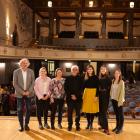
In the fall of 2024, Amitav Ghosh visited the Rachel Carson Center for Environment and Society as part of the project “One Book—Many Worlds: Munich Reads Gun Island by Amitav Ghosh.” This exhibition emerges from the multifaceted discussion of climate change and its challenges conducted in the “One Book—Many Worlds” project and grapples with the question of the role of literary fiction in interdisciplinary academic exchange and climate communication beyond academia. Taking Amitav Ghosh’s recent writings on the global climate crisis, in particular the novel Gun Island, as a vantage point, the chapters in this exhibition engage with various aspects Gun Island from different disciplinary perspectives, drawing on storylines and narrative elements that allow a multifocal engagement with different social and ecological repercussions of climate change. Additionally, pieces from the spring 2025 taumelnd trauen, verschlungen bleiben student exhibition and winning and honorable mentions from the 2025 “Tell the Untold!” writing competition take the provocation to think creatively about the past and future of our environment and world further. Thereby, the exhibition chapters create a web of diverse thoughts on and readings of the role of storytelling for the contemporary interlinked social and environmental crises from a number of perspectives.
About This ExhibitionAbout the author