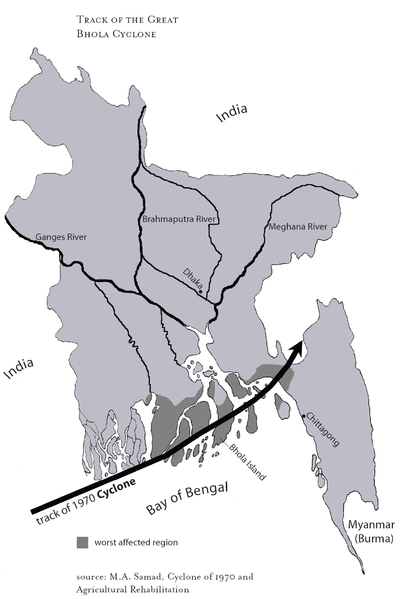
One of the worst disasters ever recorded would hit Bangladesh, then known as East Pakistan, with incredible winds speeding above 50 m/s. The 1970 Bhola Cyclone formed over the Bay of Bengal, where it would intensify into a powerful tropical storm by the morning of 11 November 1970. Due to its low-lying shore, East Pakistan was particularly vulnerable, with coastal towns and cities such as Patuakhali and Chittagong being the worst off. The storm would make landfall upon villagers sleeping by the coastline in the middle of the night on 12 November, and it lead to widespread drowning under the tidal waves and the tragic loss of hundreds of thousands of civilians, marking its place as the deadliest tropical cyclone in human history.
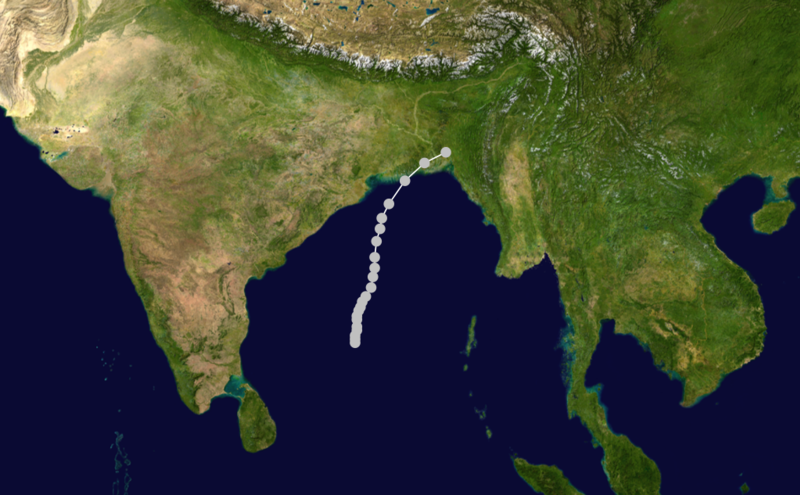
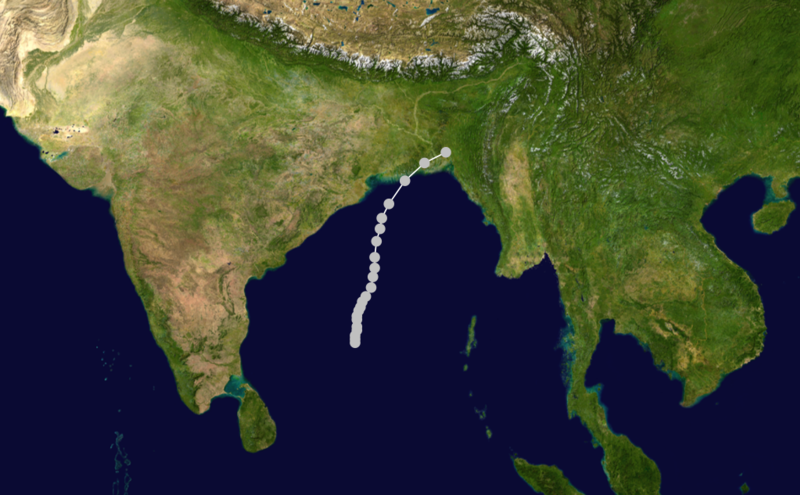
Map tracking the path of the Bhola Cyclone from 7–13 November 1970.
Map tracking the path of the Bhola Cyclone from 7–13 November 1970.
Map by Nilfanion. Click here to view Wikimedia source
 This work is licensed under a Creative Commons Public Domain Mark 1.0 License.
While the region around what is now Bangladesh has had a dire history of recurrent storm surges, the mass devastation brought by the Bhola Cyclone would have long-term political ramifications, as analyzed by historians such as Sravani Biswas and Patrick Daly. Their study demonstrates that poor disaster management by the Pakistani government fueled existing desires for autonomy, worsening relations between the two states and propelling a full-scale movement for independence. After the 1947 partition of India, a newly founded Pakistan gained control of what would become East Pakistan in 1956, despite their being geographically separated by India. Ruled by a Western Pakistani military junta known as the Martial Law Administration (MLA), East Pakistan suffered systematic neglect and exploitation. This escalated following the Bhola Cyclone as the legitimacy of the MLA was questioned amid mass public scrutiny of the organization’s lack of disaster preparedness and its failures in responding. Fundamental flaws in Pakistan’s preexisting Flood Action Plan (FAP), such as misallocating disaster funds and early warnings not reaching coastal residents, worsened the already massive death toll.

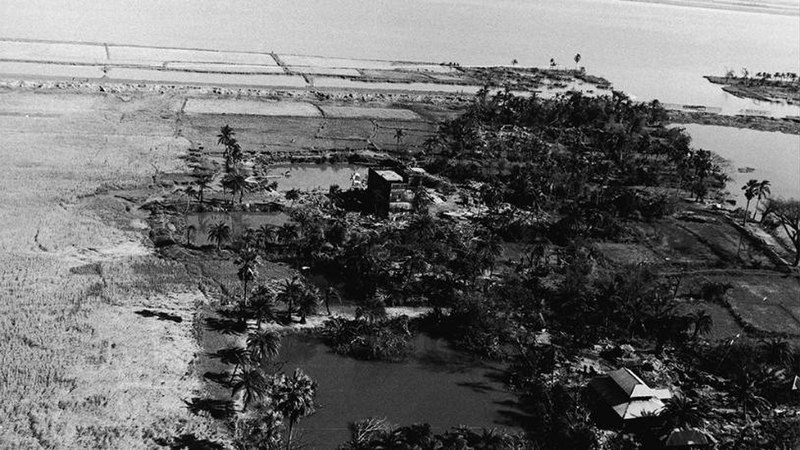
Aerial image of the aftermath of the Bhola Cyclone on the coastal town of Patuakhali.
Aerial image of the aftermath of the Bhola Cyclone on the coastal town of Patuakhali.
Unknown photographer, November 1970.
Click here to view Wikimedia source
This work is licensed under a Creative Commons Public Domain Mark 1.0 License.
The MLA’s response became derided as lax and incompetent due to a seeming lack of urgent coordination in relief efforts. This is supported by analyzing reports by the United States Agency for International Development (USAID), indicating that most aid was not from the Pakistani government but from USAID and other international organizations. Stagnant crisis management and ineffective communication regarding resource allocation, such as boats, hindered Pakistan’s cooperation with international relief operations during the early aftermath of the disaster. Tensions were also aggravated by the East Pakistani Government’s disaster messaging, with officials like Governor Syed Mohammad Ahsan attempting to minimize the scope of the disaster by initially claiming a death toll as low as 16,000, starkly contrasting later estimates by US officials of upwards of 300,000 or more.
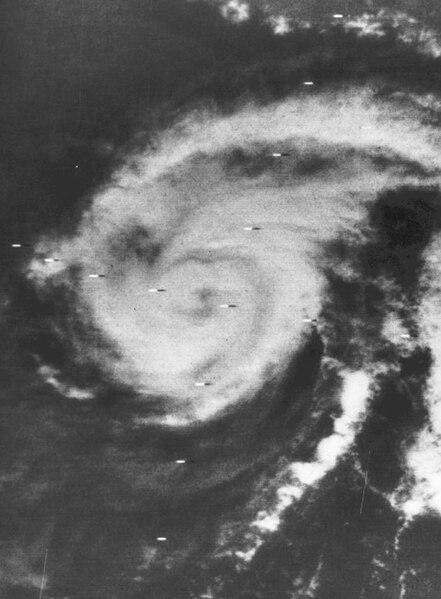
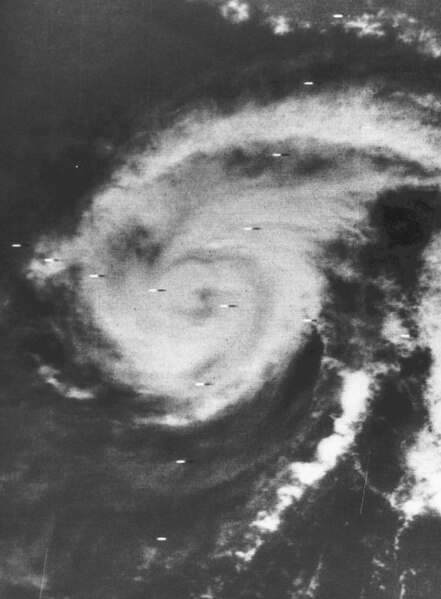
Satellite imagery of the Bhola Cyclone approaching East Pakistan on 12 November 1970.
Satellite imagery of the Bhola Cyclone approaching East Pakistan on 12 November 1970.
IDCS imagery from NASA’s Nimbus 4 Satellite. Click here to view source.
This work is licensed under a Creative Commons Public Domain Mark 1.0 License.
The resultant public outcry is why it was of little surprise when the Awami League, which framed the victims of the cyclone as martyrs for the cause of nationalism and sovereignty from Pakistan, won the 1970 election with a supermajority. The political fallout allowed figures such as Maulana Bhasani (1880–1976) to capitalize on public anger, who highlighted the MLA’s suppression of information surrounding impacted areas and the extent of the cyclone, for example, and frame the disaster as evidence of the need for East Pakistan’s autonomy, While the public was largely swayed, however, this led to a bloody civil war, complicating relief efforts by USAID and culminating in the region’s reestablishment as the independent nation of Bangladesh. While the storm did not single-handedly alter Bangladesh’s political trajectory, it underscored the disparities between both regions and eroded any remaining goodwill in the MLA and Pakistan. The disaster highlighted the central government’s failings and provided a rallying cry for independence.
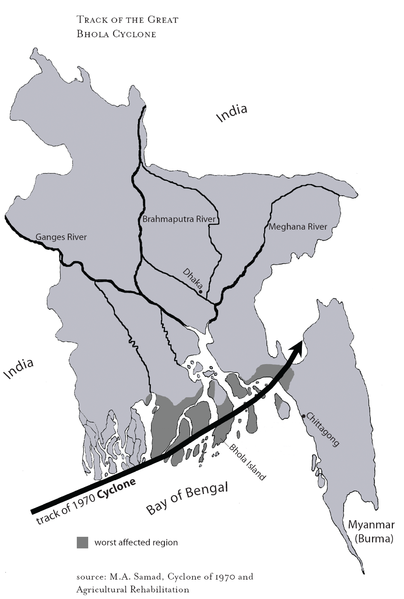
Map highlighting areas in East Pakistan most impacted.
Map highlighting areas in East Pakistan most impacted.
Map by BenjaminREilly, 15 February 2009.
Click here to view Wikimedia source
 This work is licensed under a Creative Commons Attribution-ShareAlike 3.0 Unported License.
In the aftermath, the newly formed government of Bangladesh took steps to improve responsiveness to future disasters. Following the 1970 disaster, the Cyclone Preparedness Programme (CPP) was introduced as a volunteer disaster risk agency tasked with addressing disaster preparedness and management needs at the local level, with over 76,000 volunteers spread across thousands of villages. The success of the CPP is in its emphasis on community-based volunteer work, promoting gender equality, and the free communication of emergency information. Because the country is under constant threat from flooding and storms, there has been a push for stronger disaster infrastructure. This led to innovations like shelters being able to remain semi-submerged while containing hundreds of occupants, reflecting the cultural influence of cyclonic disasters.
The trauma of the Bhola Cyclone and subsequent Bangladesh Liberation War has left lasting scars. Urban areas saw waves of migration, as environmental issues such as rising sea levels, erosion, and natural disasters drove many from rural coastal areas in search of economic opportunities. Those seeking a fresh start, however, faced dire conditions as Bengalis moved into overcrowded urban enclaves like the titular Bhola Slum. This has led to issues of systemic poverty and compounding pollution, with these impoverished areas often lacking access to clean water, healthcare, and sanitation, underscoring the persisting vulnerability of those displaced by natural disasters. Surviving families also demonstrated a direct correlation between natural disasters and adverse health and sociological conditions. This is supported by studies such as Shaikh Eskander and Edward Barbier’s research, which has concluded lower life expectancies, along with poorer health, reduced access to education, and lower future incomes. Most affected households were impoverished and in rural areas, with these populations, especially children, facing many adversities compared to city dwellers. Overall, the devastation of the cyclone was not merely a meteorological factor but was also exacerbated by societal inequalities and human failings, serving as a tragic lesson that has influenced Bangladesh’s path as a nation.
Primary Sources
- Agency for International Development. “U.S. Disaster Relief to Pakistan Following the
November 1970 Cyclone in East Pakistan.” B-173651. Washington, DC: Comptroller
General of the United States Elmer B. Staats, 1972. https://www.gao.gov/products/b-173651-2 - “World: East Pakistan: The Politics of Catastrophe.” Times Magazine, 7 December 1970. https://time.com/archive/6814842/world-east-pakistan-the-politics-of-catastrophe/
How to cite
Flores, Nestor. “The 1970 Bhola Cyclone and Its Lasting Legacy.” Environment & Society Portal, Arcadia (Spring 2026), no. 12. Rachel Carson Center for Environment and Society. doi:10.5282/rcc/10160.
ISSN 2199-3408
Environment & Society Portal, Arcadia
 This work is licensed under a Creative Commons Attribution 4.0 International License.
2026 Nestor Flores
This refers only to the text and does not include any image rights.
Please click on an image to view its individual rights status.
- Ahmed, Nabil. “Entangled Earth.” Third Text 27, no. 1 (2013): 44–53. https://doi.org/10.1080/09528822.2013.753191
- Biswas, Sravani, and Patrick Daly. “‘Cyclone Not Above Politics’: East Pakistan, Disaster Politics, and the 1970 Bhola Cyclone.” Modern Asian Studies 55, no. 4 (2021): 1382–1410. https://doi.org/10.1017/S0026749X20000293
- Eskander, Shaikh M.S.U, and Edward B Barbier. “Long-Term Impacts of the 1970 Cyclone in Bangladesh.” World Development 152 (2022): 105793. https://doi.org/10.1016/j.worlddev.2021.105793
- Haque, Ahmadul, Dilruba Haider, Muhammad Saidur Rahman, Laila Kabir, and Raul Perez Lejano. “Building Resilience from the Grassroots: The Cyclone Preparedness Programme at 50.” International Journal of Environmental Research and Public Health 19, no. 21 (2022): 14503. https://doi.org/10.3390/ijerph192114503
- McNamara, Karen E, Laura L Olson, and Md. Ashiqur Rahman. “Insecure Hope: The Challenges Faced by Urban Slum Dwellers in Bhola Slum, Bangladesh.” Migration and Development 5, no. 1 (2016): 1–15. https://doi.org/10.1080/21632324.2015.1082231
- Mehmood, Sultan, and Ahmed Mushfiq Mobarak. “Climate Shocks and State Formation: The 1970 Bhola Cyclone and the Birth of Bangladesh.” EGC Discussion Paper 1119, 13 October 2025. https://elischolar.library.yale.edu/egcenter-discussion-paper-series/1119/