In c. 397, the writer Sulpicius Severus (c. 363 – c. 425), who had recently renounced wealth and a successful legal career for an ascetic life, crafted a tale in his Vita Sancti Martini of the holy life and miraculous deeds of a Christian bishop called Martin of Tours (316/336–397). Within it was an influential story of multispecies transformation. Whether it was pure fiction or drew on eye-witness accounts, it was certainly rich with classical literary allusions.
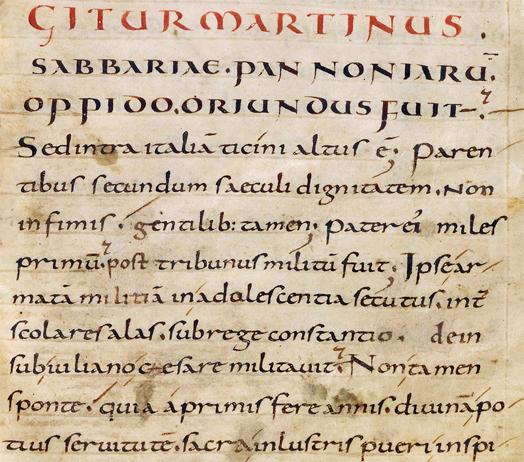
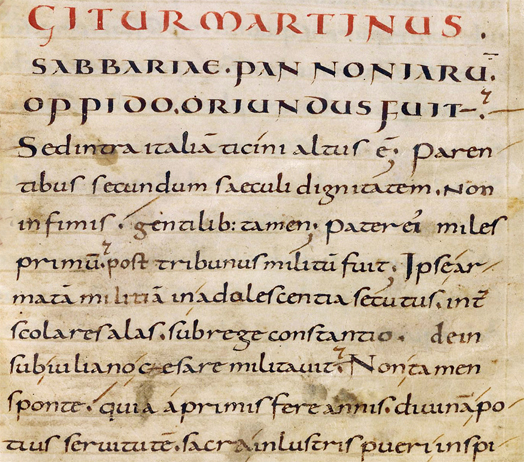
First page of a tenth-century copy of part of Sulpicius Severus’ Vita sancti Martini, in BnF MS. Latin 2854.
First page of a tenth-century copy of part of Sulpicius Severus’ Vita sancti Martini, in BnF MS. Latin 2854.
Unknown manuscript writer, eighth century.
Click here to view Wikimedia source.
 This work is licensed under a Creative Commons Public Domain Mark 1.0 License.
A few decades earlier, Sulpicius related, somewhere in Gaul—today’s France—a tall pine tree stood near an ancient village shrine. The tree mattered to the villagers. But times were changing. One day Martin arrived, accompanied by a group of monks. He was travelling around the region to put an end to local devotional practices that revered places and non-human life forms. As he wrecked the shrine, the people watched in silence. But when he turned his attention to the tree, they couldn’t bear the felling of the pine. The bishop took pains to impress on them that there was nothing to revere in a chunk of wood and that they should obey the superior god that he served. The tree, he said, had to be cut down because it was dedicated to a demon.
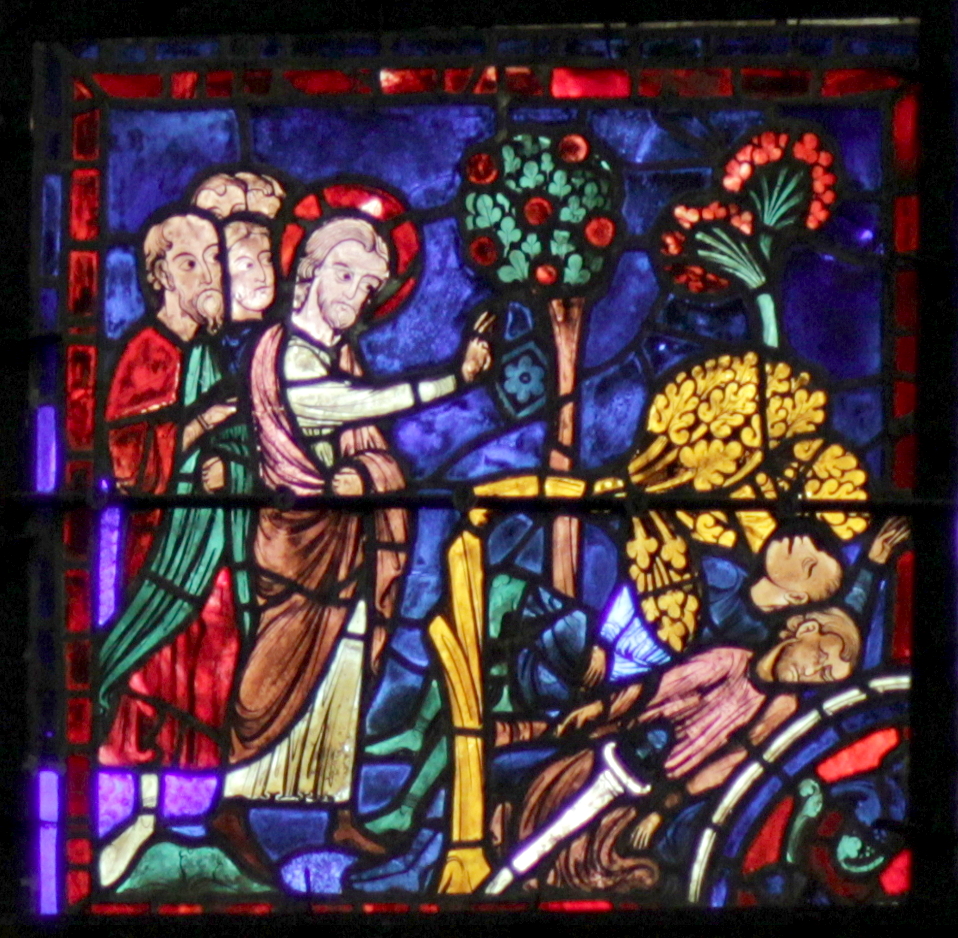
A strange bargain was struck. Everyone could see that the pine was leaning to one side, making the direction in which it would fall quite certain. The people agreed to cut down the tree themselves on the condition that the bishop be tied up where it would crash down and crush him. The bishop, confident in his god, agreed and was bound. The axes sounded on the trunk and the tree began to topple towards the bishop.
At this moment, he made the sign of the cross with his hand.
The tree suddenly spun like a whirlwind and crashed down in the opposite direction, nearly landing on some of the local people. A great wailing clamour rose: the name of Christ was proclaimed by all present. Amid the pine’s broken branches, everyone begged for baptism. “And on that day,” concluded Sulpicius, “salvation came to that region.” Though Sulpicius’ subject was Martin’s holy power, it operated by acting on an existing multispecies relationship. The tree’s violent reversal made possible the sharp turn in belief of the people.
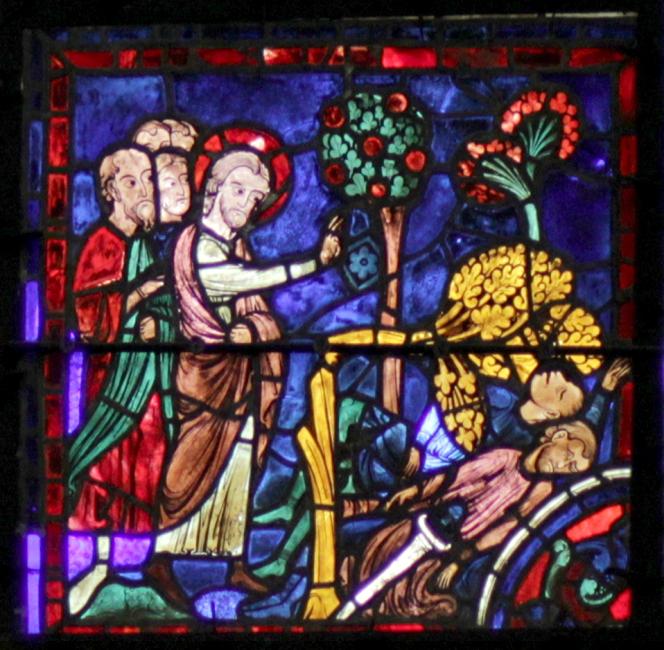
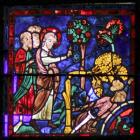
Stained glass panel showing the tree falling on local people in response to St Martin’s gesture. Chartres Cathedral (bay 20), made ca. 1215-25. This differs from the textual version, in which the people are saved, not harmed, by the direction of the tree’s collapse.
Stained glass panel showing the tree falling on local people in response to St Martin’s gesture. Chartres Cathedral (bay 20), made ca. 1215-25. This differs from the textual version, in which the people are saved, not harmed, by the direction of the tree’s collapse.
Unknown creator, 13th century (1215–1225).
Photograph by Michelet-密是力, 2016
Click here to view Wikimedia source
This work is licensed under a Creative Commons Public Domain Mark 1.0 License.
Nearly two centuries later, in support of the growing cult of Martin in the city of Tours, an Italian poet called Venantius Fortunatus (c. 530 – c. 600/609) rewrote Sulpicius’ Vita. What had been spare before was lavishly wrapped in striking imagery and metaphors that had men thundering and fire flying on wings to bite the wind. Now, at Martin’s gesture, the tree felt a great fear of him. In terror, it held still in mid-air. Then it fought against the natural forces of gravity and launched itself in the opposite direction. It directed its fall towards the gathered people, transforming itself in that moment from an instrument of revenge to one bringing Christian salvation. The people were tamed by the tree’s verdict. Like their tree, the villagers had been turned sharply backwards, conversa, converted, changed. “The pine’s fear,” observed Venantius, “made Martin loved.”
What was the nature of this salvation, achieved through a beloved tree’s fear and death?
Salvation as some Christians of the time envisaged it seems an eerie promise in modern ecological terms. It was continued human consciousness after the obliteration of the biosphere. It implied the reconstitution of the human body after its posthumous dispersal into earth’s ecosystems. According to the book of Revelation, it was eternity living within the walls of a vast megacity, a new Jerusalem, entirely made of precious metals and stones.
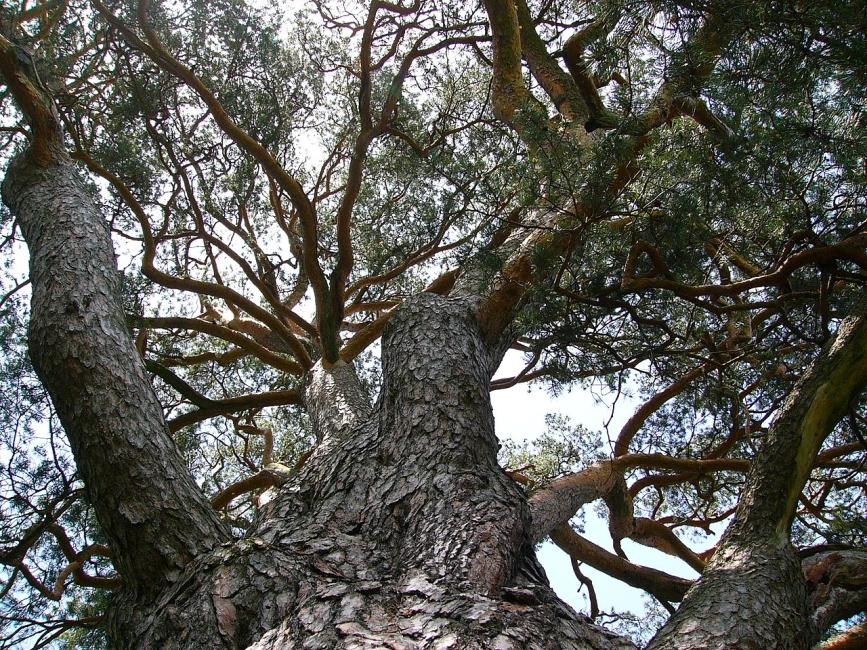
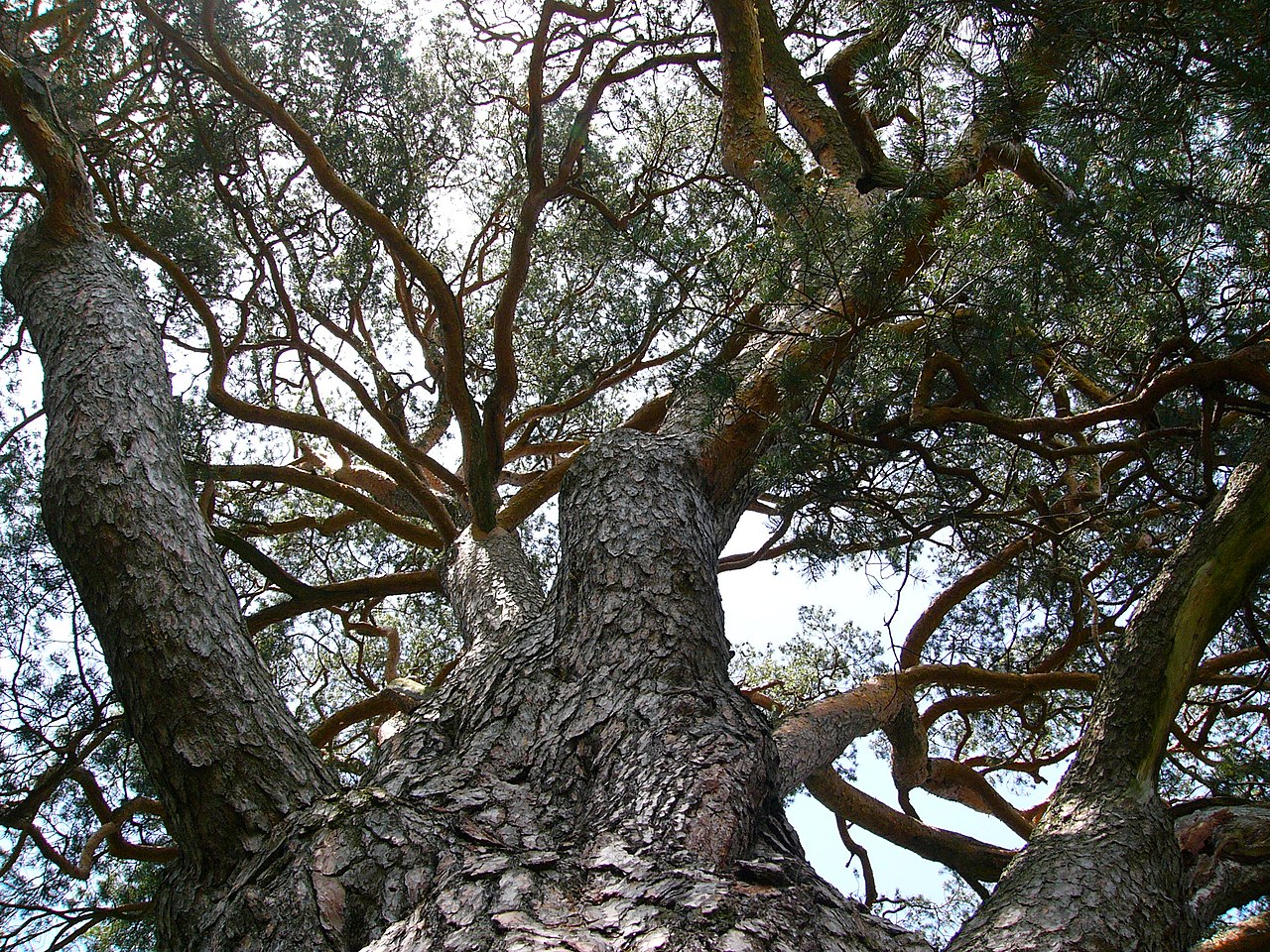
A photograph looking up into a pine of the most likely species (Pinus sylvestris) to feature in the story.
A photograph looking up into a pine of the most likely species (Pinus sylvestris) to feature in the story.
Photo by Teslaton, 2008.
Click here to view Wikimedia source.
 This work is licensed under a Creative Commons Attribution 3.0 Unported License.
In the earliest writings of Christian leaders, people were said to merit salvation by abandoning their home and family to follow Jesus. Later, this abandonment was institutionalised through entrance into the monastic life. Here it played a part in sustaining celibate communities, who were formally divested from worldly concerns while producing the authoritative knowledge of their societies. The effect of this on western intellectual traditions should not be underestimated.
Equally insidious was the mobilisation of a parallel—but very different—idea of divestment in efforts to put the wider population under ecclesiastical authority. The word used to describe these people was paganus, “pagan,” which increasingly meant “belonging to the country,” rustic, unlearned. The problems with pagans, according to certain Christians, arose from practices that showed reverence for earthly things in themselves. While the realities of local practices are notoriously difficult to recover, hostile textual records specify honouring the sun, the moon, stars, fire, and deep water, as well as making sacrifices to trees, springs, and “idols” in the fields, thickets, forests, and at crossroads. The error, the irrationality, was worshipping created things, rather than the Creator himself. The world could be loved, but as manifestation of the greatness of its maker. Its resources were this god’s gift to humanity. Its wild forces could be feared, but the crucial fear was the transformative fear felt by pine and people as Martin showed them something of his god’s power. It induced the trust in their Creator that was the proper remedy for mortals’ fear.
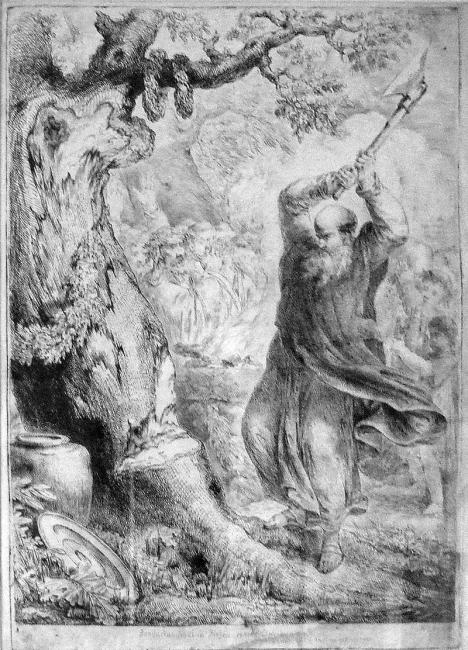
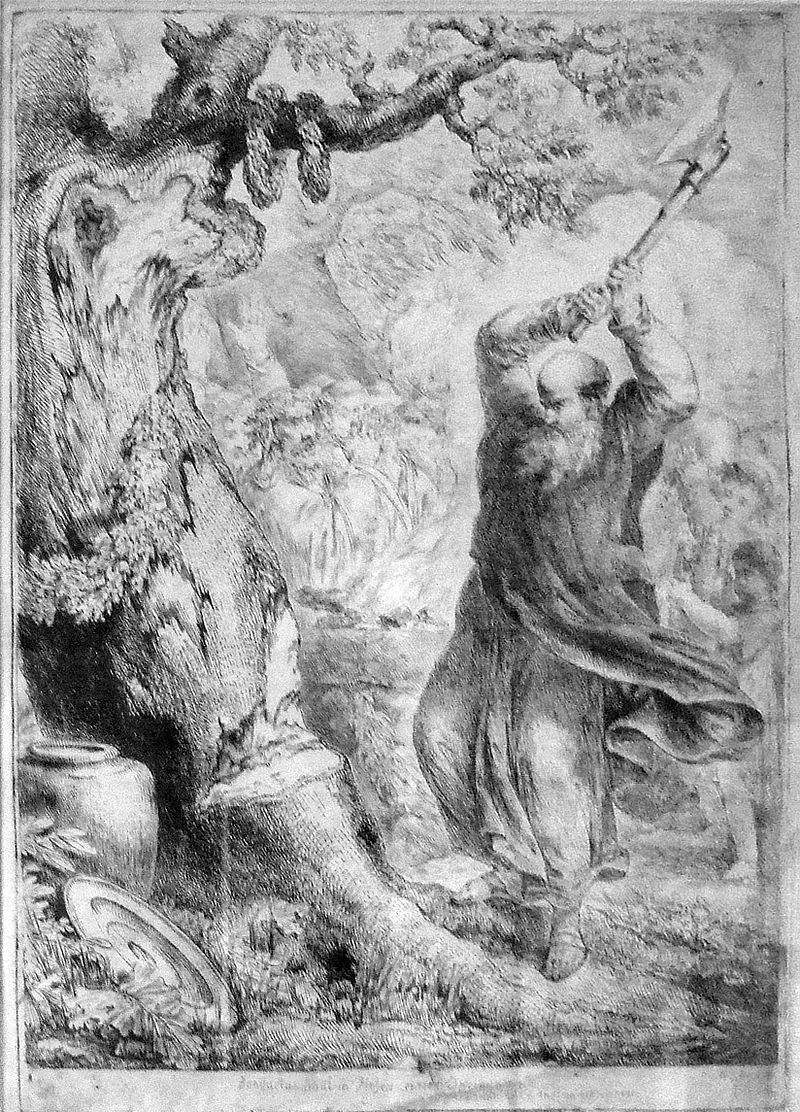
St Boniface (675–754) felling an oak tree to which people were making offerings. Etching made after 1781 by Bernhard Rode, as part of a fireplace screen depicting significant events in German history, from the Gotisches Haus in Wörlitz.
St Boniface (675–754) felling an oak tree to which people were making offerings. Etching made after 1781 by Bernhard Rode, as part of a fireplace screen depicting significant events in German history, from the Gotisches Haus in Wörlitz.
Etching by Bernhard Rode, 1781.
Click here to view source
 This work is licensed under a Creative Commons Attribution 4.0 International License.
What had to be ended, in the eyes of militant churchmen, was an unmediated sense of belonging to place and planetary life. And so, shrines were burned, idols broken, trees hacked down, and particular kinds of multispecies relationships denigrated as ignorant—or, worse, as demon-worship. It lingers today in western thought: the prejudice against lovers of trees, environmentalists, and the corresponding imperative to harden the heart against all life, so that the economy may grow. It lingers even as scientists recognise that plants learn, remember, communicate, and have self-perception—and that their “fear” may both communicate to other plants and induce internal protective chemical responses.
Yet it is striking that Venantius, writing for a literate Christian audience, made his point by requiring the pine to acknowledge the immense force of the cross and pull the villagers into a new belief system in which they would never again improperly revere trees. He was “thinking with the pine,” certainly, but we should not miss the fact that, for him, the pine’s terrified submission mattered only because it opened the way for humans to transcend the biosphere rather than be lastingly part of its processes. The pine was, Venantius concluded, “a tree that generated a greater harvest when it came down.”
How to cite
Power, Amanda. “‘The pine’s fear made the bishop loved’: Thinking with Plants in Early Medieval Gaul.” Environment & Society Portal, Arcadia (Spring 2026), no. 11. Rachel Carson Center for Environment and Society. doi:10.5282/rcc/10155.
ISSN 2199-3408
Environment & Society Portal, Arcadia
This work is licensed under a Creative Commons Attribution 4.0 International License.
2026 Amanda Power
This refers only to the text and does not include any image rights.
Please click on an image to view its individual rights status.
- Burton, Philip, ed. and trans. Sulpicius Severus’ Vita Martini. Oxford: Oxford University Press, 2017.
- Cusack, Carole. The Sacred Tree: Ancient and Medieval Manifestations. Newcastle: Cambridge Scholars, 2011.
- Kay, N. M., ed. “Sulpicius Severus Vita Sancti Martini” and “Venantius Fortunatus Viti sancti Martini.” In Venantius Fortunatus: Vita Sancti Martini Prologue and Books I–II. Cambridge: Cambridge University Press; 2020.
- Martin of Braga. “De correctione rusticorum.” In Œuvres morales et pastorals, Edited by C.W. Barlow, 234–73. Turnhout: Brepols, 2010.
- McKinley, Allan Scott. “The First Two Centuries of Saint Martin of Tours.” Early Medieval Europe 14, no. 2 (2006): 173–200.
- Moreira, Isabel. “Visions and the Afterlife.” In The Oxford Handbook of the Merovingian World, edited by Bonnie Effros and Isabel Moreira, 988–1011. Oxford: Oxford University Press, 2020.
- Palmer, James. “Defining Paganism in the Carolingian World.” Early medieval Europe 15, no. 4 (2007): 402–425.