


Arcadia
Multispecies Walden Woods: Reevaluating Thoreau’s Religion
What happens when we look at Walden Woods of 1845 through a multispecies lens?
What happens when we look at Walden Woods of 1845 through a multispecies lens?

Indonesian state experts introduced invasive species into West Papua, a deliberate ecological disruption that advances a colonial agenda disguised as development.

Villagers witness and push to maintain ecological relations in the face of development that has decimated olive groves and scattered fences and turbines.
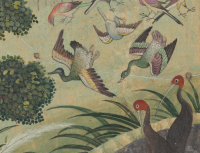
Zahīr ud-Dīn Muhammad Bābur’s autobiography anticipates an ecological and multispecies way of understanding the environment, highlighting confluence rather than divergence between humans and nonhumans.

Miyaoi Yasuo’s 1858 collection of tales, Kidan zasshi, challenges assumed human–animal boundaries, portraying shared ethics, reincarnation, and emotional connections by blending folklore and insights drawn from Edo-period experience.

How a Japanese naturalist-polymath’s fascination with slime mold shaped a multispecies onto-epistemology—and a fierce campaign to protect shrines and sacred forests.
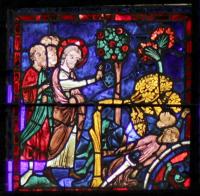
A hagiographer tells us that when Martin of Tours made the sign of a cross at a falling pine tree, the tree felt fear and was forced to change direction.

In former Northern Rhodesia, the case of the Tsetse fly shows how knowledge has been co-created by humans and nonhumans.
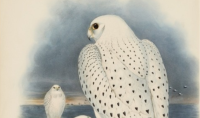
In April of 1191, a gyrfalcon from the far north flew over Acre. How did it get there? Did it feel hot? Can one use scant medieval sources to explore the experiences of a bird that lived at the end of the twelfth century?