With its greenery and flowers, Kabul is paradise in the spring,
Especially the Baran plain and Gulbahar at this season.
—Zahīr ud-Dīn Muhammad Bābur (2002: 243)
The poetic emotions that Zahīr ud-Dīn Muhammad Bābur (1483–1530), founder of the Mughal Empire in 1526, penned in his autobiography, Bāburnāma, convey his naturalist passion—a passion that remained mutually inclusive with his military conquests, and which endured conditions less stable than those of his successors. The naturalist passages in Babur’s autobiography are still worth reading, since they anticipate an ecological and multispecies way of understanding the environment, through which the activities and environs of humans and nonhumans highlight confluence rather than divergence.
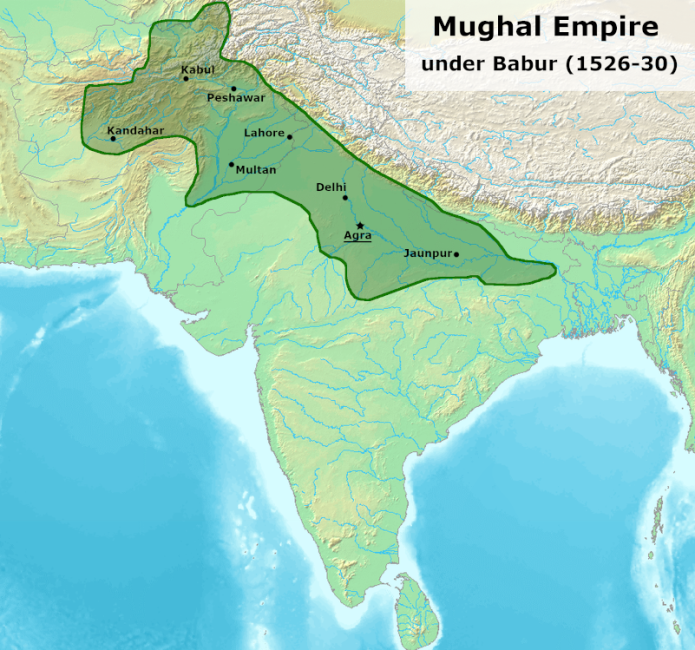
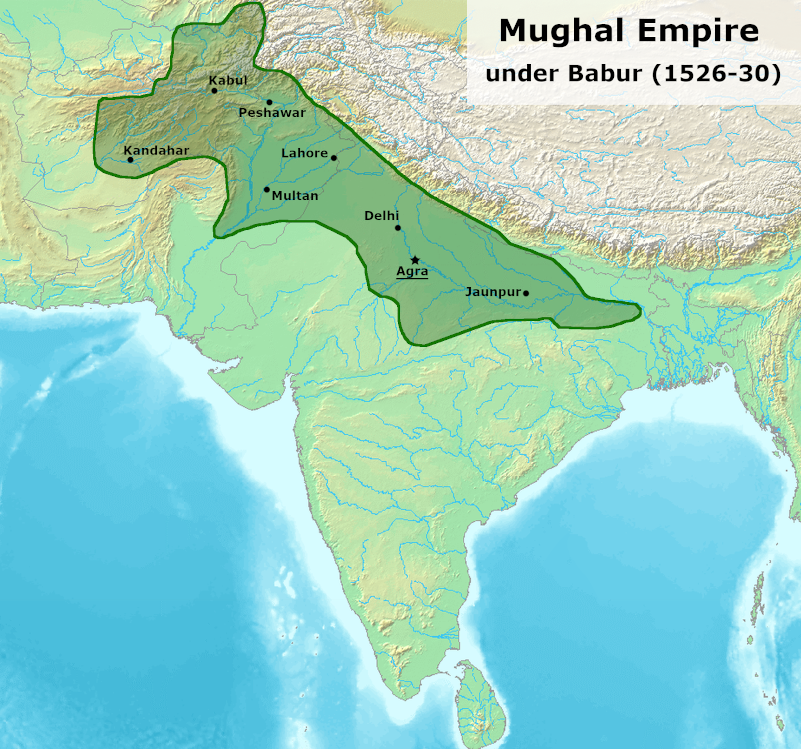
Map of the Mughal Empire in 1530.
Map of the Mughal Empire in 1530.
Map by Avantiputra7, 2020. Click here to view Wikimedia source.
 This work is licensed under a Creative Commons Attribution-ShareAlike 4.0 International License.
The Mughal Empire lasted until 1857 and would at its height in 1707 cover most of the Indian subcontinent, but already during Babur’s reign it was vast, stretching from current-day Afghanistan to the plains of Bihar in what is now eastern India. Though he would rule from Agra later, Kabul and the adjoining region, which he conquered in 1504, remained dear to him and was made the empire’s first capital. Largely a high-altitude, semi-arid-to-arid mountainous region interspersed with fertile valleys, meadows, and orchard-bearing slopes, the Kabul region is where a number of snow-fed, swift rivers like Ghorband and Panjshir converge to the north of the exotic city of Kabul, and then form the Kabul River. At the time, however, this river was called Baran, both at and before its convergence with Panjshir (Fazl-I-‘Āllami 1949, vol. II: 410; Habib 1986: sheet 1 A–B).
The valley of the Baran supported agriculture while it was dotted with meadows; in its foothills blossomed some thirty to forty unique varieties of tulips during spring (Babur 2002: 161, 243). During the same season, as Babur observed, fish migrated in the Baran and were caught using nets and wattles and by the use of indigenous plants like qulan quyruqi (wild ass tail) and green wormwood to drug them so as to angle them at an appropriate place downstream (Babur 2002: 169).
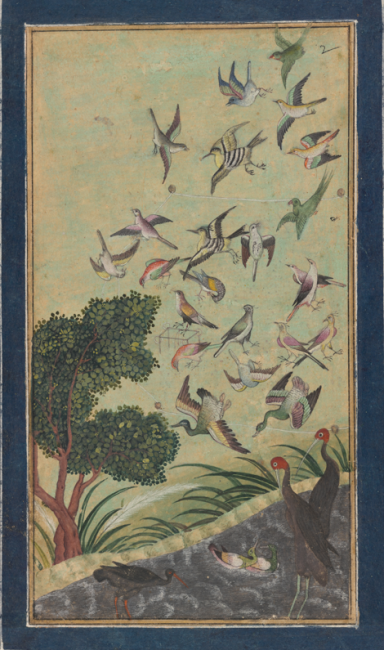
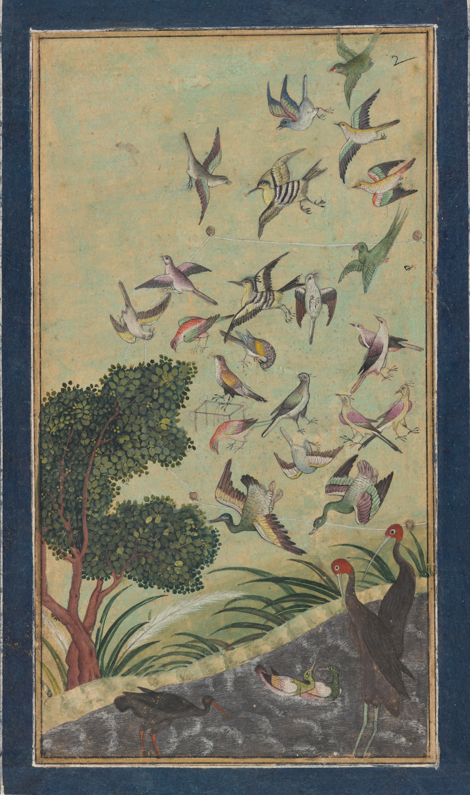
Illustration of birds at the Baran, possibly from the Bāburnāma.
Illustration of birds at the Baran, possibly from the Bāburnāma.
The image has been cropped.
Courtesy of the Smithsonian National Museum of Asian Art.
Click here to view source.
 This work is licensed under a Creative Commons Public Domain Mark 1.0 License.
However, it is especially through his vivid chronicling of the terrain of Baran and bird-hunting therein that Babur’s explicit descriptions and astute observations present a layered interaction between humans, nonhumans, and related environs. To this day, the region remains a critical, high-altitude corridor of Central Asian flyway routes of migratory birds, and Babur thus presents a multispecies perspective of the region’s lasting environmental history. Among popular medieval forms of recreation, Babur mentioned different tactics and techniques for hunting and trapping birds, like falconry, hawking, shooting, the use of darts, flails, bow and arrow, nets, and decoys—some of which still remain popular in the Kabul region. Thus, the techniques used in the Baran valley in the early 1500s were largely based on what we today might call ecological knowledge, as they took into account the dynamics of climate, seasons, geography, and the respective behaviors of different species.
In this light, Babur documented faculties of latitudinally migrating birds, like a visual ability aiding navigation and orientation by utilizing landmarks like river, hills, mountain passes, and winds to comprehend the landscape:
In the heats the fowling-grounds of Kābul are crowded. The birds take their way along the Bārān-water. For why? It is because the river has mountains along it, east and west, and a great Hindū-kush pass in a line with it, by which the birds must cross since there is no other near. They cannot cross when the north wind [Parwan] blows, or if there is even a little cloud on Hindū-kush ; at such times they alight on the level lands of the Bārān-water and are taken in great numbers by the local people. Towards the end of winter, dense flocks of mallards (aūrdūq) reach the banks of the Bārān in very good condition. Follow these the cranes and herons, great birds, in large flocks and countless numbers (Babur 1922: 224).
Babur further described a distinct hunting technique utilizing the climate and the characteristic nocturnal migration undertaken by wintering avians: as birds lowered their altitudes to avoid turbulence caused by clouds during rainy nights for a more stable and energy-efficient flight, the human predators waited by the Baran to hook them. Observing and unsuccessfully trying this type of hunting, Babur wrote:
Along the Bārān people take masses of cranes (tūrna) with the cord; masses of aūqār [grey heron], qarqara [egret] and qūt̤ān [water hen] also. This method of bird-catching is unique. They twist a cord as long as the arrow’s flight, tie the arrow at one end and a bīldūrga at the other, and wind it up, from the arrow-end, on a piece of wood, span-long and wrist-thick, right up to the bīldūrga. They then pull out the piece of wood, leaving just the hole it was in. The bīldūrga being held fast in the hand, the arrow is shot off towards the coming flock. If the cord twist round a neck or wing, it brings the bird down. On the Bārān everyone takes birds in this way; it is difficult; it must be done on rainy nights, because on such nights the birds do not alight, but fly continually and fly low till dawn, in fear of ravening beasts of prey. Through the night the flowing river is their road, its moving water showing through the dark; then it is, while they come and go, up and down the river, that the cord is shot (Babur 1922: 224–225).
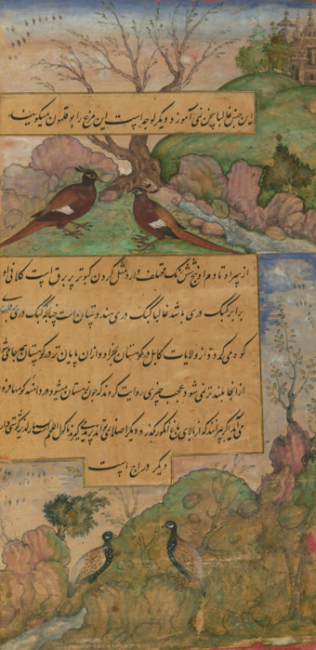
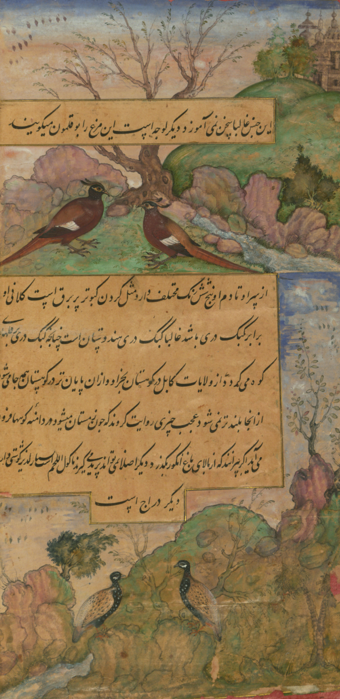
Painting from the Bāburnāma portraying a bird known as luchas, also called Buqalamun in the text, and partridges.
Painting from the Bāburnāma portraying a bird known as luchas, also called Buqalamun in the text, and partridges.
The image has been cropped.
Courtesy of the Walters Art Museum.
Click here to view source
This work is licensed under a Creative Commons Public Domain Mark 1.0 License.
In his hunting descriptions, Babur also mentions the pursuit of buqalamun (probably Himalayan snow-cock) in the inaccessible grape- and fruit-bearing region of Nijrao, which was on the course of Baran too: “As soon as winter sets in, the birds descend to the foothills. If they are put to flight over a grape orchard they absolutely cannot fly any longer, and can therefore be caught” (Babur 2002: 160–61). Apart from such techniques and tactics used for bird-hunting, one cannot ignore a large group of professional hunter bondsmen from Multan who were earlier settled in the region and caught migratory birds for their livelihood. Henceforth, Babur noted their practice: “They dig tanks, stick branches and set traps in the middle of the tanks, and catch all sorts of birds. Not only professional hunters catch birds—all the people living in the Baran cast ropes, set traps, and catch many birds of all sorts by every conceivable method” (Babur 2002: 168–69).
The excerpts from the Bāburnāma quoted above, specifically the first two techniques, reflect the use of the same environmental conditions by both humans and birds, simultaneous but with different motivations. The cognitive abilities, spatial memory, homing capabilities, social learning, and navigation through changing climates and landscapes undoubtedly highlight behaviors and faculties stemming from avian genetics, but these abilities also reveal the birds’ capacity to adapt. While geomorphological features and climate guided both humans and nonhumans to chart their individual journeys, albeit with intersections, the birds’ use of the Baran and the mountain passes to traverse the Hindu Kush mountain range towards the steppes and their northern breeding grounds was similar to how humans used them for building their networks or conquering regions. Meanwhile, the hunting of birds informed by ecological knowledge was yet another example of human understanding of the environment. Above all, the hunting notwithstanding, such insights from Bāburnāma lent a voice to nonhumans and they latently highlight the intellect, adaptability, and resilience of birds among others, prompting us to question human capabilities to think, maneuver, and dominate nature as given and unique.
Primary Sources
- Bābur, Zahīr ud-Dīn Muhammad. Bābur-nāma (Memoirs of Bābur), Vol. 1. Trans. Annette Susannah Beveridge. Luzac & Co, 1922.
- Bābur, Zahīr ud-Dīn Muhammad. The Baburnama: Memoirs of Babur, Prince and Emperor. Trans. Wheeler M. Thackston. The Modern Library, New York, 2002.
- Fazl-I-‘Āllami, Abul. ‘Ain-i-Ākbari, Vol. II. Trans. H. S. Jarrett. Royal Asiatic Society of Bengal, 1949.
Acknowledgments
I am sincerely grateful to Eiko Honda, Jonatan Palmblad, and the two anonymous peer reviewers for their invaluable suggestions and coordination throughout this process of publication, and to Rachel Carson Centre for Environment and Society for publishing it. I gratefully acknowledge Yogesh Sharma, Mayank Kumar, Natasha Nongbri, Ravi K. Mishra, Monika Saxena, and the Prime Ministers Museum & Library (formerly, Nehru Memorial Museum & Library) for directly or indirectly helping me during this endeavor.
How to cite
Nawani, Smarika. “A Paradise in Spring: An Ecological Account of Birds, Fishes, and Hunters in the Bāburnāma.” Environment & Society Portal, Arcadia (Spring 2026), no. 4. Rachel Carson Center for Environment and Society. doi:10.5282/rcc/10057.
ISSN 2199-3408
Environment & Society Portal, Arcadia
 This work is licensed under a Creative Commons Attribution 4.0 International License.
2026 Smarika Nawani
This refers only to the text and does not include any image rights.
Please click on an image to view its individual rights status.
- Burnes, Alexander. Cabool: A Personal Narrative of a Journey to, and Residence in that City in the Years 1836, 7, and 8. Philadelphia: Carey and Hart, 1843.
- Dale, Stephen Frederic. Babur, Timurid Prince and Mughal Emperor, 1483–1530. Cambridge University Press, 2018.
- Habib, Irfan. An Atlas of the Mughal Empire. Oxford University Press, 1986.
- Haidar, Mansura. Medieval Central Asia. Manohar Publishers, 2004.
- Hasan, Mohibul. Babur: Founder of the Mughal Empire in India. Manohar Publishers, 1985.
- Verma, Som Prakash. The Illustrated Baburnama. Routledge, 2016.