Kidan zasshi (奇談雑史, A Collection of Strange Tales), written in 1858 by Miyaoi Yasuo (宮負定雄, 1797–1858), challenges the Confucian moral hierarchy that places humans above animals. In nineteenth-century Japan, urban intellectuals often adhered to a Confucian view of animals that portrayed them as morally and intellectually inferior to humans (Bandō 2023). This paper highlights how farmers in the same period, who typically maintained a close bond with animals through their daily lives and folk beliefs, embraced a worldview that contrasted with the dualistic perspective held by intellectuals.
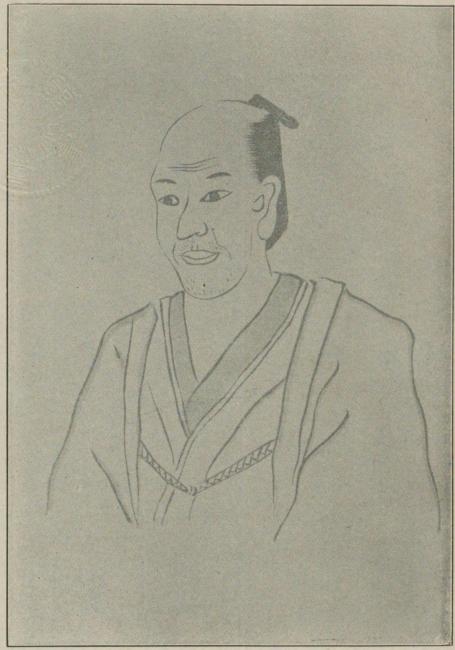
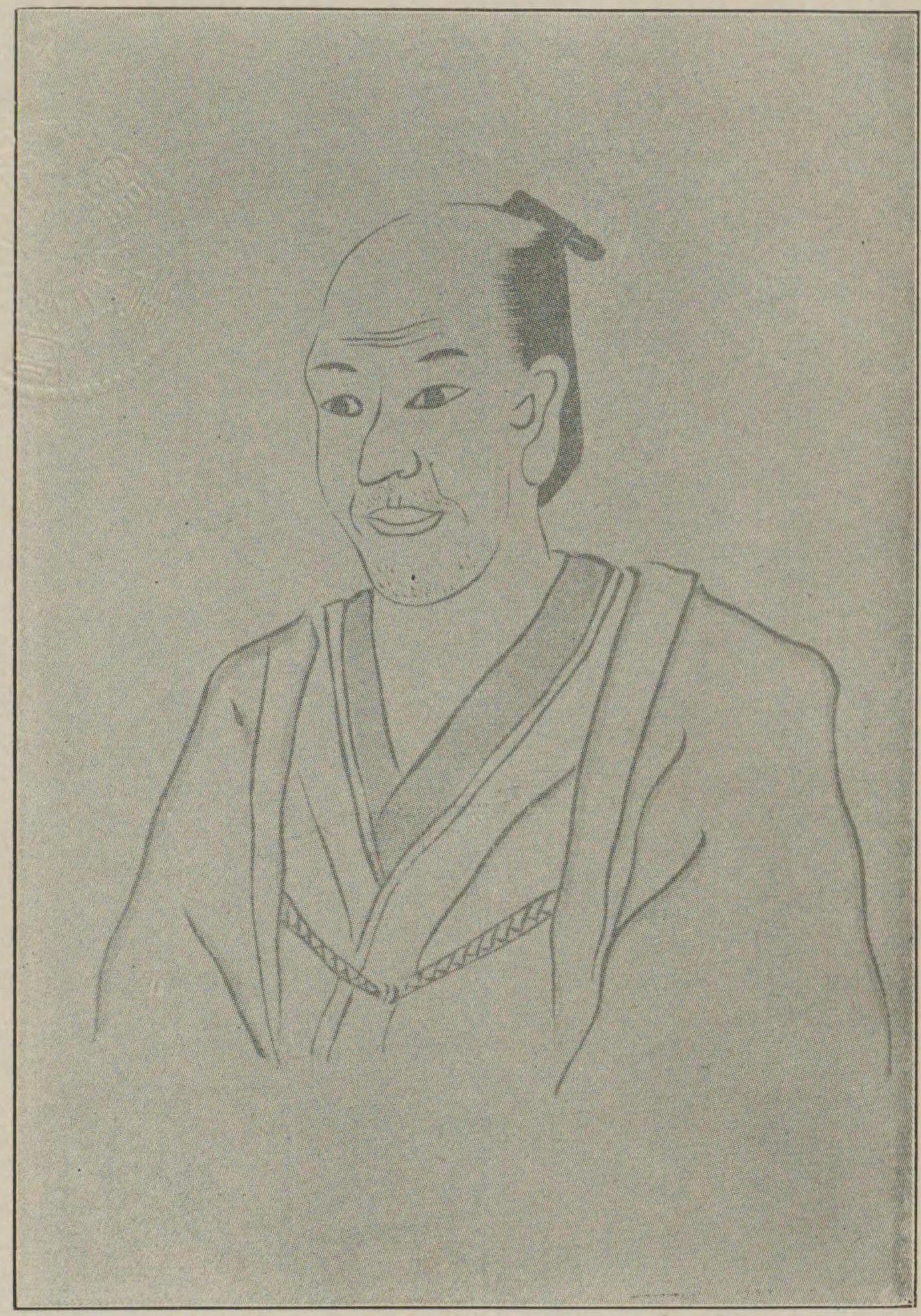
A portrait of Miyaoi Yasuo (illustration by Shinji Yamanaka)
A portrait of Miyaoi Yasuo (illustration by Shinji Yamanaka)
Portrait by Shinji Yamanaka, n.d.
Courtesy of the National Diet Library, Japan.
Click here to view source.
The copyright holder reserves, or holds for their own use, all the rights provided by copyright law, such as distribution, performance, and creation of derivative works.
Miyaoi was a rural intellectual from Matsuzawa Village in the Katori District, Shimousa Province (present-day Asahi City, Chiba Prefecture)—a long-established agricultural community appearing in records as early as the twelfth century. Born into a farming household, Miyaoi served as village headman and participated in local governance. He described the village as “remote” and portrayed himself as a farmer who had worked in the fields since childhood, often covered in dirt (Miyaoi 1932: 295). Yet he also took pride in practical learning related to agricultural administration and engaged in publishing activities. From this standpoint, he criticized literary and poetic pursuits as not constituting genuine learning (Miyaoi 1932: 286). His self-identification as a farmer was not merely a simple occupational label but rather a stance opposing urban literary intellectuals.
Miyaoi’s Kidan zasshi is a compilation of 160 strange tales gathered from various sources, including accounts of animals that either assist or harm humans, as well as stories of humans transforming into animals and vice versa. Miyaoi regarded the stories as historical truths rather than allegories, through which he aimed to instill moral values in people who lacked formal education. In the preface, Miyaoi states that “from 1853 I gathered and edited strange tales that I had long enjoyed hearing,” and explains that the purpose of Kidan zasshi was “simply to record facts in order to admonish the young” (Miyaoi 2010: 19). Miyaoi sometimes emphasizes the realism of his stories by presenting them as experiences of his contemporaries, for example, specifying details such as “November 1854, Mariko post station on the Tōkaidō, the farmer Kyūsuke” (Miyaoi 2010: 253).
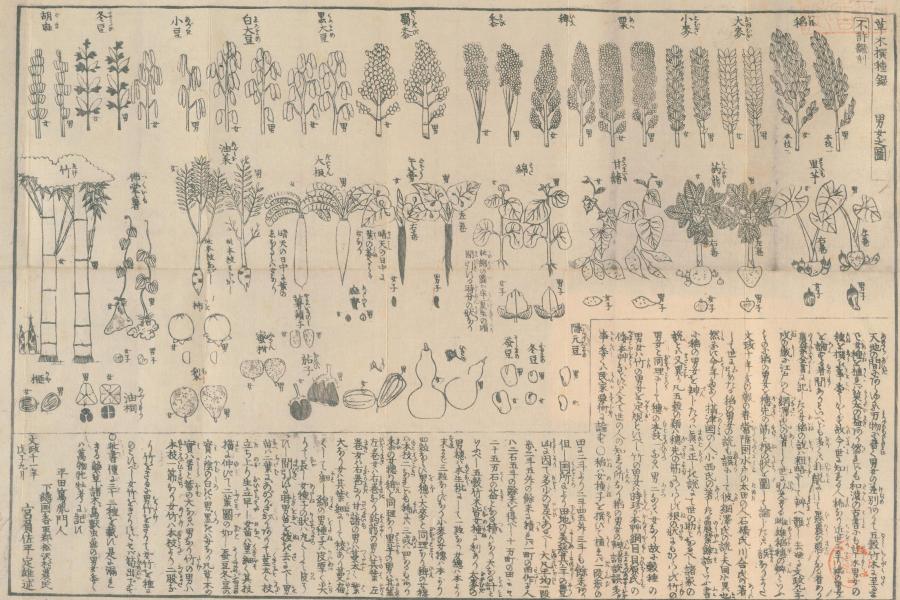
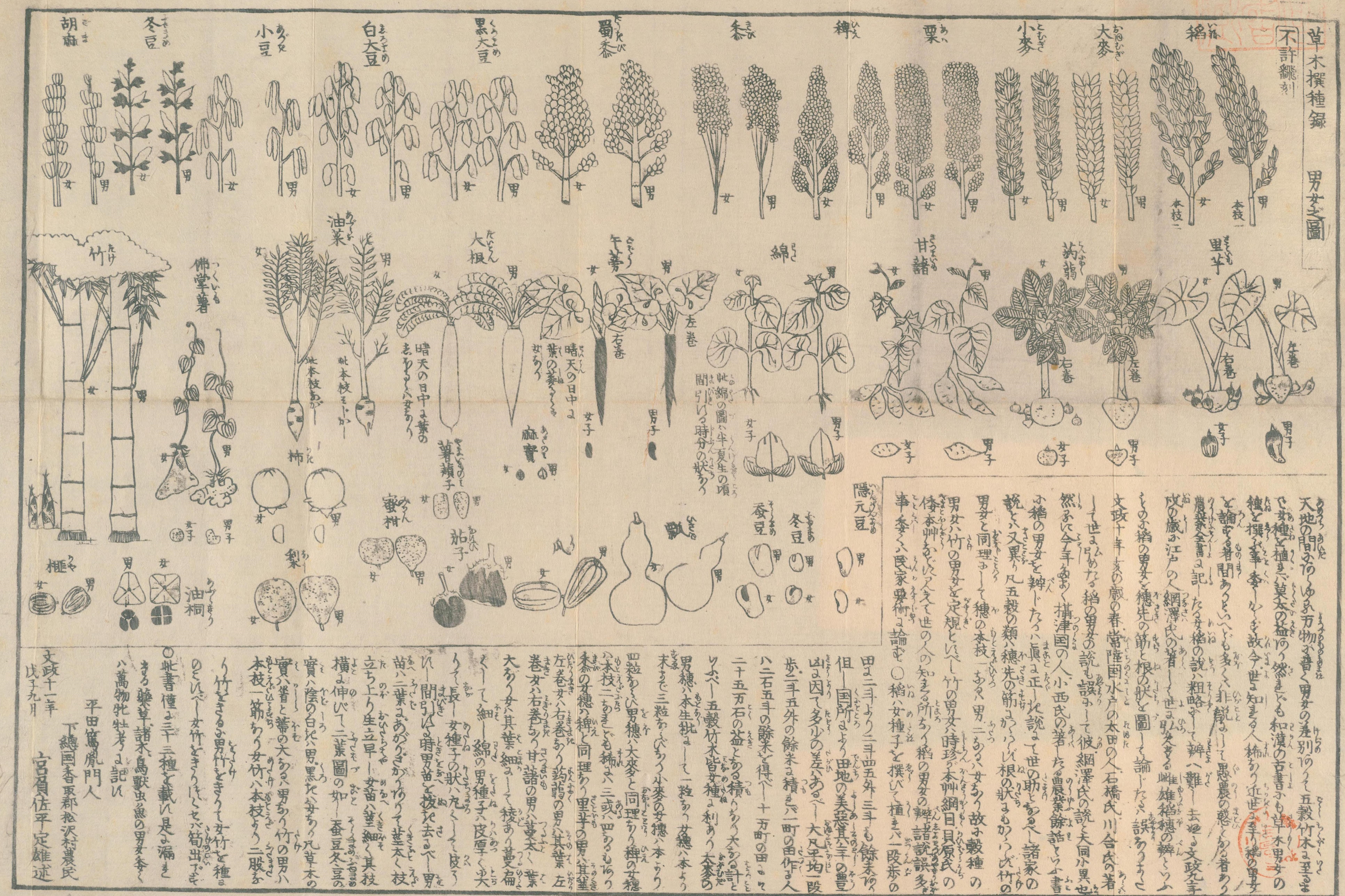
Miyaoi believed that all living organisms have male and female counterparts, and that seeds harvested from female plants would produce better yields. For this reason, this illustration depicts how to distinguish between male and female crops. From Sōmoku sensyu roku (草木撰種録).
Miyaoi believed that all living organisms have male and female counterparts, and that seeds harvested from female plants would produce better yields. For this reason, this illustration depicts how to distinguish between male and female crops. From Sōmoku sensyu roku (草木撰種録).
Illustration by Miyaoi Yasuo, n.d.
Courtesy of the National Diet Library, Japan.
Click here to view source.
 This work is licensed under a Creative Commons Public Domain Mark 1.0 License.
Kidan zasshi contains multiple accounts of humans reincarnating as animals or plants. For instance, there are stories depicting individuals consumed by obsession during their lifetimes who are reborn as snakes after death to seek revenge. Similarly, those who die without repaying debts are reborn as oxen or horses to work off their obligations. For farmers, oxen and horses were indispensable labor resources in daily life, leading to their conceptualization as reincarnation forms for humans repaying debts or fulfilling obligations. In this way, Miyaoi and his contemporaries believed that a person’s actions in life determined the type of animal they would be reborn as. Stories of people becoming oxen in order to repay debts also appear in Nihon ryōiki, the oldest Japanese Buddhist tale collection. This suggests that Miyaoi’s worldview was not exceptional but part of a long-lived narrative tradition shared across social strata.
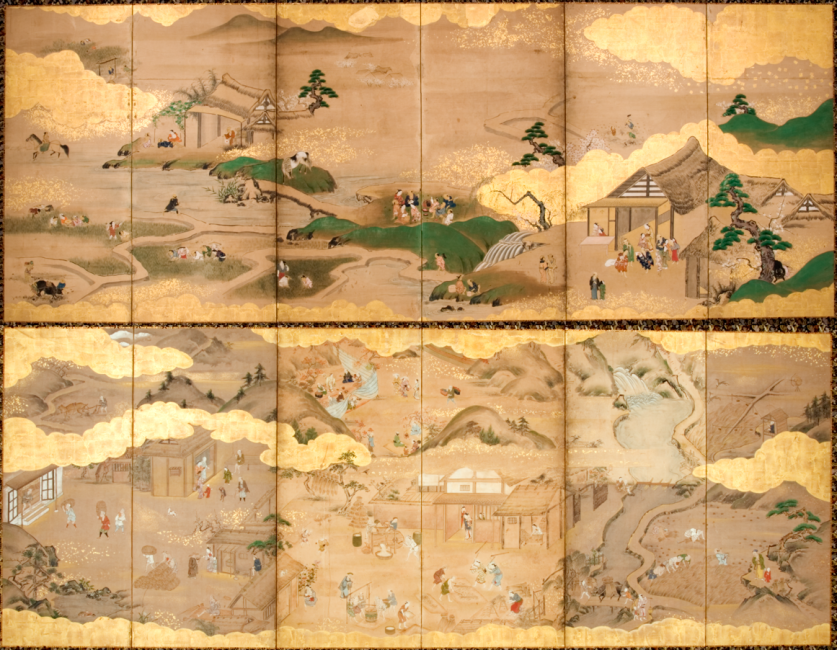
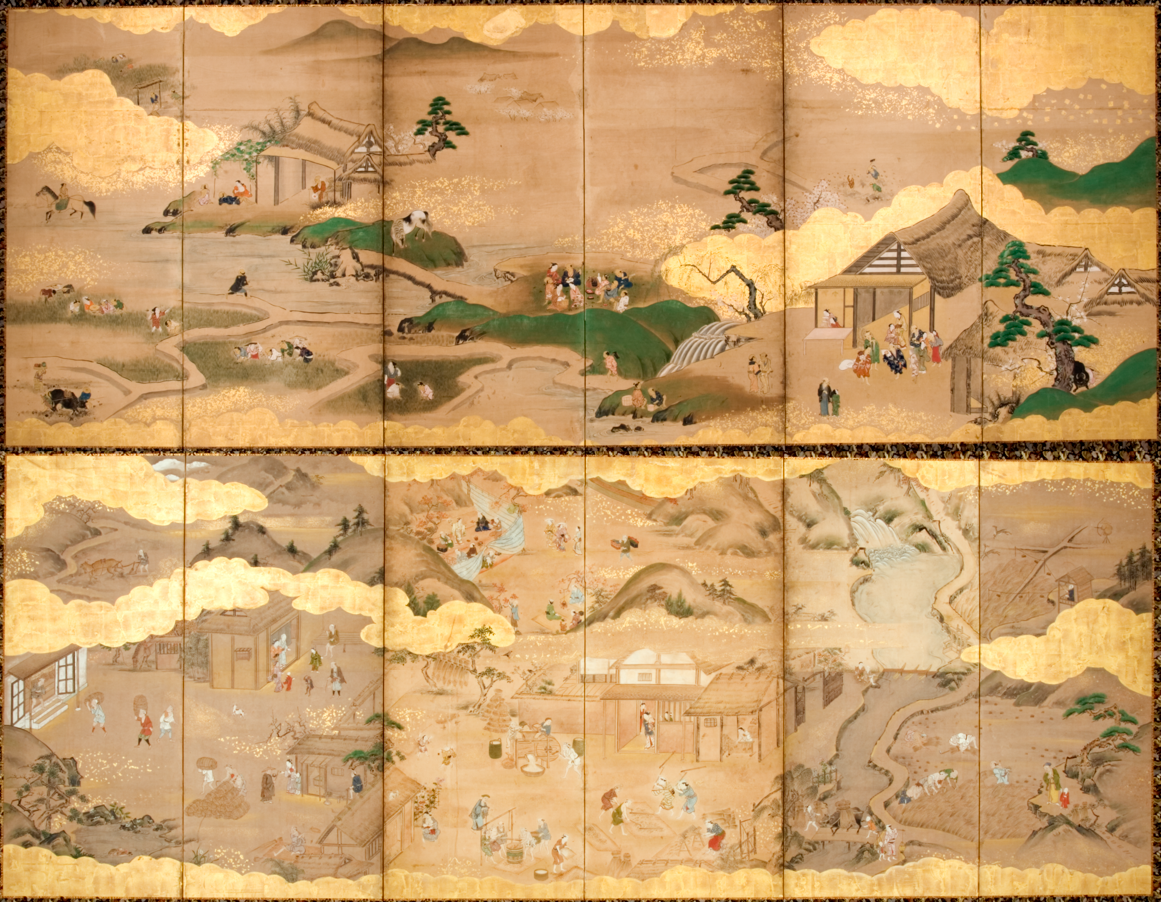
Rice Cultivation through the Four Seasons This is a folding screen depicting a rural village in the Edo period. The farmers lived alongside animals such as oxen, horses, and dogs.
Rice Cultivation through the Four Seasons This is a folding screen depicting a rural village in the Edo period. The farmers lived alongside animals such as oxen, horses, and dogs.
Unknown artist, c. 1700–1725.
Courtesy of the Los Angeles County Museum of Art (LACMA).
Click here to view source.
This work is licensed under a Creative Commons Public Domain Mark 1.0 License.
In the text, animals are also depicted transforming into humans. Animals subjected to harm or kindness by humans change their forms to repay those actions. This concept is not limited to foxes and raccoon dogs, traditionally believed to shapeshift, but extends to turtles, birds, and fish, who transform into humans to confront them directly and communicate through language. One story recounts an incident involving an ambitious physician who created medicines using animal-derived ingredients and intended to publish his findings in books. In retaliation, a coalition of birds, beasts, insects, and fish conspired against the physician, successfully thwarting the publication of his work. The tale ends with a reflection on the sinfulness of taking lives. Although the aversion to killing aligns with Buddhist values, Miyaoi’s perspective goes further, viewing animals as sentient beings sharing emotions and ethical principles.
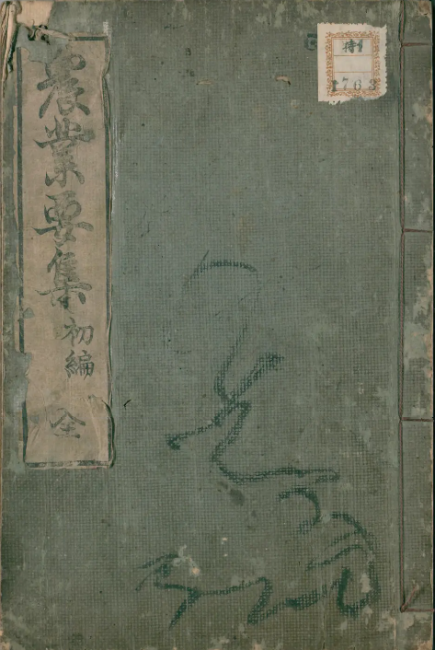
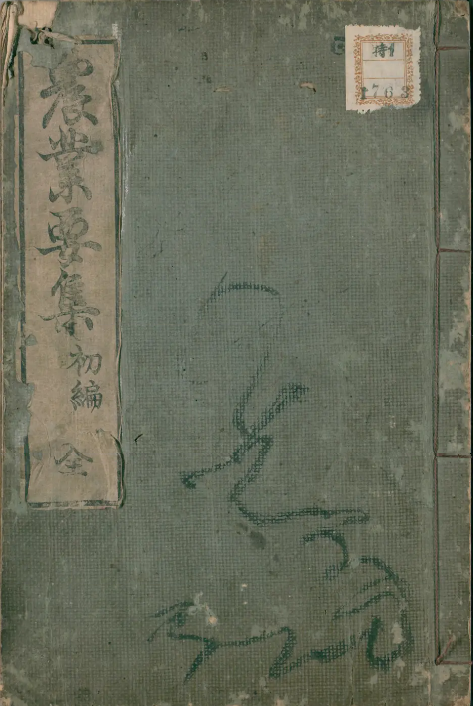
A woodblock-printed manual, Nōgyo yōusū (農業要集), describing the proper conduct of farmers and methods of crop cultivation. At the end of the volume, the compiler identifies himself as “Miyaoi Yasuo, a farmer of Matsuzawa Village.”
A woodblock-printed manual, Nōgyo yōusū (農業要集), describing the proper conduct of farmers and methods of crop cultivation. At the end of the volume, the compiler identifies himself as “Miyaoi Yasuo, a farmer of Matsuzawa Village.”
Courtesy of the National Diet Library, Japan.
Click here to access the full volume.
This work is licensed under a Creative Commons Public Domain Mark 1.0 License.
His tales include accounts of loyal dogs, cats, and monkeys that take on their masters’ illnesses or avenge their masters’ enemies. According to Miyaoi, such animals were honored with funerals comparable to those of humans, with graves or burial mounds that still existed during his time. Animals are also portrayed as equals capable of appropriate retaliation against malice. Even creatures typically regarded as weak, such as aphids or eels, are depicted as being able to seek revenge against humans.
Miyaoi Yasuo’s outlook on life, shaped by his experience of spending his time in a rural village, reflects his perspective as a farmer who resists seeing humans and animals in a binary framework. Furthermore, humans and animals were also thought to share ethics and emotions, with consistent behavior in response to virtuous or immoral actions. The late Edo period is often portrayed as a move toward modern rationalism. Yet Kidan zasshi does not treat animals and humans as opposing beings but finds emotional commonality between them and allows for the possibility of mutual rebirth. Rather than a primitive belief system, such ideas reveal an alternative ethical framework for human–animal relations that coexisted with emerging modern rationalism. Miyaoi’s work therefore invites us to reconsider not only Edo-period moral thought but also modern assumptions about the human–animal divide.
How to cite
Masuda, Tomoya. “Miyaoi Yasuo’s Perspective on Life in Nineteenth-Century Japan: Intersecting Humans and Animals, Shared Emotions and Ethics.” Environment & Society Portal, Arcadia (Spring 2026), no. 5. Rachel Carson Center for Environment and Society. doi:10.5282/rcc/10085.
ISSN 2199-3408
Environment & Society Portal, Arcadia
 This work is licensed under a Creative Commons Attribution 4.0 International License.
2026 Tomoya Masuda
This refers only to the text and does not include any image rights.
Please click on an image to view its individual rights status.
- 板東洋介 [Bandō Yōsuke]. “犬をめぐる論争:国儒論争における動物観の対立と帰趨 [A controversy surrounding the dog: The conflict and consequence of the notion of animal in the Confucianist-nativist controversy].” 日本文学研究ジャーナル [Academic journal of Japanese literature] 25 (2023): 49–63.
- Kojima, Yasunori. “Hirao Rosen: Late-Tokugawa Folklorist from Tsugaru Domain.” Asian Cultural Studies 36 (2010): 1–22. doi:10.34577/00002811.
- 宮負定雄 [Miyaoi Yasuo]. 奇談雑史 [Kidan zasshi, A collection of strange tales]. Tokyo: 筑摩書房 [Chikuma Shobō], 2010.
- 宮負定雄 [Miyaoi Yasuo]. “民家要術 [Essential Techniques for Rural Households].” In 近世地方経済史料 [Kinsei chihō keizai shiryō] vol. 5, edited by 小野武夫 [Ono Takeo], 263–320. Tokyo: 近世地方経済史料刊行会 [Kinsei chihō keizai shiryō kankou-kai], 1932.
- 宮負定雄 [Miyaoi Yasuo]. 農業要集 [Nōgyō yōshū]. In 日本農書全集 [Nihon nōsho zenshū], vol. 3. Tokyo: 農山漁村文化協会 [Nōsan Gyoson Bunka Kyōkai], 1979: 3–64.
- 宮負定雄 [Miyaoi Yasuo]. 草木撰種録 [Sōmoku senshu roku]. In 日本農書全集 [Nihon nōsho zenshū], vol. 3. Tokyo: 農山漁村文化協会 [Nōsan Gyoson Bunka Kyōkai], 1979: 65–74.