In the early twentieth century, British colonial administrations in Africa were simultaneously evaluating land for extraction and settlement, maintaining control over colonial subjects, and finding ways to manage unfamiliar ecologies that included “big game” and tropical, insect-borne diseases. This spurred significant developments in a number of emerging social and natural sciences to assist with the objectives of colonial governance that are the forebears of current fields of public health and epidemiology. Intellectual developments within these fields were driven by encounters with unfamiliar ecologies, nonhuman species, and the knowledge and labor of African people.
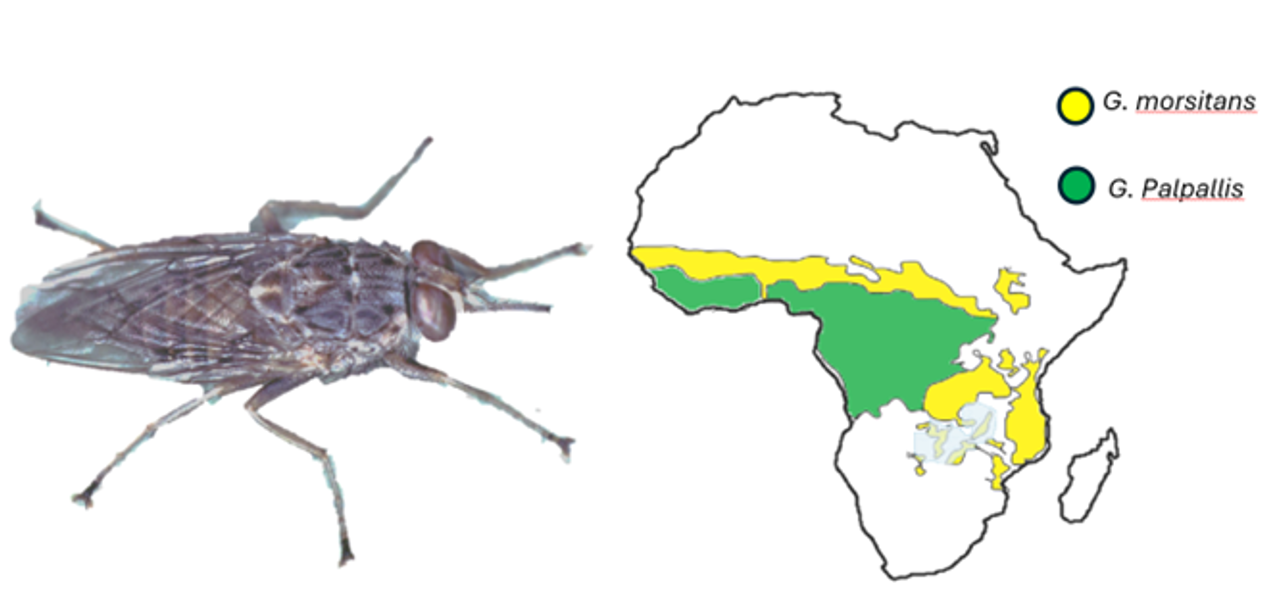
British colonial administrators of Northern Rhodesia (hereon colonial Zambia) saw the tsetse fly (Glossina spp.) as “the most formidable obstacle to development and progress” (Society for the Preservation of the Fauna of the Empire, 1926). Tsetse are vectors of different forms of trypanosomiasis, deadly diseases known as African sleeping sickness for humans, and nagana (a Zulu term now widely used) in animals. Tsetse flies have shaped the human ecology of Africa for tens of thousands of years with African peoples negotiating them through various measures, including managing routines in accordance with daily and seasonal variations in tsetse activity, through accumulated genetic resistance for humans and cattle for some populations, and through controlled burning associated with shifting agriculture (Chitemene) that destroyed tsetse breeding grounds (Farr and de Luna, 2024). The species of greatest concern to British colonial interests was Glossina morsitans, which thrives in scrubby parts of the dry miombo woodlands of Central and East Africa (figure 1). Livestock and herd animals (“big game”) are the preferential prey for G. morsitans and themselves act as a reservoir for trypanosomiasis.
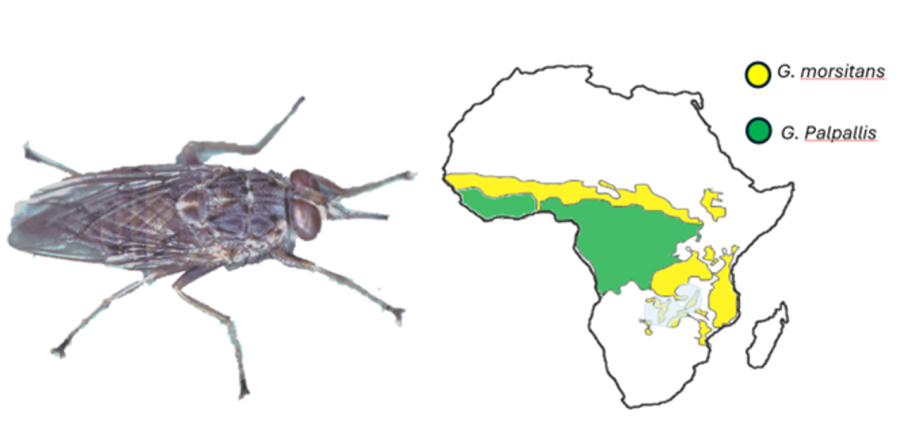
Fig. 1. Tsetse fly (Glossina) and the distribution of the two species G. morsitans and G. Palpallis. Zambia highlighted in blue.
Fig. 1. Tsetse fly (Glossina) and the distribution of the two species G. morsitans and G. Palpallis. Zambia highlighted in blue.
Edited version of graphic from Jeremy Farr and Kathryn de Luna, “How Insects Might Have Mediated Human Mobilities and the Intensficiation of Food Production in the Zambezian Bioregion of South Central Africa in the First and Second Millennium CE,” Archaeology Review from Cambridge 39 (2024).

This work is licensed as a Public Domain Dedication.
Already in the 1890s, the challenge of the tsetse fly was closely entwined with the development of entomology, ecology, and epidemiology as the “scramble for Africa” gathered momentum. The infection of humans and the loss of animals needed for meat, milk, and traction was a severe impediment to ambitions to establish a white European colony on mineral wealth and cash crops in colonial Zambia (Swynnerton and Buxton, 1938). Dispatches between the British South African Company and the Colonial Office in 1919 indicate the urgency of convening a Conference of Entomologists and the appointment of entomologists to understand how to control G. morsitans:
It is considered that further investigations into the relationship which exists between Fly and Game are required, and that a careful study of the conditions obtaining in fly areas where Game is almost completely absent is most likely to give results which will assist in determining this relationship (May, 1919).
In 1924, the British Colonial Office formally took over the administration of colonial Zambia from the British South Africa Company. From Livingstone, the territories capital till 1935, the colonial administration set about attempting to rapidly reshape the political ecology of the region. The Game Ordinance, 1925 created boundaries on areas for the exclusive use of white Europeans to hunt, and at the same time conducted a series of commissions to pave the way for largescale displacements of African Zambians through the “Northern Rhodesia (Crown Lands and Native Reserves) Order in Council, 1928.” The Crown Lands were deemed to have good agricultural potential or mineral value and were to be settled by white Europeans and governed by British Common Law. The Native Reserves, on the other hand, concentrated the African Zambian population into zones managed through customary laws (Vail, 1977).
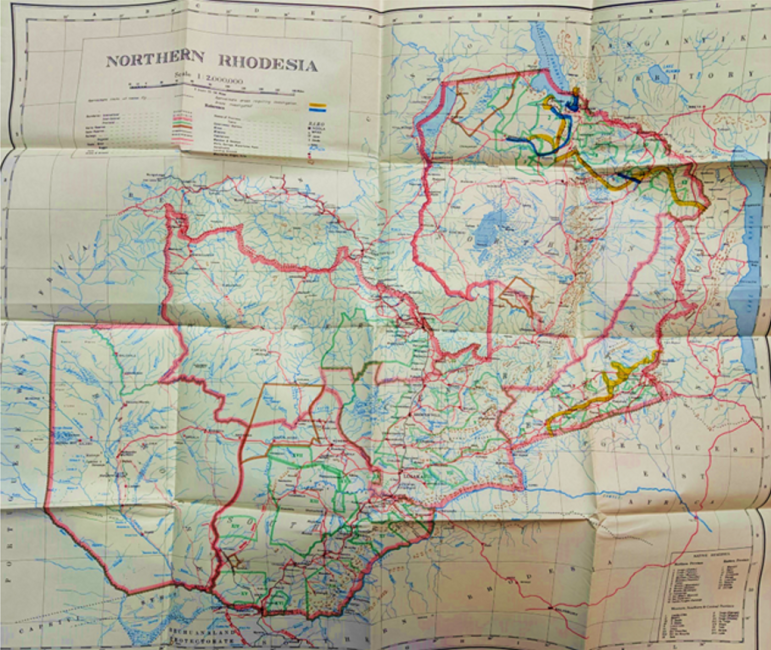
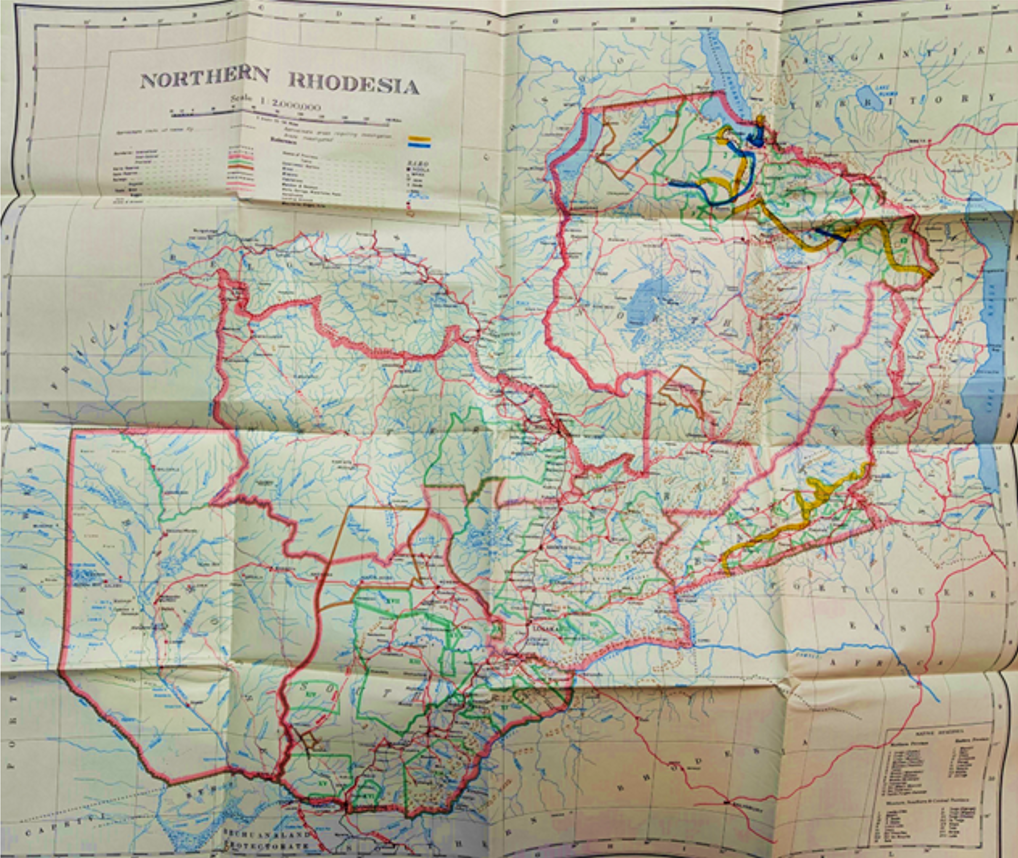
Fig. 2. Map of “Native Reserves” with area marked in blue for proposed tsetse control investigations.
Fig. 2. Map of “Native Reserves” with area marked in blue for proposed tsetse control investigations.
Source: Tsetse Fly Control, 1938. The National Archives of the UK (TNA), CO 795/84/8.
 This work is licensed under a Creative Commons Public Domain Mark 1.0 License.
Figure 2 is a map detailing the borders of colonial Zambia, the native reserves, game reserves, and areas designated for tsetse control. The forced displacement and depopulation of land reserved for European settlement and game reserves created swathes of unmanaged woodlands ideal for tsetse to thrive on the borders of Native Reserves, leading to epidemics of trypanosomiasis. This led to increased pressure on land in lesser-affected areas that in turn contributed to soil erosion, poor harvests, and food shortages throughout the 1930s (Colonial Development Advisory Committee, 1938).
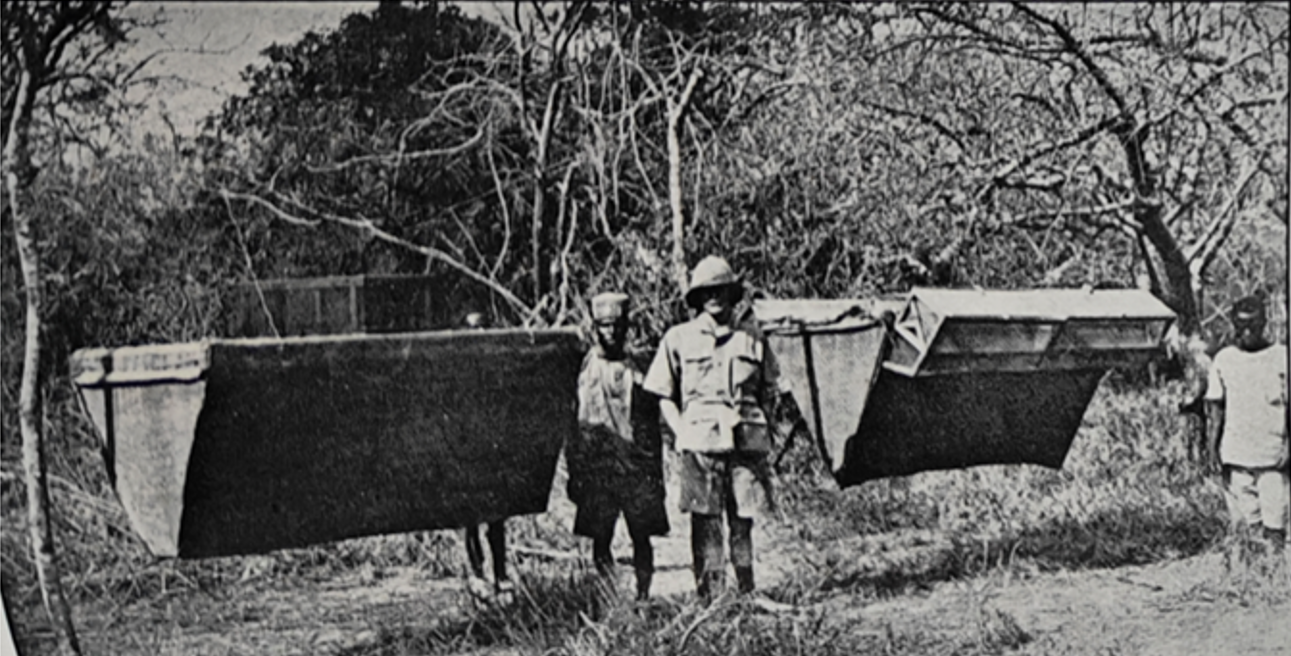
Correspondents from the 1920s through to the 1940s describe the advances of tsetse in the manner of an enemy army. The British Colonial Office put significant resources towards a Tsetse Research Department that funded surveys and experiments by entomologists, surveying land and trapping tsetse flies to create cartographies of “fly zones,” “fly corridors,” and “fly belts.” This crucially relied on “fly boys,” Zambians whose knowledge, skills, and capabilities were vital to continuing scientific experiments and finding effective management strategies for tsetse. Despite being identified as essential (Tsetse Fly Committee, 1936: 33) for the growing corpus of knowledge comprising a mix of government reports, maps, and scientific publications, the contribution of the Zambian fly boys is largely muted. Fly boys were tasked with catching samples of tsetse fly, undertaking land clearance, and setting up fences and barriers to create biosecurity systems to manage tsetse through human and animal mobilities (Mavhunga and Spierenburg, 2007). Destruction of animals, concentration of human settlement, and immunization and treatment were also attempted as control measures with limited success (Society for the Preservation of the Fauna of the Empire, 1926; Tsetse Fly Committee, 1936).
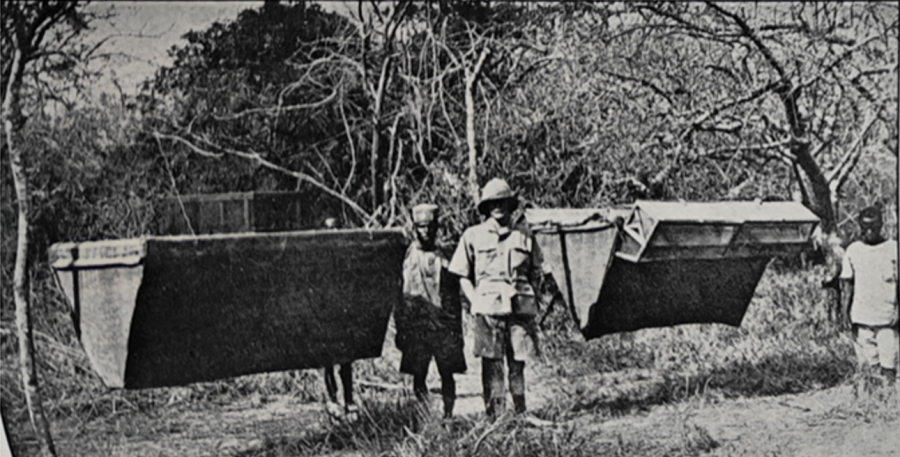
Fig. 3. Colonial scientist with African “fly boys” in Tanzania standing by different tsetse fly traps.
Fig. 3. Colonial scientist with African “fly boys” in Tanzania standing by different tsetse fly traps.
Unknown photographer, n.d.
Digitized by Jeremy Farr.
Source: Tsetse Fly Control, 1938. The National Archives of the UK (TNA), CO 795/84/8.
This work is licensed under a Creative Commons Public Domain Mark 1.0 License.
The incoherence of concentrating the Zambian population and these destructive approaches to biosecurity turned out to be to the benefit of the tsetse fly, as the frontiers of the fly zones continued to expand from the late nineteenth century through to the 1940s. The Tsetse Research Department maintained that solutions involved killing big game, concentrating human settlement, and immunization (Tsetse Fly Committee, 1936: 21). Improvements came as policy on the reserves relaxed through the 1940s and people once again managed the lands. As noted by Mavhunga and Spierenburg:
The tsetse fly spoke through the mobility of Africans, the Africans spoke through the mobility of the tsetse fly, and both were considered a problem (2007: 20–21).
This episode highlights how multispecies interactions in colonial context involve processes of knowing and unknowing. While local farming methods practiced by Zambians was effective at managing tsetse, knowledge production in the colonial context was inseparable from the objectives of governance, enforcing cartographies of power through social and ecological boundaries. Tsetse flies shaped the development of colonial sciences through co-constructions of knowledge that emerged from encounters between colonial administrators and scientists, and the Zambian fly boys performing scientific research, a process through which local ecological knowledge appears to be subsumed into colonial knowledge (Mavhunga and Spierenburg, 2007). By considering this episode from a multispecies lens, the role of Zambians and nonhuman animals (“the fly”) as actors and actants in the formation of emergent scientific fields can be understood as an epistemological negotiation with authorship extending beyond the colonial narrative.
Primary Sources
- Colonial Development Advisory Committee. Letter from Assistant Secretary S.W. Smith on funds for tsetse fly control in Northern Rhodesia, 1938. The National Archives of the UK (TNA), CO 795/101/10.
- May, Aylmer W. “Entomology: Glossina.” Report by Principal Medical Officer. Medical Department, Livingstone, Northern Rhodesia, 13 May 1919. The National Archives UK (TNA), CO 323/815.
Entomology Report by Principal Medical Officer. Medical Department, Northern Rhodesia, 1919. The National Archives UK (TNA), CO 847/34/4. - Society for the Preservation of the Fauna of the Empire. “The Tsetse-fly Problem and its Solution.” Occasional Papers 1, memorandum no. 1 (1926): 1–10.
- Swynnerton, Charles F. M., and Patrick Alfred Buxton. “Tsetse-Flies of East Africa.” Journal of the Royal African Society 37, no. 146 (1938): 92–94.
- Tsetse Fly Committee, 1936. “Tsetse Fly Control in the Tanganyika Territory.” Economic Advisory Council. Tenth report, 25 March 1936. London. The National Archives of the UK (TNA), CO 795/84/8.
How to cite
Farr, Jeremy. “Epistemological Negotiations of ‘the Fly’ and Native Reserves in Colonial Zambia.” Environment & Society Portal, Arcadia (Spring 2026), no. 13. Rachel Carson Center for Environment and Society. doi:10.5282/rcc/10158.
ISSN 2199-3408
Environment & Society Portal, Arcadia
 This work is licensed under a Creative Commons Attribution 4.0 International License.
2026 Jeremy Farr
This refers only to the text and does not include any image rights.
Please click on an image to view its individual rights status.
- Farr, Jeremy, and Kathryn de Luna. “How Insects Might Have Mediated Human Mobilities and the Intensficiation of Food Production in the Zambezian Bioregion of South Central Africa in the First and Second Millennium CE.” Archaeology Review from Cambridge 39 (2024). https://doi.org/10.17863/CAM.118228
- Mavhunga, Clapperton, and Marja Spierenburg. “A Finger on the Pulse of the Fly: Hidden Voices of Colonial Anti-Tsetse Science on the Rhodesian and Mozambican Borderlands, 1945–1956.” South African Historical Journal 58, no. 1 (2007): 117–41. https://doi.org/10.1080/02582470709464747
- Mavhunga, Claperton C. The Mobile Workshop: The Tsetse Fly and African Knowledge Production. MIT Press, 2018.
- Vail, Leroy. “Ecology and History: The Example of Eastern Zambia.” Journal of Southern African Studies 3, no. 2 (1977): 129–55.