In 1925, Walther Horn, director of the German Entomological Institute in Berlin-Dahlem, published a note in Entomologische Mitteilungen announcing his success finding rust-proof insect pins, the culmination of thirty years of stoically collecting different pin models. Horn stressed that his collection was not a hobby but rather aimed to document the history and improvements of this essential entomological tool—the metal pin to fix beetles and other insects in specifically designed boxes for shipping and preservation. His declaration of finally having found a rust-free needle was preceded by a six-year correspondence with Heinrich Hugo Karny, a German entomologist, then working at the Zoological Museum in the Dutch colony of Bogor (today’s Java). Karny had originally contacted Horn, soliciting help in identifying the species of the beetles found in Bogor. But many of the collections sent from Bogor to Berlin-Dahlem arrived at the German Entomological Institute entirely moldy and thus unusable for scientific studies or display. The letters exchanged between Karny and Horn between 1921 and 1927 reveal that rust was just one manifestation of a more fundamental challenge with which colonial science grappled: the high humidity of the southern Asian climate that co-determined which specimens could enter the scientific record and which preservation methods proved viable.

Portrait painting of Walther Horn made in 1916.
Portrait painting of Walther Horn made in 1916.
Painting by Ernst Bischoff, 1916.
Click here to view Wikimedia source.
 This work is licensed under a Creative Commons Public Domain Mark 1.0 License.
Humidity’s role in shaping the conditions of entomological work became clear in Karny’s letter to Horn on November 1, 1921. Writing from Buitenzorg, he described the climate as “the humid-warm incubation temperature of the tropics,” which created perfect conditions for both rust and mold. His attempts to tinker with these conditions reveal the lengths to which colonial scientists would go to try to tame nature and impose European standards of preservation even under diverse climatic conditions—often to no avail. Despite using metal boxes that were heated day and night and trying an arsenal of chemicals—as well as “carbolic acid, formalin, naphthalene, sublimate”—Karny could not keep his specimens dry enough to prevent mold growth.
Horn’s responses show how colonial scientists sought solutions through imperial networks: he first suggested consulting the Calcutta Museum, where similar humidity conditions had led to strict protocols including “the prohibition of opening any box during the rainy season.” When Karny explained this was impossible in Buitenzorg, where it rained almost daily and humidity approached 100% even in dry periods, Horn proposed moving the collections to higher altitudes where the climate was “more reasonable.” Yet as Karny pointed out, such solutions failed to recognize local realities—the financial austerity the Dutch government had imposed on its colonies made moving collections impossible. The challenge of humidity thus exposed both material and institutional limits to European control over tropical conditions.
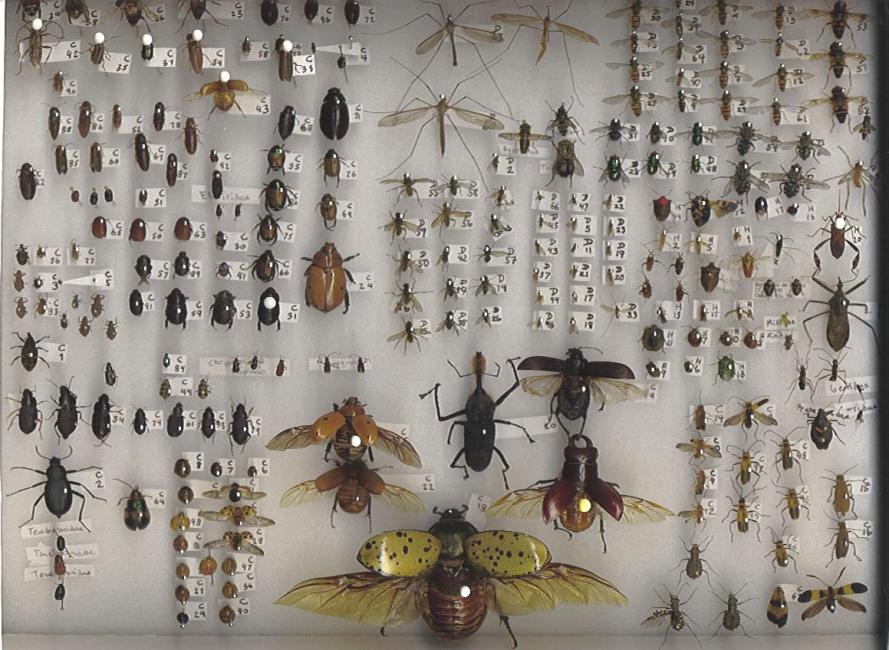
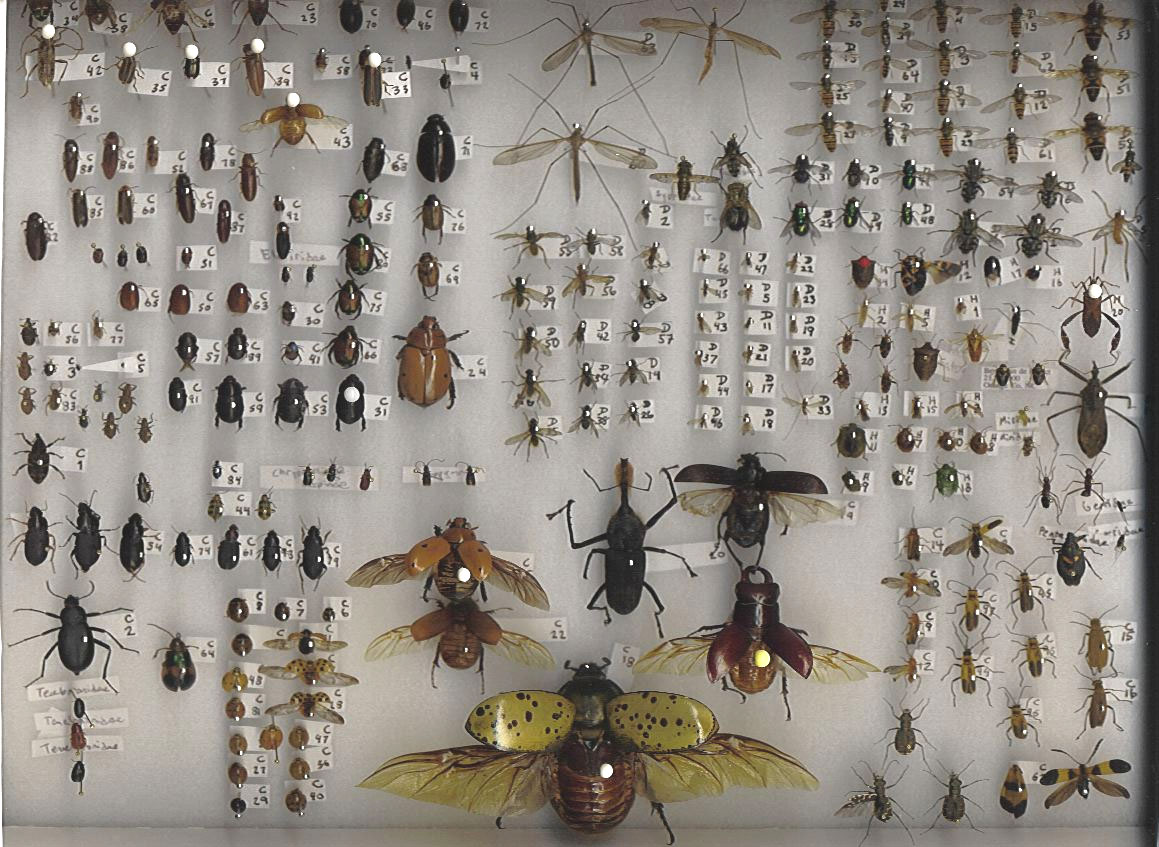
A small amateur insect collection.
A small amateur insect collection.
Photograph by Debivort, 2006.
Click here to view Wikimedia source.
 This work is licensed under a Creative Commons Attribution-ShareAlike 3.0 Unported License.
As Horn and Karny’s correspondence about tropical humidity continued, their exchange revealed how entangled German and Dutch colonial science remained even after Germany’s loss of colonies. German expertise and materials remained relevant to colonial science’s ongoing negotiation with tropical humidity even after World War I. The requirements for specimen preservation set by humidity led Horn to pursue multiple technical solutions. In October 1924, he wrote to Karny about his months-long efforts to solve the needle problem, spurred by Karny’s “troubling experiences” with specimen preservation. The challenge was multifaceted: nickel needles, once the standard, were no longer manufactured in Germany because the same qualities that made them resistant to humidity also made them too soft—they bent too easily when pinning harder insects. Horn’s systematic testing of alternatives, detailed in his note in the Entomologische Mitteilungen, shows the complexity of finding materials that could withstand both humidity and regular use. The path to these rust-proof needles involved multiple failed attempts, from gold-plated needles that proved “completely unusable” to a first batch of Krupp steel that delivered “absolutely devastating results” by rusting through within four weeks (Horn 1925, 106). When Krupp’s “V.2.A” steel finally showed promise, Horn arranged for the firm Hermann Kreye to produce a set of samples for other entomologists to order. Horn’s note tacitly acknowledged the difficulty of controlling tropical environments when he stated that even the new needles required extensive testing “under the most diverse environmental conditions” before their efficacy could be confirmed (Horn 1925, 107).
The materiality of colonial entomology—the need to preserve specimens in specific ways using particular tools—required constant attention to environmental conditions that European science could neither fully grasp nor master. When Horn wrote to Karny in July 1927 that a joint colleague was “entirely enthusiastic” about the needles, and Karny confirmed they continued to perform “excellently,” their exchange essentially celebrated an adaptation: rust-proof needles had met one of humidity’s requirements, but mold remained a persistent reminder of tropical nature’s resistance to European standardization. The development of rust-proof needles thus emerges as both less and more than Horn’s article suggests—less in that it addressed only one facet of the conditions humidity imposed on specimen preservation, more in that it reveals how colonial science operated through networks of expertise and material exchange that survived the end of formal empire, even as its aspirations for control over tropical environments remained unfulfilled.
Primary Sources
- Heinrich Hugo Karny to Walter Horn, 30 July 1925, Box 20, Folder 122, Nachlass Walther Horn, Deutsches Entomologisches Institut, Müncheberg.
- Walter Horn to Heinrich Hugo Karny, 28 August 1925, Box 20, Folder 123, Nachlass Walther Horn, Deutsches Entomologisches Institut, Müncheberg.
- Walter Horn to Heinrich Hugo Karny, 31 August 1925, Box 20, Folder 124, Nachlass Walther Horn, Deutsches Entomologisches Institut, Müncheberg.
- Horn, Walther Hermann Richard. “Über Insekten-Nadeln aus ‘nicht-rostendem Stahl’. ” Entomologische Mitteilungen 14 (1925): 105–107.
How to cite
Marktanner, Alina. “Of Rust and Mold—The Insect Pin as a Token of Transimperial Cooperation.” Environment & Society Portal, Arcadia (Autumn 2025), no. 13. Rachel Carson Center for Environment and Society. doi:10.5282/rcc/10048.
ISSN 2199-3408
Environment & Society Portal, Arcadia
 This work is licensed under a Creative Commons Attribution 4.0 International License.
2025 Alina Marktanner
This refers only to the text and does not include any image rights.
Please click on an image to view its individual rights status.
- Barth, Volker and Roland Cvetkovski. “Introduction: Encounters of Empires: Methodological Approaches.” In Imperial Co-Operation and Transfer, 1870–1930: Empires and Encounters, edited by Volker Barth and Roland Cvetkovski, 3–23. London, UK: Bloomsbury Academic 2015.
- Bartoletti, Tomás. “The Transimperial Emergence of Pest Control Research: Economic Entomology between Europe and the Tropical World, c. 1890–1930.” Comparativ 32, no. 6 (2022): 704–25. doi:10.26014/j.comp.2022.06.03.
- Bührer, Tanja, Flavio Eichmann, Stig Förster, and Benedikt Stuchtey. “Introduction: Cooperation and Empire: Local Realities of Global Processes.” In Cooperation and Empire: Local Realities of Global Processes, edited by Tanja Bührer, Flavio Eichmann, Stig Förster, and Benedikt Stuchtey, 1–29. New York; Oxford, 2017.
- Goss, Andrew. The Floracrats: State-Sponsored Science and the Failure of the Enlightenment in Indonesia. Madison, Wis: University of Wisconsin Press, 2011.
- Hofmeyr, Isabel. “There’s a Bug in my Media: Insects, Colonial Archives and Book History.” Kronos 51 (2025): 1–11. doi:10.17159/2309-9585/2025/v51a2.
- Johnson, Kristin. Ordering Life: Karl Jordan and the Naturalist Tradition. Baltimore: Johns Hopkins University Press, 2012.
- Roy, Rohan Deb. “White Ants, Empire, and Entomo-Politics in South Asia.” The Historical Journal 63, no. 2 (2020): 411–36. doi:10.1017/S0018246X19000281.