Since its inception in 2005, the Regional Conservation Area Cordillera Escalera (RCA-CE) has resulted in Indigenous Amazonian peoples losing access to the forest and the economic and cultural activities associated with it. This is illustrated by the case of the Kichwa people from the province of San Martin, on the eastern edge of the Andes in northeastern Peru, who have struggled to participate in the regional government’s decision-making process regarding the management of the RCA-CE, a conservation area encompassing 1498.7 km² (370,337 ac).
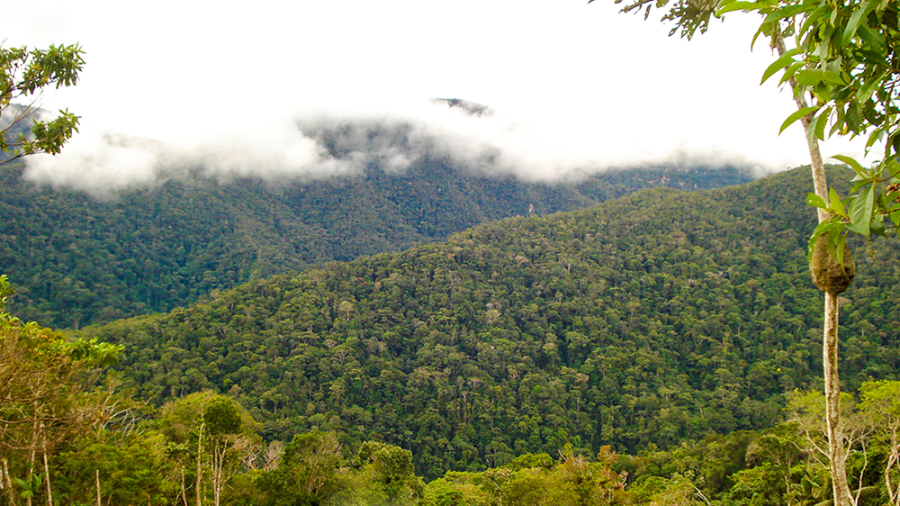
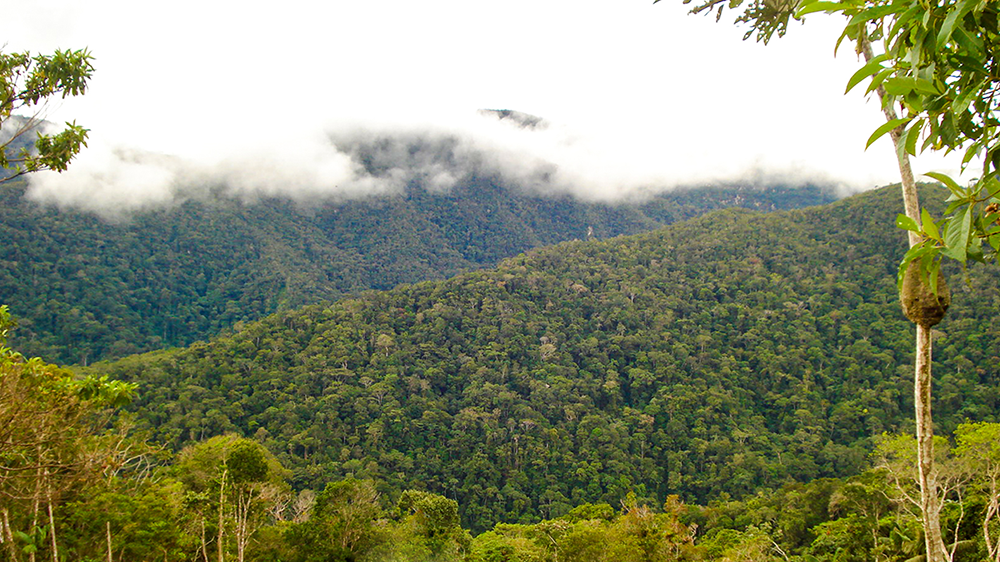
The Montaña Region in San Martín, Peru.
The Montaña Region in San Martín, Peru.
Photograph by Sevilla Ximena, 2013.
 This work is licensed under a Creative Commons Attribution-NonCommercial-ShareAlike 4.0 International License.
To understand the Kichwas’ demands in maintaining their relationship with this mountainous forested area, it is necessary to take a closer look at the history of the interface between the Andean highlands and lowland Amazonia—known since the colonial period as the Montaña region—as well as the centrality of the forest to Indigenous peoples’ livelihoods. While the conflict between the Kichwas against the regional government’s conservation policies is often framed as a fight over territorial rights alone, I argue that this is an oversimplification that fails to account for Indigenous people’s reliance on the forest to define their own identity.
At 809 meters (2,653 feet) above sea level, the Montaña region, where the RCA-CE lies, has long served as an essential pathway connecting the Andean highlands with lowland Amazonia, where different ethnic groups have historically engaged in the production and exchange of goods as well as in the transmission of forest-based knowledge embedded in this region. Though the original intention behind creating this conservation area was to protect the forest from the expansion of the agricultural frontier; in practice, the regional government has not been able to allocate enough resources to fulfill it. This failure in safeguarding the conservation area from the increasing presence of illegal settlers (colonos), remains one of the main threats to the Amazonian ecosystem. Now that the Kichwas have been excluded from entering the forest, they have fewer opportunities to denounce colonos seeking land to farm at the expense of the forest’s survival.
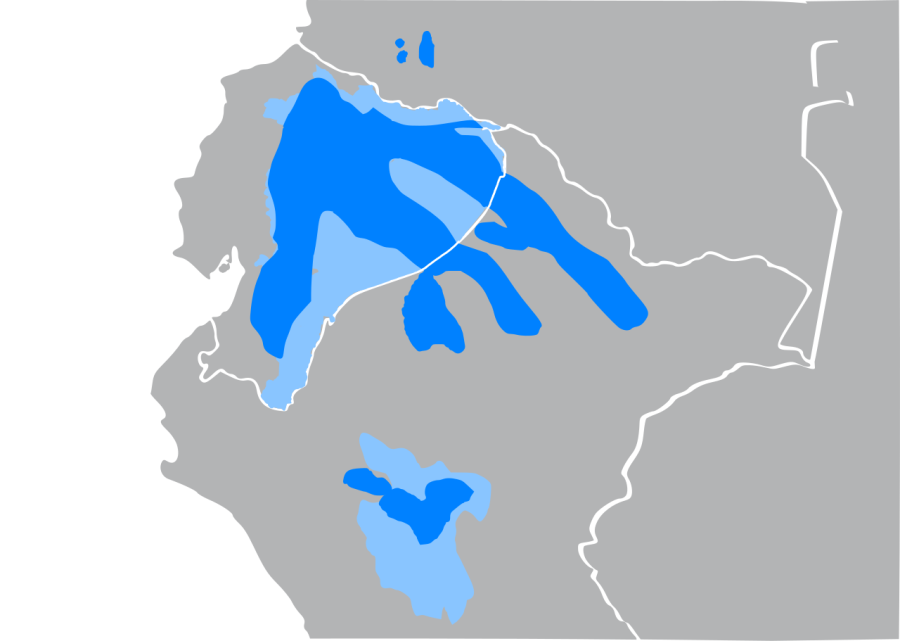
The current distribution of the Kichwa language, covering areas across Colombia, Ecuador, and Peru. Cordillera Escalera is located in the region to the south.
The current distribution of the Kichwa language, covering areas across Colombia, Ecuador, and Peru. Cordillera Escalera is located in the region to the south.
Map by Katariq, 2020.
Click here to view Wikimedia source.
 This work is licensed under a Creative Commons Attribution-ShareAlike 4.0 International License.
The regional government’s inability to acknowledge the Kichwas’ role in preserving the forest within this conservation area has also directly impacted the Kichwas’ struggles to reclaim their territorial rights while protecting the cultural markers that have shaped their identity. For centuries, Indigenous people have produced and reproduced economic, spiritual, and cultural ties to this Montaña landscape while solidifying their own permanence in it. The Kichwas have maintained those ties by learning from their elders and teaching new generations the best ways to use the forest’s resources in their healing, farming, fishing, and hunting practices. Within their worldview, every nonhuman component of this environment has a purpose, and the Kichwas honor that understanding by disrupting the forest as little as possible. Denying the Kichwas access to the forest not only risks them losing the unique knowledge drawn from past generations, but also endangers the forest itself.
The Kichwas’ requests to get involved in the governance of RCA-CE is a response to a long history of Montaña Indigenous peoples’ livelihoods and culture being threatened by outsiders’ aspirations about this environment and its people. In 1538, factors such as the Montaña’s proximity to the Amazon River’s main tributaries and the popularity of its fertile soils among Indigenous peoples living in the area motivated Spanish colonial authorities to establish the first Iberian-style towns in this region, specifically where the Kichwas live today. From the Spaniards’ perspective, the Montaña’s strategic location allowed them to secure a rest stop before their incursions into the Amazonian rainforest. Despite these colonial attempts to exert dominance to the east of the Andes from the sixteenth to the nineteenth centuries, locals’ expertise in navigating the forest and its vicinities prevented the culmination of these imperial plans.
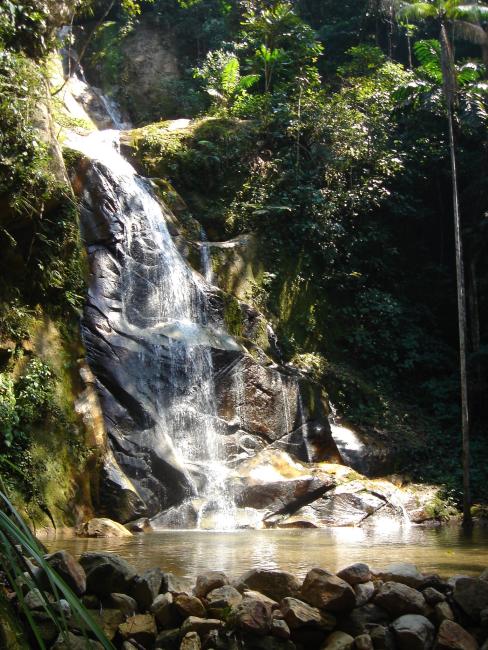
The Ahuashiyacu waterfall in Tarapoto, Cordillera Escalera.
The Ahuashiyacu waterfall in Tarapoto, Cordillera Escalera.
Photograph by Vicente González Camacho, 2008.
Click here to view Flickr source
 This work is licensed under a Creative Commons Attribution-ShareAlike 2.0 Generic License.
Throughout the colonial period, Natives’ deep knowledge of their surroundings within and outside the Montaña region ensured their survival and allowed them to defy colonial rule. This is apparent in colonial accounts that recognize the people from the Montaña as being part of a large economic and social network, acting as interpreters, guides, and the main source of labor. Natives’ flow of communication with ethnic groups from different locales was rooted in their bonds with the forest and their physical strength for walking long distances carrying heavy loads of merchandise.
By taking advantage of their geographic location, situated between the Andean and Amazonian worlds, Indigenous peoples from the Montaña moreover acted as the main intermediaries among Spaniards and other ethnicities who lived scattered in the rainforest. As a result, the Montaña people became essential to the production and trade of highly valuable goods native to their environment that could not be found elsewhere, such as salt, salted fish, and a poison called Ampi, among other resources. The Spaniards benefited from this mobility and the economic exchanges, while at the same time recognizing Indigenous people’s advantage in being familiar with such a complex forested terrain. It was clear to these colonial representatives that the Natives had relative autonomy to flee Spanish settlements and live off the forest’s resources.
The case of the RCA-CE sheds light on the Montaña’s historical and ecological significance, constantly redefined depending on outsiders’ economic interests and Indigenous people’s persistence in maintaining their bonds with this landscape. The Kichwa people’s ties helped preserve the area long before it was designated a conservation area, and without their presence it has become even more vulnerable. While territorial rights are an important part of the Kichwas’ struggle, these bonds, their history, and the identity they form show that much more than territory is at stake.
How to cite
Sevilla, Ximena. “More Than Territory: The Cultural and Ecological Importance of Indigenous People’s Ties to the Andean-Amazonian Conservation Area Cordillera Escalera.” Environment & Society Portal, Arcadia (Autumn 2025), no. 12. Rachel Carson Center for Environment and Society. doi:10.5282/rcc/10045.
ISSN 2199-3408
Environment & Society Portal, Arcadia
 This work is licensed under a Creative Commons Attribution 4.0 International License.
2025 Ximena Sevilla
This refers only to the text and does not include any image rights.
Please click on an image to view its individual rights status.
- Wakild, Emily. Revolutionary Parks: Conservation, Social Justice, and Mexico’s National Parks, 1910–1940. Tucson: University of Arizona Press, 2011.
- Radding, Cynthia. Landscapes of Power and Identity: Comparative Histories in the Sonoran Desert and the Forests of Amazonia from Colony to Republic. Durham, NC: Duke University Press, 2006.
- Leal, Claudia. “Conservation Memories: Vicissitudes of a Biodiversity Conservation Project in the Rainforests of Colombia, 1992–1998.” Environmental History 20, no. 3 (2015): 368–395. doi:10.1093/envhis/emv051.