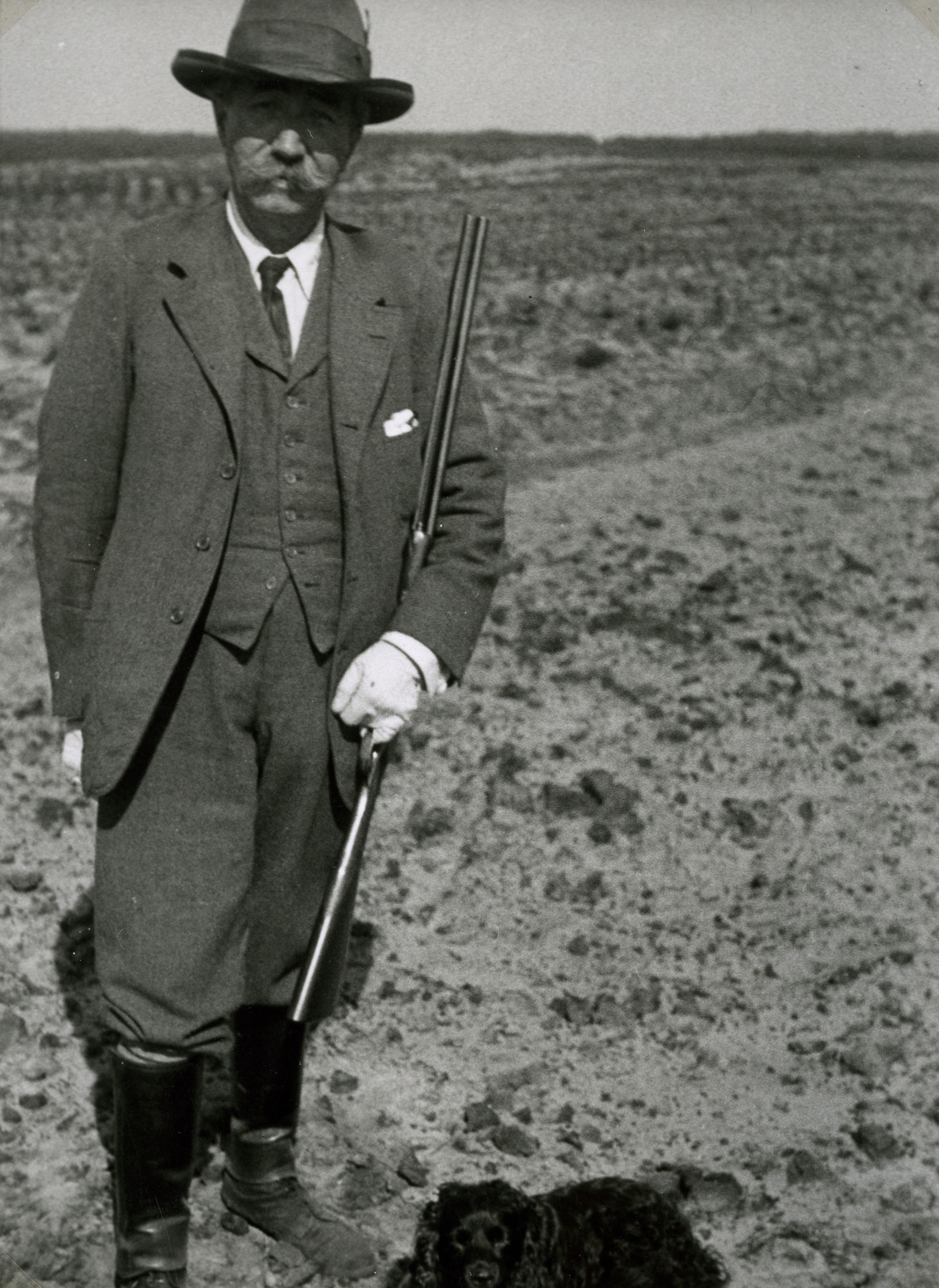

Baron Cartier de Marchienne in the “Cartierheide” natural area near Eersel, 1933.
Baron Cartier de Marchienne in the “Cartierheide” natural area near Eersel, 1933.
Photograph by Piet van Tienhoven, 1933.
© Fotoarchief Natuurmonumenten, Amersfoort (HIST no. 1668). Used by permission.
The copyright holder reserves, or holds for their own use, all the rights provided by copyright law, such as distribution, performance, and creation of derivative works. https://rightsstatements.org/page/InC/1.0/?language=en.
On 12 November 1929, the Belgian baron Émile de Cartier de Marchienne approached his friend Piet van Tienhoven, President of the Vereeniging tot Behoud van Natuurmonumenten in Nederland (Natuurmonumenten), at that time the most important conservationist association in the Netherlands. Cartier offered to donate part of his property for the purpose of nature conservation: a heathland area of 112 hectares, near Eersel in the Kempen region.
Nature conservation in the Netherlands was mainly a private affair in 1929: the private association Natuurmonumenten raised money via public campaigns and donations to purchase endangered “natural monuments.” In other countries, by contrast, conservation had become a state duty at that time, with legislation in place for designating and managing protected areas, such as the National Parks of the United States, Sweden, and Italy. The Netherlands, however, followed a different model, aligned with the United Kingdom and Belgium: nature conservation as the remit of private citizens and associations. Sometimes, Dutch state institutions did get involved. The work of the State Forestry Service (Staatsbosbeheer) was formally confined to forests and woodlands, for the purpose of timber production. The “preservation of natural beauty” was not added to Staatsbosbeheer’s duties until 1929. In the absence of a substantial state commitment, Baron Cartier’s offer was a welcome support: a generous donation from a private individual to a private association.

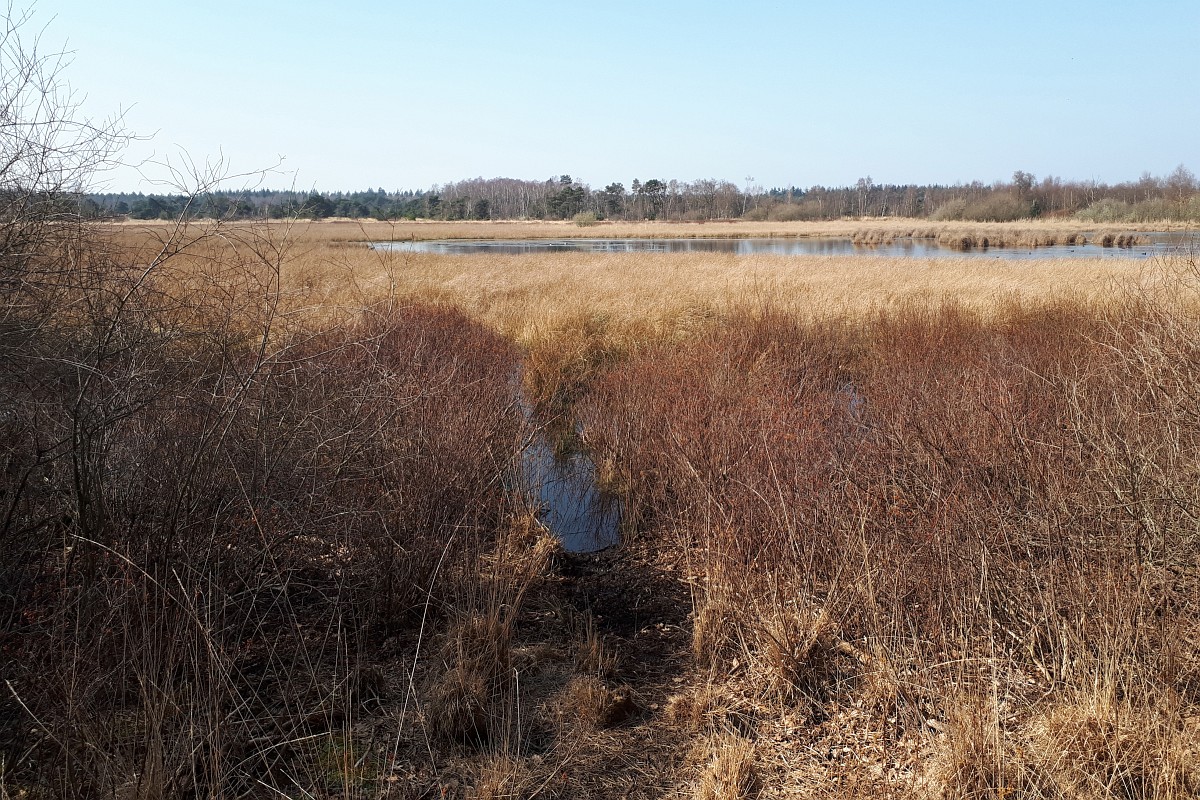
The fenland of the Cartierheide, today.
The fenland of the Cartierheide, today.
Photograph by Tom Heijnen, n.d.
Courtesy of the Saxifraga Foundation. Click here to view source.
 This work is licensed under a Creative Commons Attribution-NonCommercial-ShareAlike 4.0 International License.
Cartier de Marchienne was a top diplomat and held key positions in the Belgian foreign policy network, serving as ambassador in Washington and, from 1927, in London. He combined his diplomatic work with activities to promote the cause of nature conservation, which made him a prominent figure in international conservation networks at that time. He brought the concept of national parks to the attention of King Albert I and, in so doing, prepared the ground for the creation of the Parc National Albert (today Virunga National Park) in the Belgian Congo. Baron Cartier played a key role in the preparation of the International Conference for the Protection of Fauna and Flora of Africa, held in 1933. He helped his friend Piet van Tienhoven, the President of Natuurmonumenten, to extend his network to powerful aristocrats, diplomats, and colonial administrators. Van Tienhoven went on to become a member of the scientific advisory board for the Parc National Albert in 1929 and attended the 1933 international conference as “observer” for the Netherlands. In July 1930, Cartier invited Van Tienhoven and Natuurmonumenten’s Secretary, Jac. P. Thijsse, to his castle in Duizel to enjoy dinner and stay for the night. In the contact between Cartier and the Dutch conservationists, then, all scales of contemporary nature conservation were entangled: the international, national, colonial, but also the local and personal networks.
Cartier put forward various terms for his donation. Most of these were straightforward enough: for example, he wanted to keep the hunting rights in the area. More difficult, however, were his demands about the adjacent Hapertse Heide. That open heath area of 500 hectares had been purchased by Staatsbosbeheer in April 1929. Its plan was to reclaim the heathland and replace it with a newly planted Scots pine forest. A scientific committee (of which Thijsse, Natuurmonumenten’s Secretary, was a member) visited the area in May 1931 and expressed no concerns—but Cartier objected. There should be an unimpeded panoramic view from his property, the future “natural monument”, and a pine forest would spoil the typical Brabant heath landscape, he thought. So he used his donation as leverage: if Staatsbosbeheer would carry out its afforestation plans, he would rescind his donation.

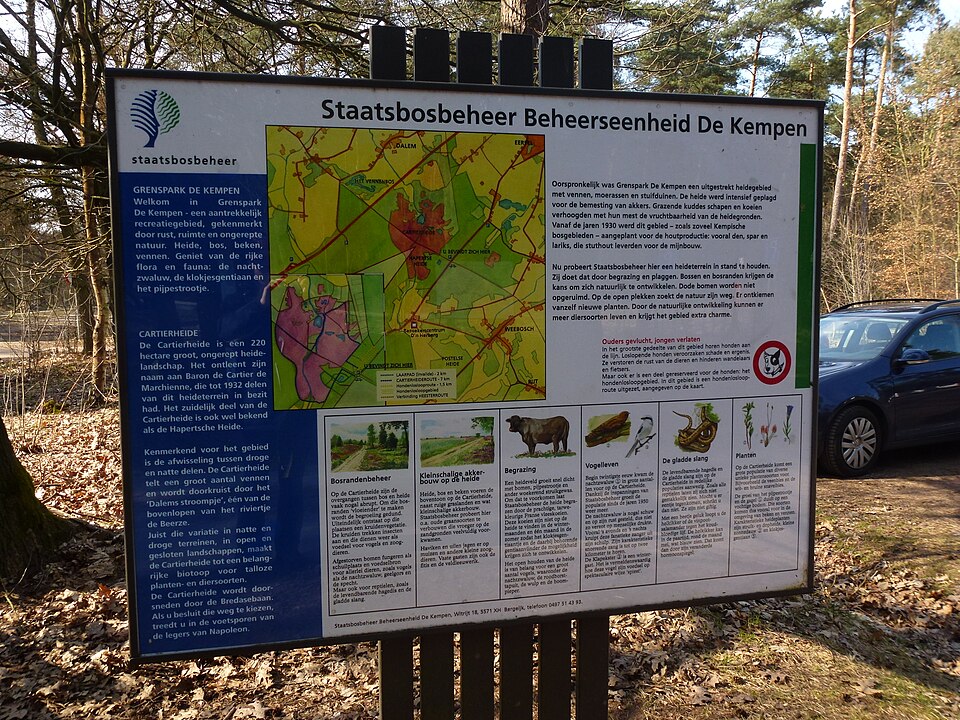
The information panel at the entrance the Cartierheide in 2013. Staatsbosbeheer manages the Cartierheide as a part of a larger management unit in the Kempen region along the Belgian border.
The information panel at the entrance the Cartierheide in 2013. Staatsbosbeheer manages the Cartierheide as a part of a larger management unit in the Kempen region along the Belgian border.
Photo by Rosemoon, 2013. Click here to view Wikimedia source.
 This work is licensed under a Creative Commons Attribution-ShareAlike 3.0 Unported License.
This put Staatsbosbeheer in an awkward position. It had bought a part of the heathland and planned to have it afforested—that is what forestry services do. Should a state institution now readjust its terrain management plans to accommodate the whims of a private owner, in order not to jeopardise his donation to a private association? In most other European countries and beyond, such demands would have been deemed outrageous.
In the Netherlands, however, it worked just fine. Van Tienhoven contacted Staatsbosbeheer to resolve the conflict. On 14 October 1931, Cartier, Van Tienhoven, Thijsse, and the responsible local forester visited the area again: after reassessing the landscape and natural beauty elements, they reached an agreement. A section of 50 hectares of the Hapertse Heide, state land, would not be afforested. As a result of the agreement, the formal transfer of property to the association Natuurmonumenten took place on 9 May 1932. In honor of the generous donor, the new natural monument was named Cartierheide (“Cartier’s heath”).
The procedure followed for the Cartierheide reflects a typically Dutch way of doing business and politics, with a focus on deliberation and finding pragmatic solutions, applied to a practical issue for the nature conservation movement. Officially, nature conservation was the responsibility of private associations, but Staatsbosbeheer, although not legally required to do so in the 1930s, was happy to co-operate and facilitate the donation of this new “natural monument” to Natuurmonumenten. All this happened without formal legislation, via back-room deals, and it proved ultimately quite successful. This procedure may not have worked in other countries or situations, but it provides an interesting lesson in how to protect a natural area beyond official laws and decrees. The Cartierheide remained in Natuurmonumenten’s hands until 1999, when the organization transferred the management of the natural area to Staatsbosbeheer, so as to ensure consistent nature management in the Kempen region.
Primary Sources
Nationaal Archief, The Hague:
- Archief Staatsbosbeheer (2.11.50): inv.nr. 506.
Stadsarchief Amsterdam:
- Archief Natuurmonumenten (999): inv.nr. 890.
- Archief Nederlandse Commissie voor Internationale Natuurbescherming (1283): inv.nr. 47, 203-204, 215.
How to cite
Mennen, Kristian. “A Generous Donation: The Case of the Cartierheide in the History of Dutch Nature Conservation.” Environment & Society Portal, Arcadia (Autumn 2026), no. 16. Rachel Carson Center for Environment and Society. doi:10.5282/rcc/10181.
ISSN 2199-3408
Environment & Society Portal, Arcadia
 This work is licensed under a Creative Commons Attribution 4.0 International License.
2026 Kristian Mennen
This refers only to the text and does not include any image rights.
Please click on an image to view its individual rights status.
- De Bont, Raf. Nature’s Diplomats: Science, Internationalism, & Preservation, 1920–1960. Pittsburgh: University of Pittsburgh Press, 2021.
- Gissibl, Bernhard, Sabine Höhler, and Patrick Kupper. Civilizing Nature: National Parks in Global Historical Perspective. New York/Oxford: Berghahn Books, 2015.
- Mennen, Kristian. Natuurbeschermers: Een politieke geschiedenis van de natuurbeschermingsbeweging (1930–1960). Hilversum: Verloren, 2025.
- Van der Windt, H. J. En dan, wat is natuur nog in dit land? Natuurbescherming in Nederland 1880–1990. Amsterdam: Boom, 1995.