
Illumination of Philip II at the Siege of Acre (1189/1191) from the Grandes Chroniques de France.
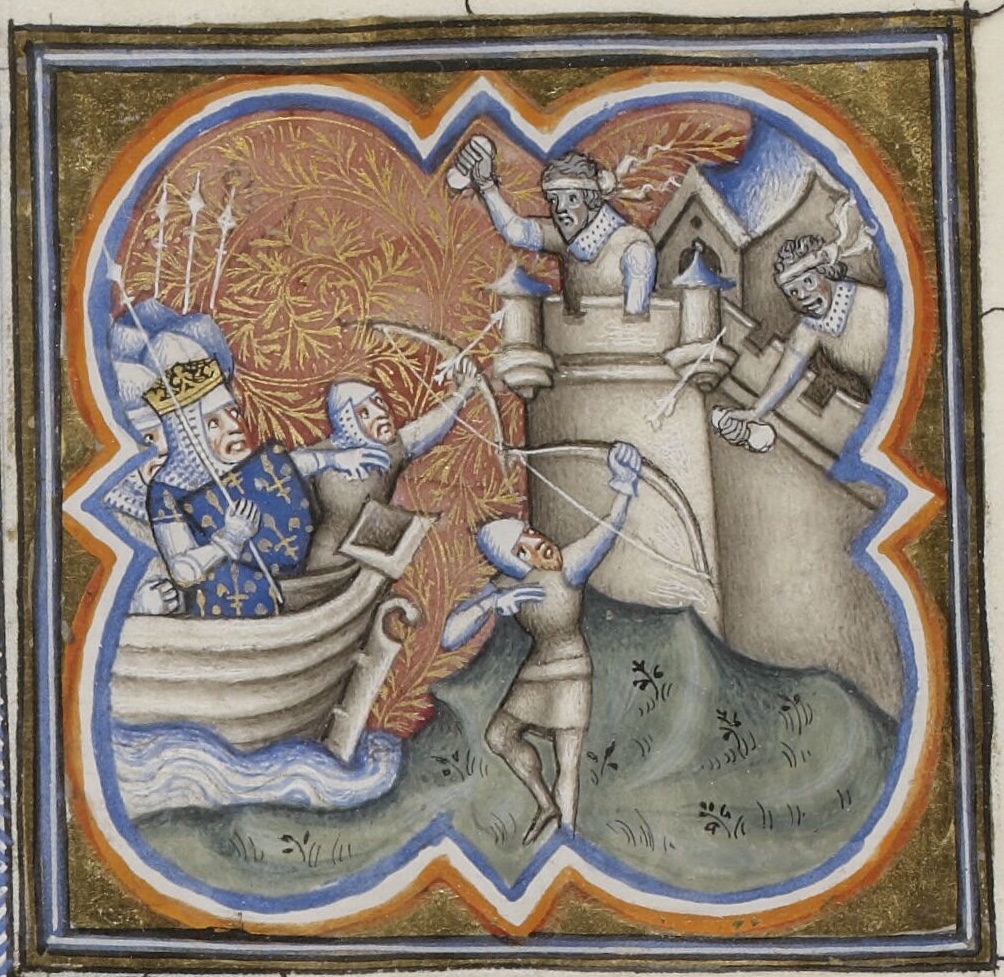
Illumination of Philip II at the Siege of Acre (1189/1191) from the Grandes Chroniques de France.
Unknown artist, n.d.
Courtesy of the Bibliothèque Nationale de France, MS Fr. 2813, f. 237r: https://mandragore.bnf.fr/ark:/12148/cgfbt43370r
 This work is licensed under a Creative Commons Attribution 4.0 International License.
In 1191, we understand, a gyrfalcon flew over the besieged walls of Acre. She was brought there by the king of France, Philip Augustus (1165–1223), arriving among his personal retinue in late April. Though the exact circumstances are unclear, the bird escaped, refusing any succulent lure that the king and his falconers may have offered. The only record of her existence comes from Saladin’s close confidant Bahā’ ad-Dīn Ibn Shaddād (1145–1234), who recorded the garrison’s testimony and his own eyewitness account in his biography of the sultan.
A rare event and a good omen: A falcon the king valued had accompanied him from his own country. It was of impressive size, white in color and of a rare type. He cherished and loved it greatly. The falcon escaped from his arm and flew off. He called it back, but it did not respond. In the end it alighted on the city wall of Acre. Our men caught it and sent it to the sultan. Its arrival caused much astonishment and was a happy omen of victory. To my eyes its color was a dazzling white. I have never seen a more handsome falcon. The Muslims considered this an auspicious event. The Franks offered 1,000 dinars for it, but this was not accepted.
—Bahā’ ad-Dīn Ibn Shaddād, al-Nawādir al-Sultāniyya wa’l-Mahāsin al-Yūsufiyya (Sultanic Anecdotes and Josephly Virtues), c.1198–1228
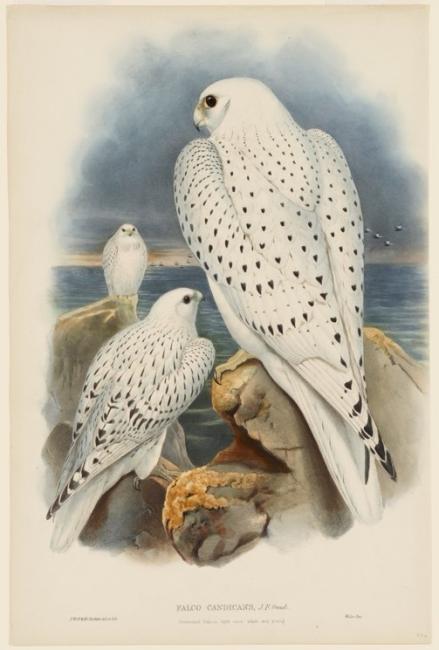
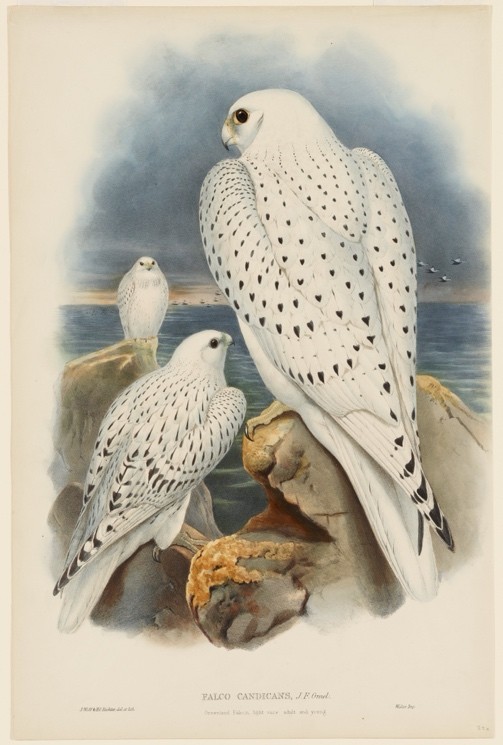
Hand-colored lithograph of Greenland gyrfalcons (Falco rusticolus) from different angles by English ornithologist John Gould.
Hand-colored lithograph of Greenland gyrfalcons (Falco rusticolus) from different angles by English ornithologist John Gould.
Illustration by John Gould, c. 1862–1873.
 This work is licensed under a Creative Commons Public Domain Mark 1.0 License.
Neither Ibn Shaddād nor any historians charmed by the story seem to have wondered much about the bird, her experience of this sequence of events, or what questions mattered to her. Releasing her story from a text exalting her new keeper and approaching the episode through the lens of multispecies intellectual history requires grounded speculation. Reconstructing the life of a bird whose inner world and body were deeply marked by entanglements foreign to her species’ customary way of life carries many risks. Yet even if the questions prove unanswerable, asking them changes the way we think, feel, and relate to, in this instance, one of innumerable animals displaced and trafficked throughout history.
Ibn Shaddād leaves little doubt that the bird was a gyrfalcon and offers clues about its background. Its impressive size strongly suggests it was an adult female, which are, on average, forty percent larger than male gyrfalcons, making them desirable for falconry. Her snowy plumage, valued in the Middle Ages for its rarity and association with purity, also hints at her natal locale. Iceland was the primary source of white and grey gyrfalcons in the late twelfth century. Grey birds were native, while white birds appeared seasonally, dispersing from Greenland in autumn to more southern wintering grounds. From this we can suggest the bird in Acre was a female gyrfalcon captured in Iceland, perhaps born there or in Greenland, where white subpopulations are most prevalent.

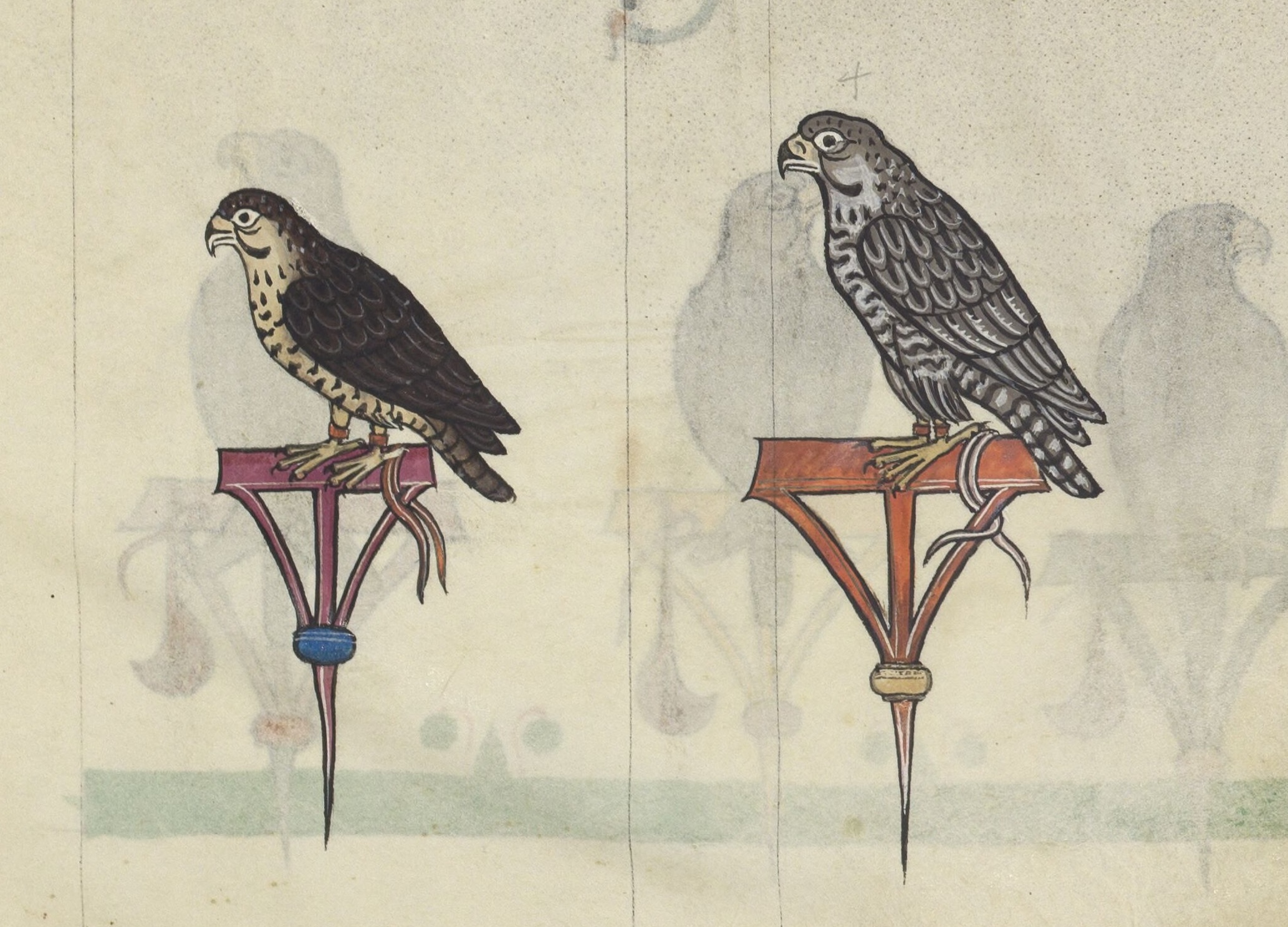
Comparison of a ‘falco’ (left), likely a saker, and a ‘girifalco’ (right) from a French translation of Frederick II’s De arte venandi cum avibus, c. 13th century.
Comparison of a ‘falco’ (left), likely a saker, and a ‘girifalco’ (right) from a French translation of Frederick II’s De arte venandi cum avibus, c. 13th century.
Illustration by Simon d’Orléans, n.d.
Courtesy of the Bibliothèque Nationale de France, MS Fr. 12400, f. 87r: https://gallica.bnf.fr/ark:/12148/btv1b525068331
This work is licensed under a Creative Commons Attribution 4.0 International License.
If so, she hatched on a sheltered ledge in the reaches of the tundra. Nestled among her siblings, she grew strong on ptarmigan and waterfowl and gazed upon the territory over which her parents ranged. This was her heritage. Yet the course of her life was profoundly altered by the desires and societal codes of another species, enraptured by her beauty and excited to take advantage of her fierce adaptation to the harsh conditions of the far north. Considering the ways in which she knew this fact forces us to think about the realities of a captured, sold, and transported bird’s experience.

Falconer in the process of descending a cliffside to take nestlings from an eyrie.
Falconer in the process of descending a cliffside to take nestlings from an eyrie.
Illustration by Simon d’Orléans, n.d.
Courtesy of the Bibliothèque Nationale de France MS Fr. 12400, f. 95v: https://gallica.bnf.fr/ark:/12148/btv1b525068331
This work is licensed under a Creative Commons Attribution 4.0 International License.
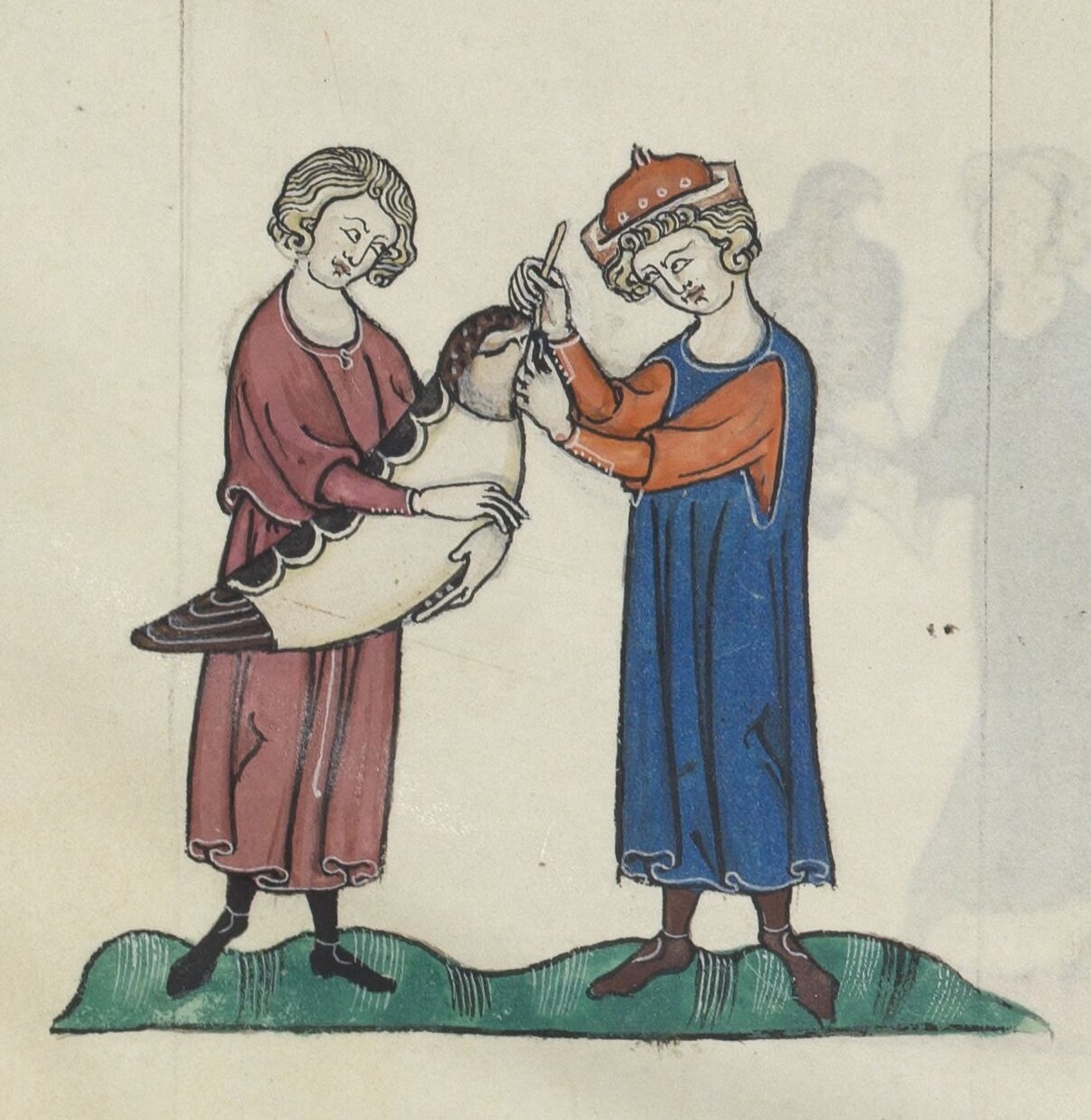
Her encounter with falcon-catchers came by surprise. She could have been taken from the nest as an eyas but was more likely trapped: suddenly entangled in a net and stuffed into a sock. Hands constrained her as needle and twine pierced and drew her eyelids shut. Temporarily blinding birds, a process known as seeling, was one technique of sensory control used to retrain behaviors and expectations, intended to habituate her to the apparatuses of falconry and hunt alongside people, other birds, dogs, and horses in pursuit of foreign prey in unfamiliar spaces. Removed from her way of life, she was deprived of her piercing vision and flooded with new stimuli and stresses.
Loaded onto a vessel likely set for Norway, she was leashed to a perch and fed freshly butchered meat from invisible palms. This was the first of many such voyages as she was gifted between royal or ecclesiastical powers before landing in Paris. How many years she spent in France, we cannot know, but her journey from Paris to Acre is clear. Assuming she traveled with the king’s party, she set off in late June 1190 and arrived by ship at Acre in April of the following year. According to Ibn Shaddād’s account, she escaped soon after.

Two falconers seeling a wild-caught falcon. One assists by holding the bird in a cloth cover called a sack to immobilize it, while the other sews thread through the lower eyelids so they can be drawn upward to cover the eyes.
Two falconers seeling a wild-caught falcon. One assists by holding the bird in a cloth cover called a sack to immobilize it, while the other sews thread through the lower eyelids so they can be drawn upward to cover the eyes.
Illustration by Simon d’Orléans, n.d.
Courtesy of the Bibliothèque Nationale de France MS Fr. 12400, f. 113r: https://gallica.bnf.fr/ark:/12148/btv1b525068331
This work is licensed under a Creative Commons Attribution 4.0 International License.
Stretching her wings, did she feel a sense of renewal following extended captivity? The twelfth-century Byzantine chronicler Constantine Manasses wrote of hunting birds in his ekphrasis, Description of a Crane Hunt, that once released “everything depends on them, while the men stand there gaping at the sky and the clouds without being able to help the birds in their aerial combats.” There was a pervasive power imbalance between falconer and falcon, but the hunt required physical release. She was out of the gauntlet’s reach, out of human control, possibly in control. Philip was left staring at the sky.
We can only imagine why she did not return, but speculations can be supported by Frederick II’s highly experienced observations in his falconry treatise De Arte Venandi cum Avibus (c.1240s).
It looks as though Philip allowed her little respite, flying her shortly after an exhausting journey. Shipping was strenuous and often deadly for birds. Frederick reports that those who survived long-distance travel were often mishandled and atrophied from sedentism, requiring a long recovery period. Even a few weeks of inactivity could be devastating. Philip also flew her during the spring breeding season. Frederick observed that his falcons lost their desire to chase, bated from the glove in anger or anxiety, and responded reluctantly to food at this time of year. He therefore recommends grounding them entirely from March until September. Philip did not retire her.
Perhaps she flew in search of a companion. Scandinavian gyrfalcons were traded to Baghdad in late Abbasid times, but the trade seems to have collapsed in the early tenth century and did not resume in significant numbers until the mid-thirteenth. Our gyrfalcon would have been a great rarity in the region. We cannot know if the gyrfalcon, as a relatively solitary species, experienced something akin to what we call loneliness. For us, aware of her predicament and imagining her confused, philopatric longing to return to her home territory—or at least to find a mate—it is difficult to regard the gyrfalcon as anything but dislocated, profoundly alone.

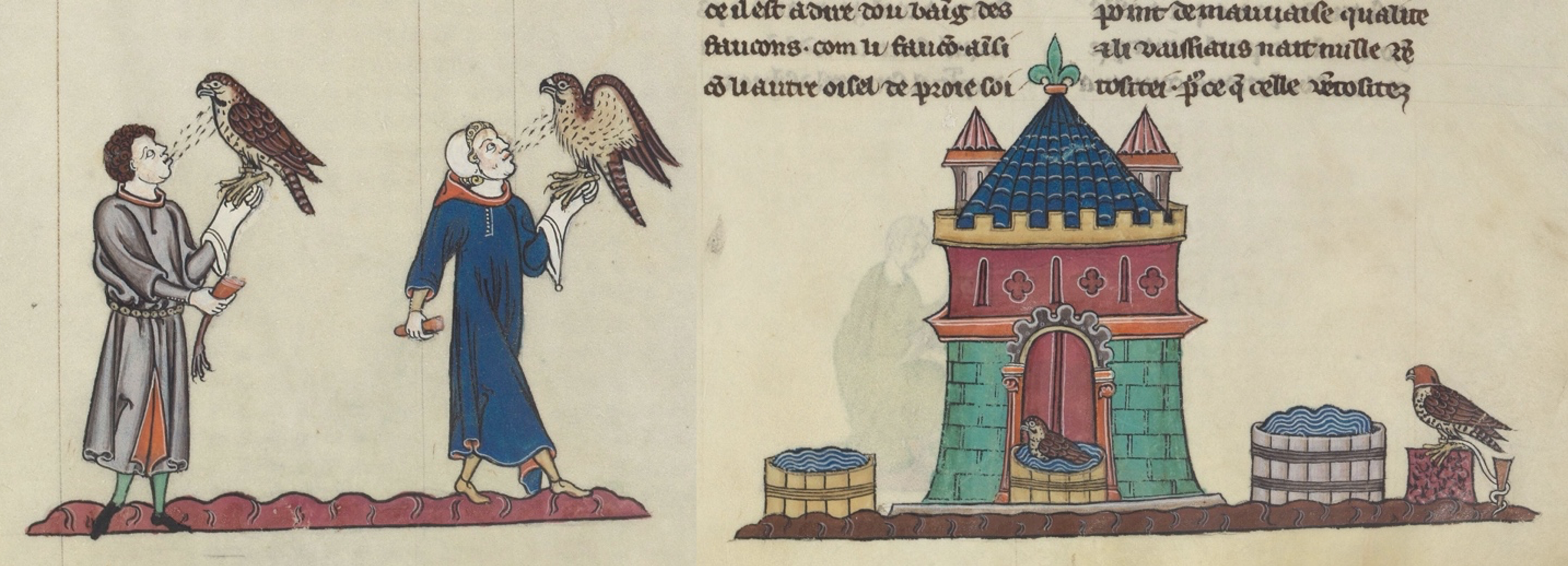
Falconers cooling birds by spraying cool water from their mouths and mews supplied with baths of cold water.
Falconers cooling birds by spraying cool water from their mouths and mews supplied with baths of cold water.
Illustration by Simon d’Orléans, n.d.
Courtesy of the Bibliothèque Nationale de France MS Fr. 12400, fols. 157r and 158r: https://gallica.bnf.fr/ark:/12148/btv1b525068331
This work is licensed under a Creative Commons Attribution 4.0 International License.
She found herself in an inhospitable environment, over five thousand kilometers from her homeland.
Did she feel hot?
The largest and northernmost true falcon, a gyrfalcon’s size and dense plumage are specially adapted to conserve body heat in freezing conditions. The same traits make heat and humidity insufferable. With extended exertion in flight, a gyrfalcon in Acre’s Mediterranean climate may have experienced heat stress. Frederick went to great pains and expense to prevent his falcons from overheating, advising falconers to spray and bathe birds with cold water, rest them at midday, and even travel with them at night to avoid heat-induced illness. Unable to properly thermoregulate without the regimen of knowledgeable keepers, her physiology turned against her.
Alighting on the city wall, she was recaptured, this time by Saladin’s men. Ibn Shaddād tells us that Saladin later elected to keep the gyrfalcon in his care. From here, she disappears, presumably into the Levant.
What was a spectacular interlude from the violence of religious warfare was equally a moment of turbulence for the bird above Acre. Comparing human and avian perspectives has inadvertent yet fundamental implications for the mood of Ibn Shaddād’s narrative. Tensions emerge between the gyrfalcon, her adaptations to her native ecosystem, the environment in which she found herself, and humans, whose cultural values and aristocratic pastimes impelled her capture, displacement, and training. The latter was a difficult process. It required falcon and humans attune to each other’s behaviors, needs, company, and rhythms of life. These bonds were messy, violable connections. The gyrfalcon was not, and would never be, completely subdued. Yet she was evidently dependent on her captor-caretakers for survival in a clime unsuitable to her wellbeing.
What she experienced in her flight above Acre in 1191—what memories, emotions, or sensations welled up inside her between her escape and recapture—we cannot know. By straining to understand, however, we can recognize the unfathomable depths of a sentient being relegated to narrative adornment, kidnapped to enrich human stories. A field that takes as basic that the world, history, and the power of knowing do not belong, at least exclusively, to humans must ask, and attempt to answer, such questions because they mattered to nonhuman subjects whose stories stain visible the normative assumptions that have long refused historians the possibility of wondering: wondering about the gyrfalcon and her flight over Acre.
Primary Sources
- Frederick II. The Art of Falconry: Being the De Arte Venandi Cum Avibus of Frederick II of Hohenstaufen. Trans. and ed. Casey A. Wood and F. Marjorie Fyfe. Stanford, CA: Stanford University Press, 1961.
- Ibn Shaddād, Bahāʼ al-Dīn Yūsuf ibn Rāfiʿ. The Rare and Excellent History of Saladin, or al-Nawādir al-Sulṭāniyya Wa’l-Maḥāsin al-Yūsufiyya. Trans. and ed. D. S. Richards. Aldershot: Ashgate, 2002.
- Messis, Charles, and Ingela Nilsson. “The Description of a Crane Hunt by Constantine Manasses: Introduction, text and translation.” Scandinavian Journal of Byzantine and Modern Greek Studies 5 (2019): 9–89.
- Contract between Hugh, Duke of Burgundy and legate of Philip II, King of France, and the Genoese consuls for the ferry of troops assigned to the Holy Land expedition on 16 February 1190. “Hugo Burgundiae dux, Philippi II Francorum regis legatus, pro transfretandis militibus expeditioni Terrae Sanctae addictis, cum ianuensibus consulibus pacta init.” In Historiae Patriae Monumenta VII, Liber Jurium Reipublicae Genuensis, t. I, 355. Turin: Augustae Taurinorum ex Officina Regia, 1854.
How to cite
Mealiffe, Ryan. “Asking Avian Questions: A Gyrfalcon Flew over Acre in April. Did it Feel Hot?.” Environment & Society Portal, Arcadia (Autumn 2026), no. 14. Rachel Carson Center for Environment and Society. doi:10.5282/rcc/10178.
ISSN 2199-3408
Environment & Society Portal, Arcadia
This work is licensed under a Creative Commons Attribution 4.0 International License.
Ryan Mealiffe
This refers only to the text and does not include any image rights.
Please click on an image to view its individual rights status.
- Baratay, Éric. “Building an Animal History.” In French Thinking About Animals, edited by Louisa Mackenzie and Stephanie Posthumus, 3–14. East Lansing: Michigan State University Press, 2015.
- Buquet, Thierry. “The Gyrfalcon in the Middle Ages, an Exotic Bird of Prey (Western Europe and Near East).” In Falconry in the Mediterranean Context During the Pre-Modern Era 9, edited by Charles Burnett and Baudouin Van den Abele, 79–98. Geneva: Droz, 2021.
- Despret, Vinciane. What Would Animals Say If We Asked the Right Questions? Minneapolis: University of Minnesota Press, 2017.
- Ellis, Caitlin, and Sam Ottewill-Soulsby. “The Caliph and the Falcons: A Ninth-Century History from Iceland to Iraq.” Early Medieval Europe 34, no. 2 (2026): 299–322.
- Hosler, John D. Siege of Acre, 1189–1191: Saladin, Richard the Lionheart, and the Battle That Decided the Third Crusade. New Haven, CT: Yale University Press, 2018.
- Lie, Ragnar Orten. “Falconry, Falcon-Catching and the Role of Birds of Prey in Trade and as Alliance Gifts in Norway (800–1800 AD) with an Emphasis on Norwegian and Later Foreign Participants in Falcon-Catching.” In Raptor and Human: Falconry and Bird Symbolism Throughout the Millennia on Global Scale, edited by Karl-Heinz Gersmann and Oliver Grimms, 727–86. Kiel: 2018.