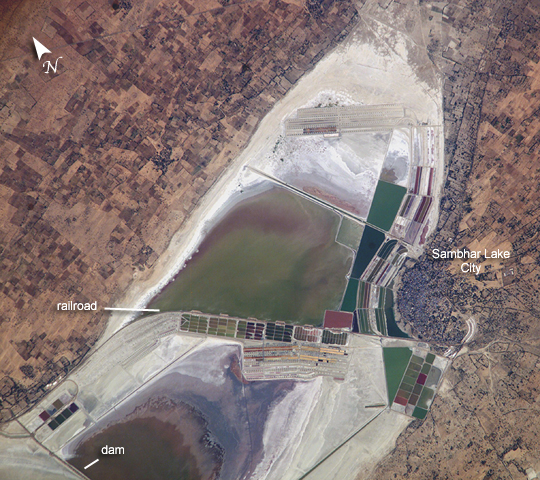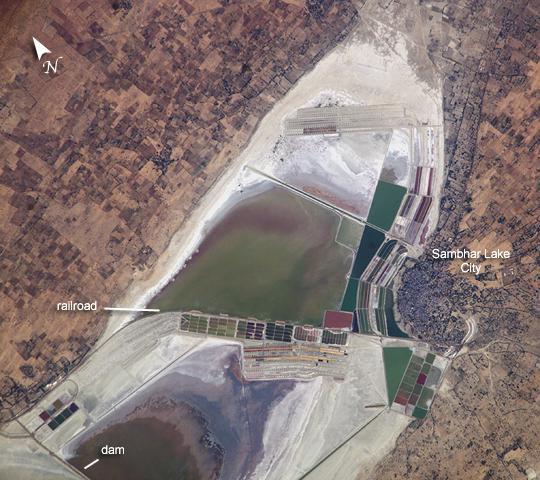
Aerial view of Sambhar Lake in 2004.
Aerial view of Sambhar Lake in 2004.
Photograph by NASA, 2004. Click here to view Wikimedia source.
 This work is licensed under a Creative Commons Public Domain Mark 1.0 License.
Salt deposits have been extracted for centuries from Sambhar Salt Lake, India’s largest inland salt farm. Since the 1990s, groundwater at the lake has been at critical levels. The water catchment area of the lake dropped from 53,000 km² in 1969 to 7560 km² in 2004—devastation caused by regional irrigation and dams that have disarticulated the watershed, with the area now listed as a “dark zone” by the Central Ground Water Board; a zone where water recharge is exceeded by extraction. Despite the fact that the lake is recognized as a wetland through RAMSAR (1990) and as a Key Biodiversity Area (2004), alongside other recognitions, groundwater depletion and pollution continue to worsen. Custody over the lake’s environment and resources are contested; in 2010, a ban on salt production along a stretch of 38 km by the state Department of Environment and Forests was rejected by local revenue officers because of the damage the ban would inflict on local livelihoods. Recent fractious debates over the exploitation of groundwater have fragmented the ecology of the lake and created a bureaucratic paralysis. Repeated outbreaks of avian botulism—connected to rising temperatures and dramatic monsoon events that have decreased the lake’s salinity and allowed Clostridium botulinum to thrive—have killed tens of thousands of birds since 2019.
I argue that the environmental crisis at Sambhar Salt Lake has been worsened by two phases in the long history of salt exploitation: from the late nineteenth century, colonial attempts to engineer the lake in order to lessen the influence of the monsoons on salt production; and from the mid-twentieth century, fractious competition between a state monopoly and independent producers over the depleting groundwater brine resources.
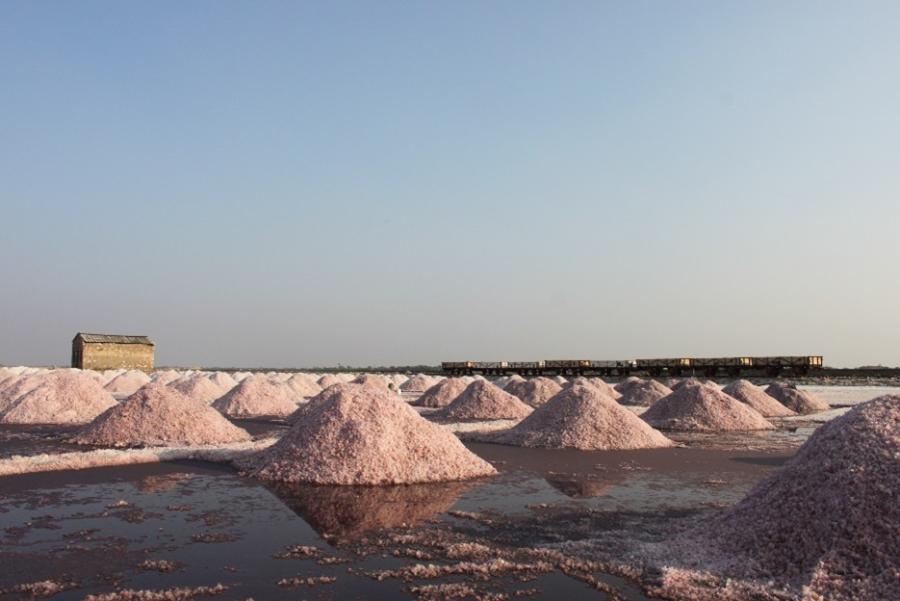
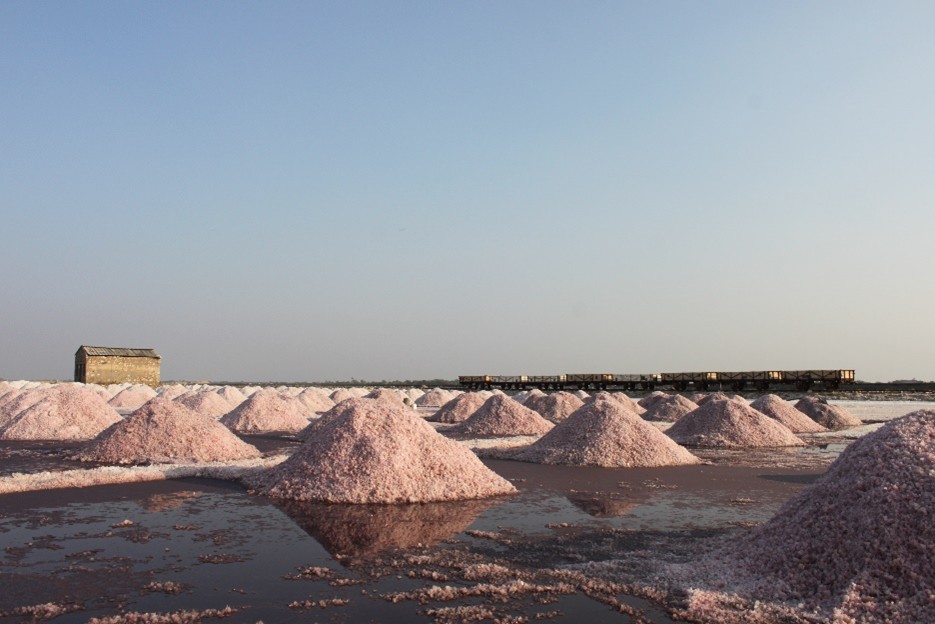
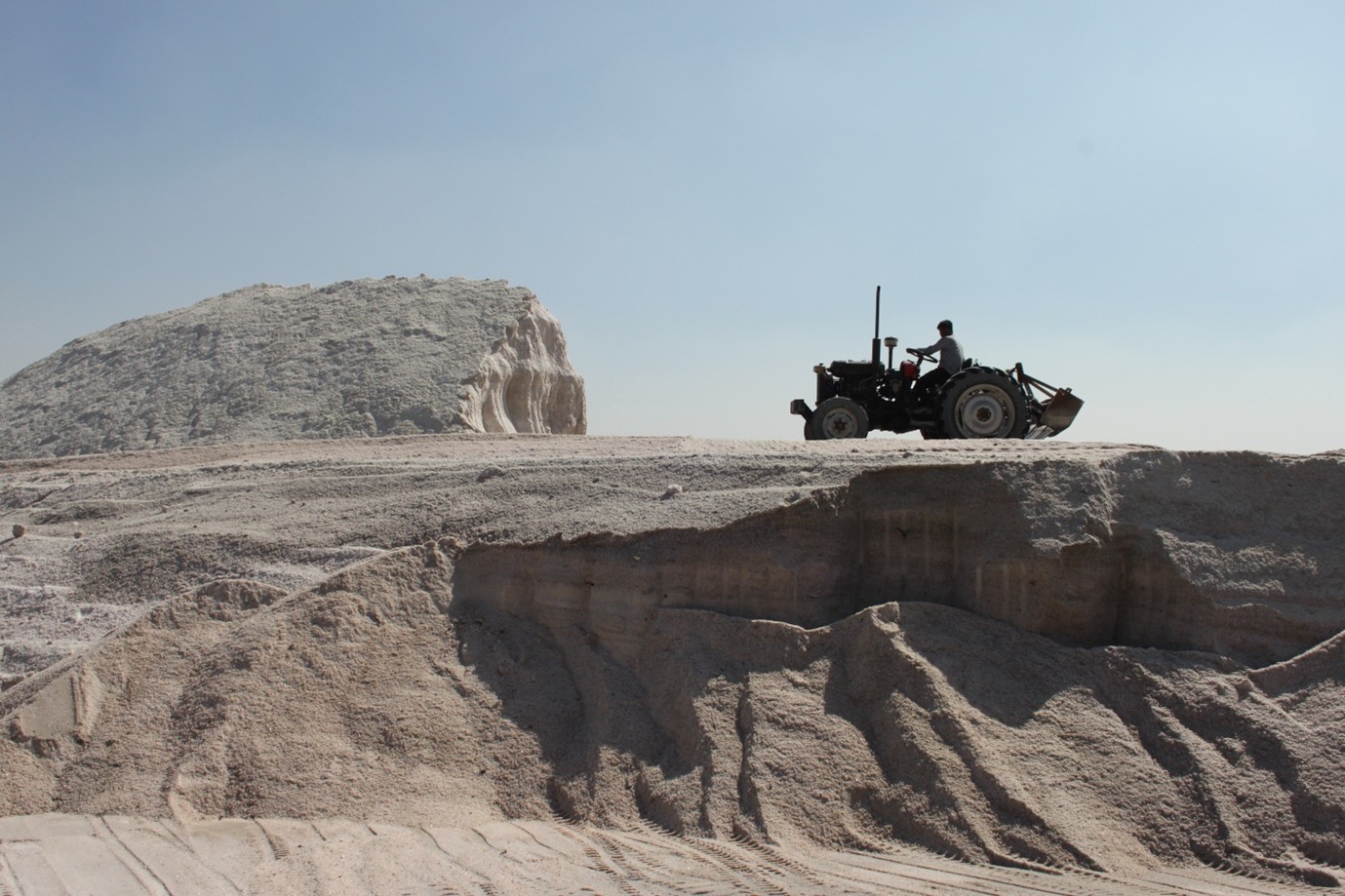
Piles of salt collected from crystallization pans at eastern end of lake, February 2024.
Piles of salt collected from crystallization pans at eastern end of lake, February 2024.
Photograph by Deborah Sutton.
 This work is licensed under a Creative Commons Attribution 4.0 International License.
Imperial Salt Production at Sambhar Salt Lake
The imperial state, which leased the lake from the native states of Jaipur and Bikaner in 1869, set about transforming salt production from the end of the nineteenth century.
The exploitation of salt deposits requires sufficient water to create brine for salt production. Lake water was provided during the monsoon season by four rivers: Mentha, Rupangarh, Khari, and Khandela. During the dry season, the lake would retreat and salt crusts would form at the center and in beds excavated from the lake mud around its margins. Heavy, concentrated rainfall between June and August created huge amounts of brine in the lake. Imperial salt production regarded rainfall variability as a persistent problem: it was the wildcard that could be either insufficient or torrential to the point of destroying both the salt works and stored salt. From the 1880s, the imperial salt department attempted to uncouple salt production from the monsoon by sinking wells to exploit groundwater.
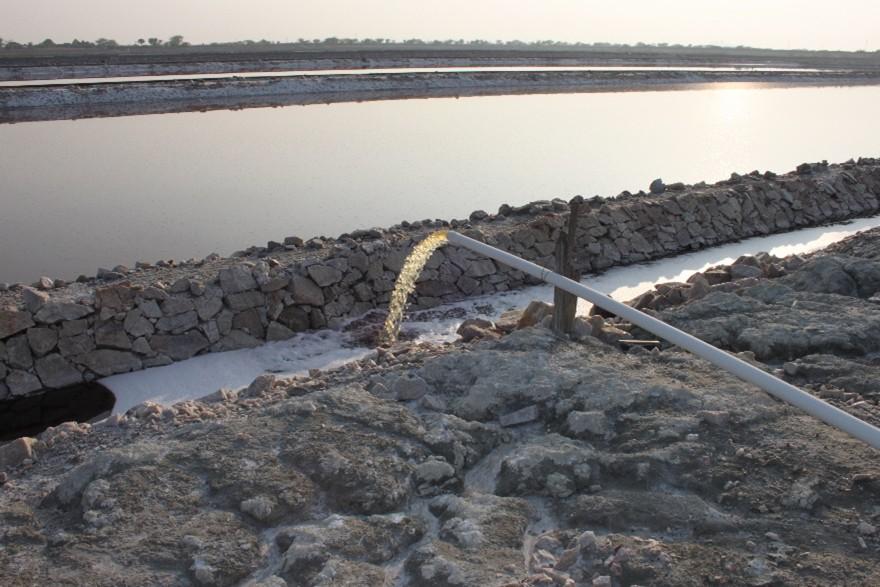
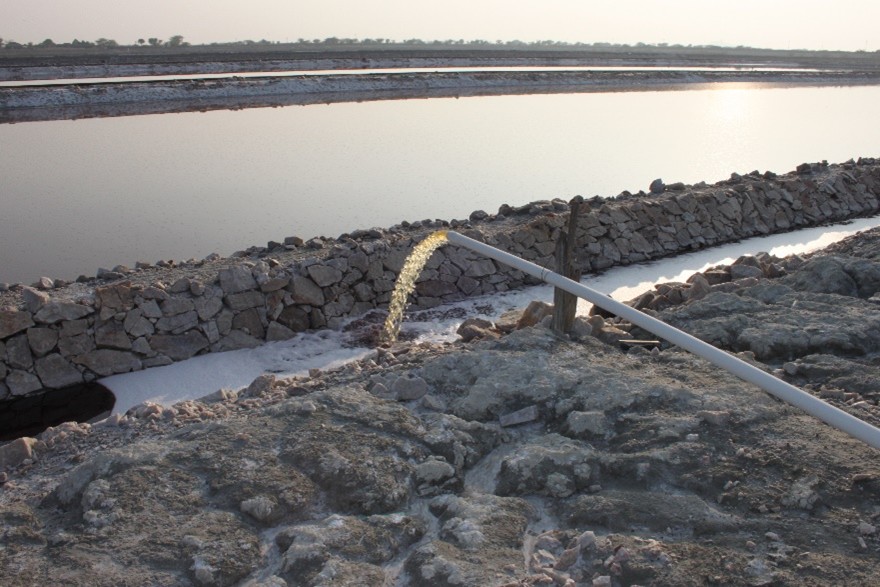
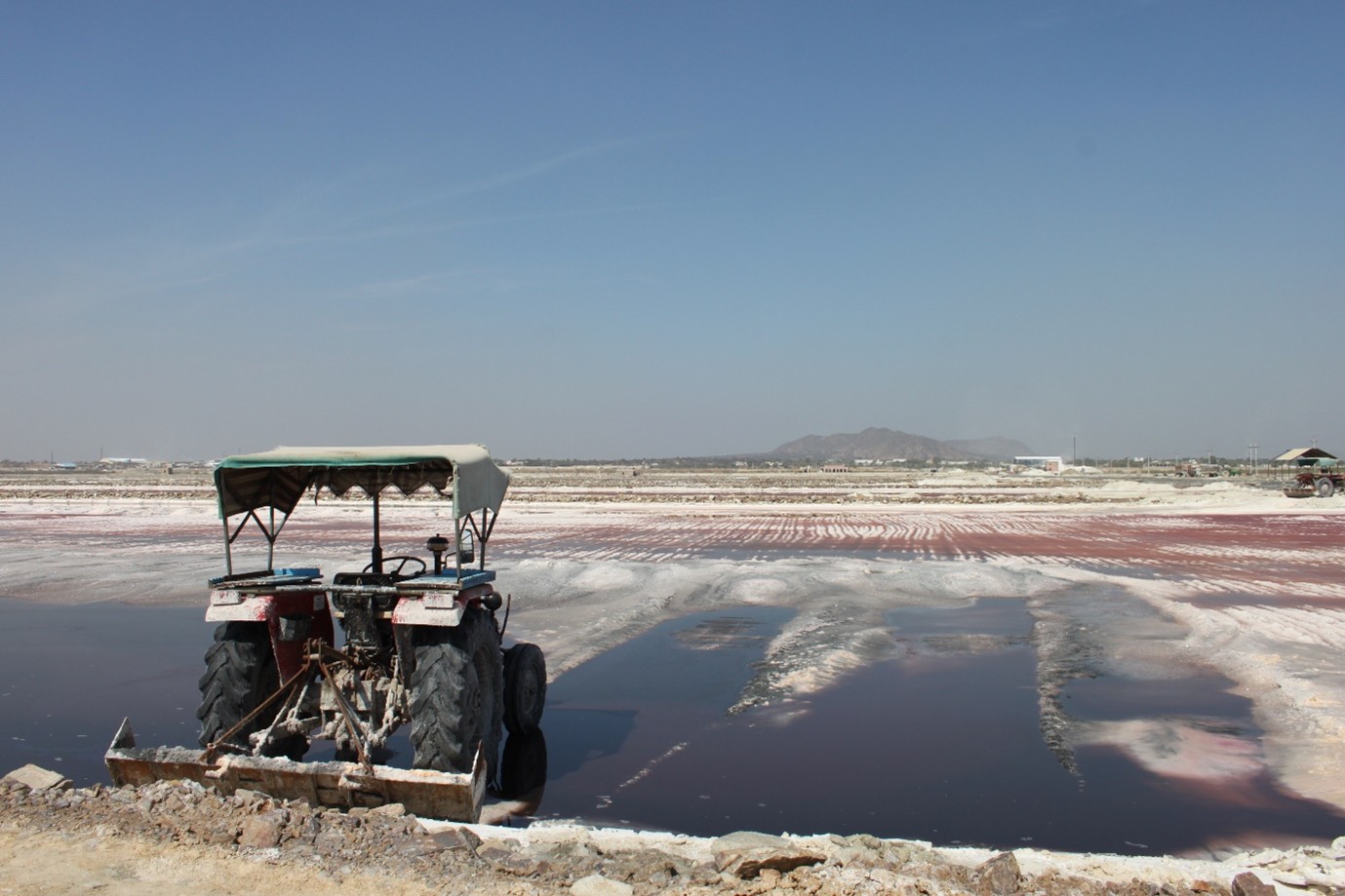
Crystallization pan from groundwater brine pumped from a borewell at Sambhar Lake.
Crystallization pan from groundwater brine pumped from a borewell at Sambhar Lake.
Photograph by Deborah Sutton, February 2024
This work is licensed under a Creative Commons Attribution 4.0 International License.
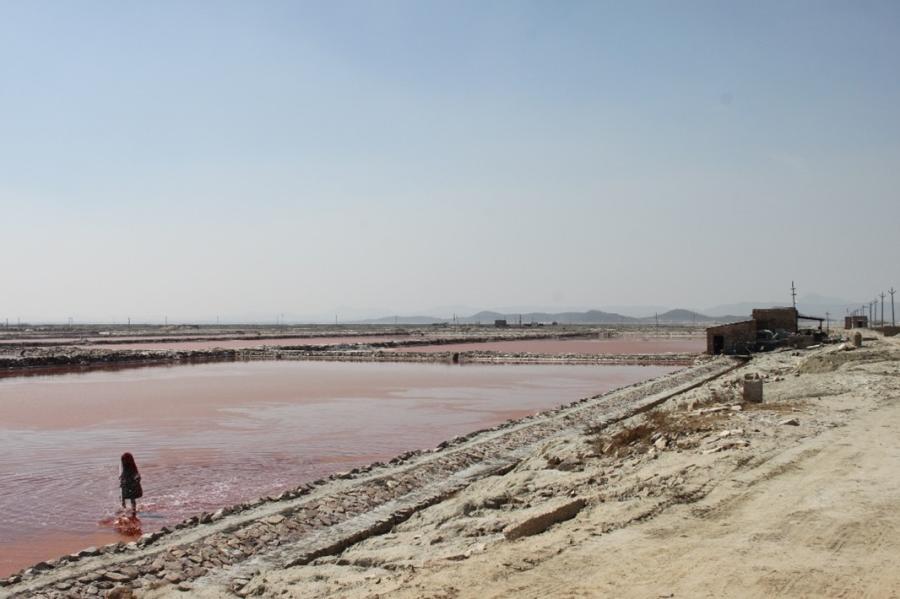
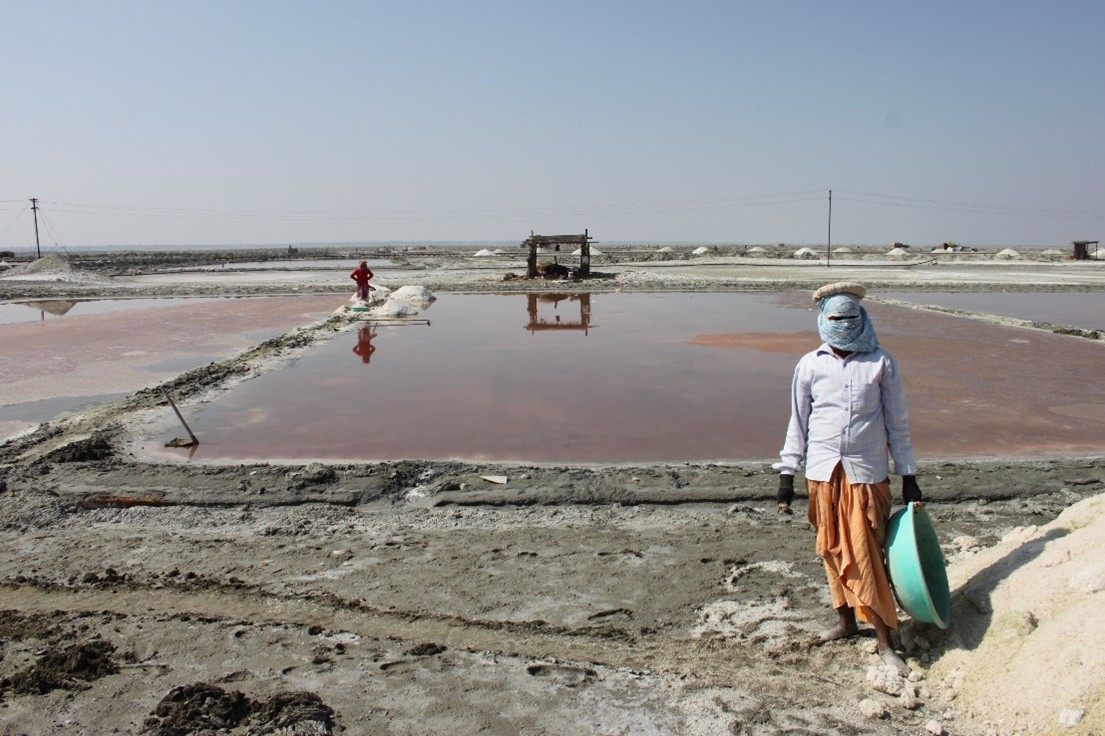
A laborer breaks a layer of salt in the crystallization pan.
A laborer breaks a layer of salt in the crystallization pan.
Photograph by Deborah Sutton, February 2024.
This work is licensed under a Creative Commons Attribution 4.0 International License.
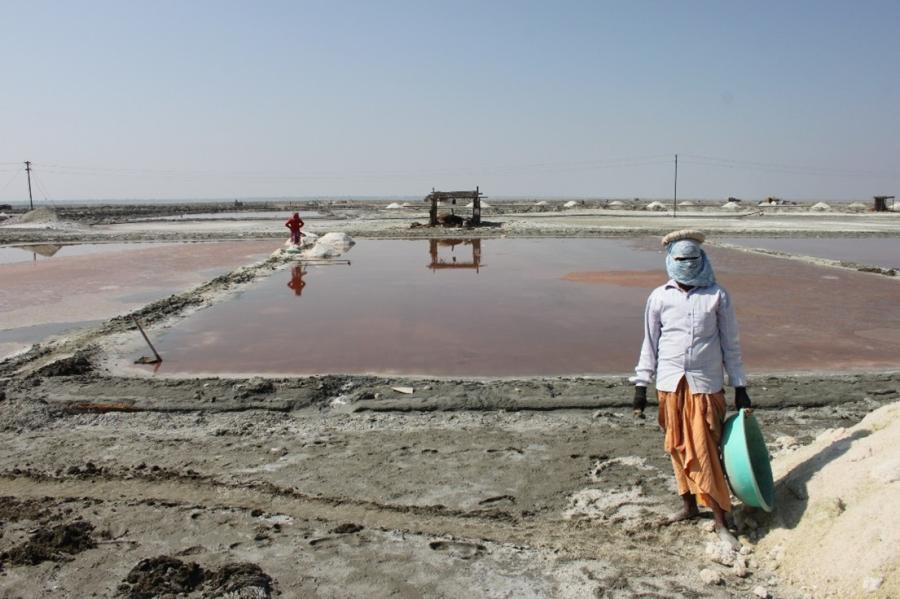
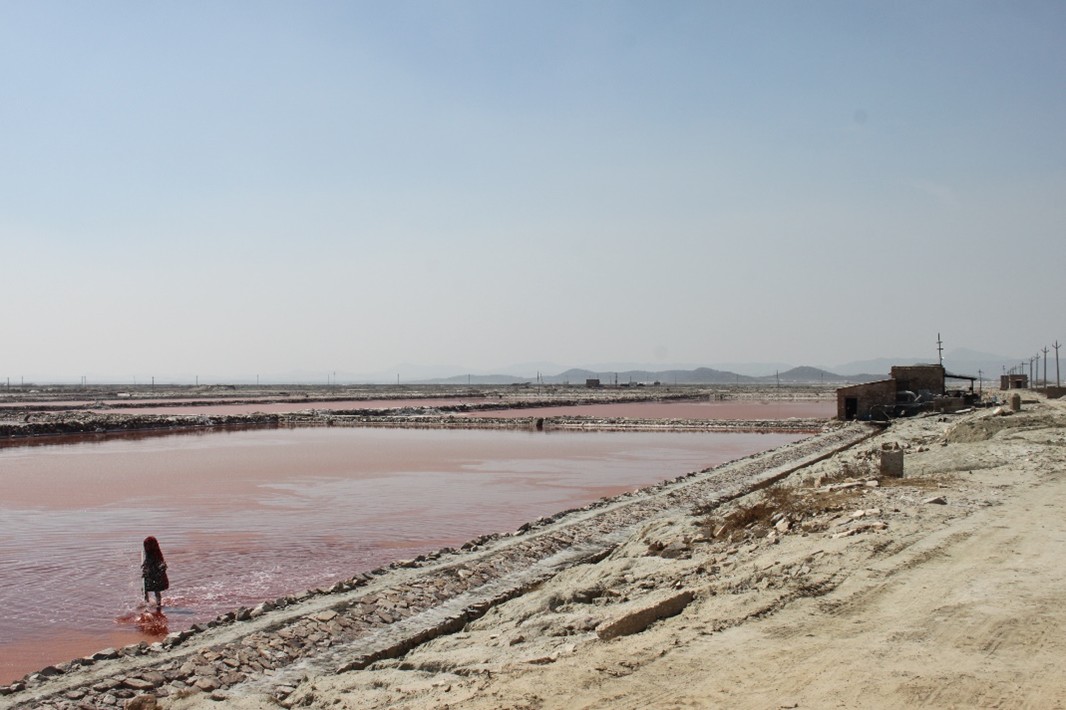
Salt crystallization pans in Nawa, entirely reliant on sub-soil brine at the Nawa Salt Works.
Salt crystallization pans in Nawa, entirely reliant on sub-soil brine at the Nawa Salt Works.
Photograph by Deborah Sutton, February 2024.
This work is licensed under a Creative Commons Attribution 4.0 International License.
Subterranean brine was regarded as a more constant and reliable supply than the seasonal monsoon and was drawn from the ground to feed evaporation pans. In addition, a two-and-a-half-mile dam was built in 1921, creating a 13 km² reservoir from which brine was pumped into pans for evaporation and salt crystallization. These changes promised to revolutionize the extraction of salt and production was forecast at a steady 200,000 tons per year, regardless of rainfall. However, the monsoons continued to exercise extraordinary force. A new reservoir constructed in 1924 was almost entirely destroyed by a flood in the following monsoon when the water level increased by 1.5 meters within 28 hours.
Salt Production After 1947
With independence, salt extraction was remodeled once again. Duties on salt, which had been a material and symbolic focus of the anti-imperial non-cooperation movement in the early 1930s, were abolished, and a series of measures were introduced to encourage small-scale salt manufacture. In 1953, the Salt Cess Act re-modelled the role of the Salt Commissioner and encouraged smaller-scale co-operatives in a separate, agrarian economic sphere.
The rights of the state to extract salt from the lake were divided between the central and state governments by the V. T. Krishnamachari award in 1964. This award gave exclusive rights to the lake salt to a new company, Sambhar Salts Limited, of which 60% was held by Hindustan Salts Limited, a central government company, and 40% by the Government of Rajasthan.
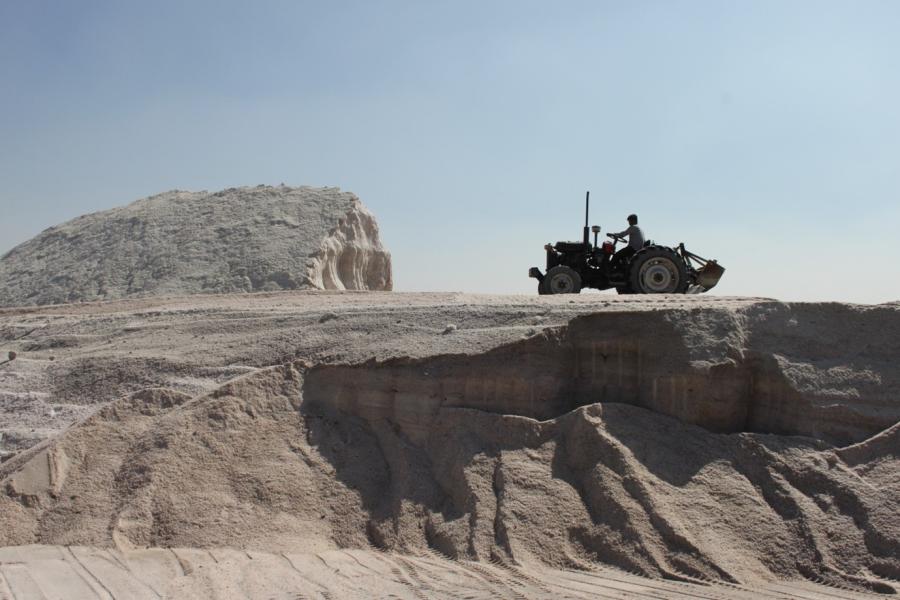
Salt is produced at the Sambhar Salt Limited Nawa Salt Works from subsoil brine on a massive scale.
Salt is produced at the Sambhar Salt Limited Nawa Salt Works from subsoil brine on a massive scale.
Photograph by Deborah Sutton, February 2024.
This work is licensed under a Creative Commons Attribution 4.0 International License.
With economic liberalization in the 1980s, Sambhar Salts Limited lost its monopoly on iodized salts, subsidies were removed, and the company began to lose money. Sambhar Salts Limited retained the sole rights to extract salt from the lake. However, beyond the lake, private production of salt—reliant on borewells to extract groundwater brine—thrived, creating increasingly antagonistic competition between the two. This division exacerbated a divide between the contract government status of the Sambhar Salts Limited and the Rajasthan State government’s jurisdiction over local governance and responsibilities for environmental management.
The environmental deterioration of the lake has been exacerbated by uncontrolled and competitive groundwater extraction, as well as the diversion of seasonal water for agricultural irrigation schemes. The antagonism between state and private salt production has fractured the custody of the lake, making collaborative stewardship of the ecology of the lake near impossible. Sewage and industrial contamination of the lake have intensified, resulting in significant sedimented heavy metal pollution. Divisions have intensified between corporate and private interests—and between the Rajasthan and central government—over depleting groundwater.
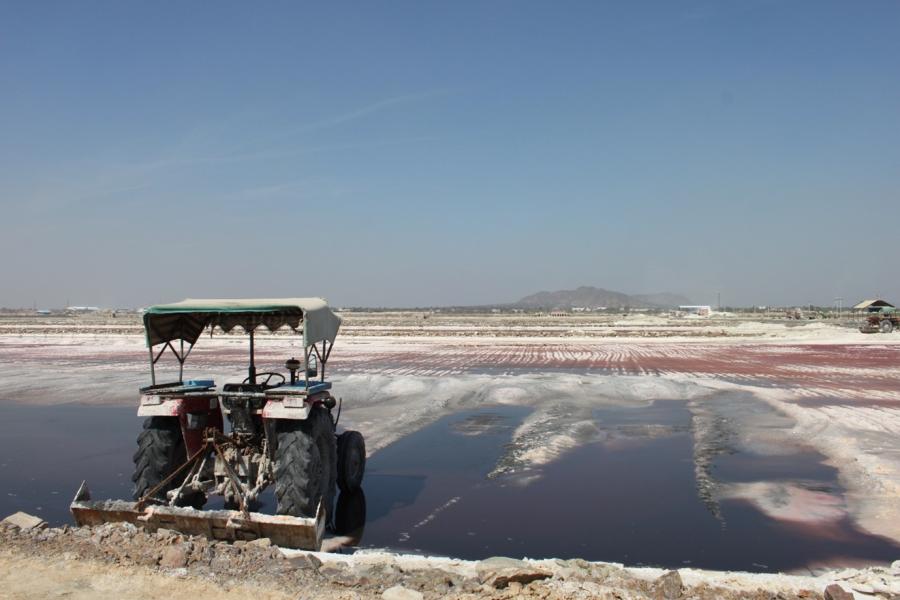
Nawa Salt Works, Sambhar Lake.
Nawa Salt Works, Sambhar Lake.
Photograph by Deborah Sutton, February 2024.
This work is licensed under a Creative Commons Attribution 4.0 International License.
Sambhar Salts Limited has attempted to leverage environmental protections to attack the exploitation of brine by private producers, lobbying the Central Ground Water Board and the National Green Tribunal to enforce what are, at best, ambiguous regulations of saline groundwater. This contestation puts environmental regulations at the service of ecological commodification and resource exploitation. It also fails to acknowledge the longstanding reliance on groundwater for salt production and exonerates Sambhar Salts Limited’s regime of salt production that is also at odds with, rather than in harmony with, the monsoon. Sambhar Salts’ tactical conservationism and antagonism towards private salt extraction around the lake isolates the management of the lake from the calamity of regional watershed management over the last hundred years.
How to cite
Sutton, Deborah. “Between Salt and Water: The Environmental Crisis at Sambhar Lake, Rajasthan, India.” Environment & Society Portal, Arcadia (Spring 2026), no. 1. Rachel Carson Center for Environment and Society. doi:10.5282/rcc/10055.
ISSN 2199-3408
Environment & Society Portal, Arcadia
This work is licensed under a Creative Commons Attribution 4.0 International License.
2026 Deborah Sutton
This refers only to the text and does not include any image rights.
Please click on an image to view its individual rights status.
- Aggarwal, S. C. The Sambhar Lake Salt Source. Government of India Press, 1951.
- Baid, I. C. “The Arthropod Fauna of Sambhar Salt Lake, Rajasthan, India.” Oikos 19, no. 2 (1968): 292–303. doi:10.2307/3565015.
- David, A. “Superintendent, Northern Indian Salt Revenue, Nawa, to General Manager, Rajputana Salt Sources, Sambhar.” 20 December 1930, Remodelling of Pans, no. 11–13. General Manager’s Office, Sambhar, NAJ.
- Ghosh, Sudipta, Sohini Das, Arindam Gantait, Shubhabrata Mukhopadhyay, and Sanjay Das. “Ecological Risk Mapping and Heavy Metal Assessment in Sambhar Lake Sediments, Rajasthan, NW India.” Discover Geoscience 3, no.1 (2025): 220. doi:10.1007/s44288-025-00333-0.
- Kothiyal, Tanuja. “Salt, Sovereignty and Law in Colonial India: The Case of Rajputana Salt in the Late Nineteenth Century.” South Asia 46, no. 4 (2023): 774–90. doi:10.1080/00856401.2023.2235858.
- Sambhar Salt Limited. Annual Report. Jaipur, 1965.
- Sinha, R., and B. C. Raymahashay. “Evaporite Mineralogy and Geochemical Evolution of the Sambhar Salt Lake, Rajasthan, India.” Sedimentary Geology 166, no. 1 (2004): 59–71. doi:10.1016/j.sedgeo.2003.11.021.