


Exhibition chapter
The Power of a Book | Rachel Carson’s Silent Spring
This is Chapter 1 of the exhibition “Rachel Carson’s Silent Spring: A book that changed the world” by historian Mark Stoll.
This is Chapter 1 of the exhibition “Rachel Carson’s Silent Spring: A book that changed the world” by historian Mark Stoll.
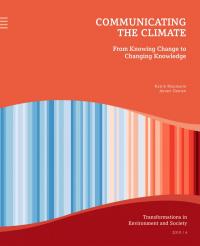
Tabak explores the potential of novels for communicating about climate change.
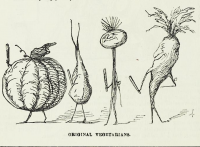
While English satire magazines mocked vegetarianism since the 1840s, the first German caricatures appeared some 30 years later. Early drawings often imagined that a vegetarian would gradually transform into a plant. Other recurring topics are the assumed correlation between (meatless) nutrition and (peaceful, fragile) physical appearance and character, as well as the debate over whether a meat-rich or a meat-free diet was better for human health.
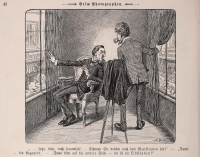
In the early phase of the vegetarian movement, satirists playfully imagined how this diet and worldview affected different aspects of culture. Other cartoons make fun of the fact that vegetarianism quickly became a trend that was seen as sign of the Zeitgeist of the 1880s. Surprisingly, they overlooked the fact that vegetarianism was indeed intended as a sociocultural reform that could contribute to social and gender equality.
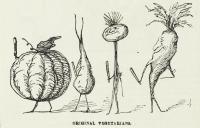
While English satire magazines mocked vegetarianism since the 1840s, the first German caricatures appeared some 30 years later. Early drawings often imagined that a vegetarian would gradually transform into a plant. Other recurring topics are the assumed correlation between (meatless) nutrition and (peaceful, fragile) physical appearance and character, as well as the debate over whether a meat-rich or a meat-free diet was better for human health. This is from the German version of “Satirical Glimpses of the Cultural History of Vegetarianism.” For the English-language version of this exhibition, click here.
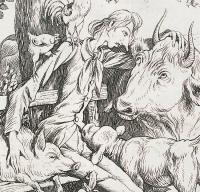
In the nineteenth century, there was much debate about the question of which way of living could be regarded as “natural.” Caricatures on vegetarianism mock ideas of the “natural” relationship between animal and man, and draft utopian as well as dystopian visions of a vegetarian future. This is from the German version of “Satirical Glimpses of the Cultural History of Vegetarianism.” For the English-language version of this exhibition, click here.
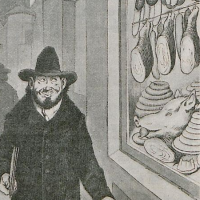
Since vegetarian societies began to spread and organize events in Germany, their missionary attitude and their supposed moral superiority have been ridiculed. Caricatures mocked the rigid rules of the vegetarians and their societies, accusing them of hypocrisy or of reinterpreting the self-imposed prohibitions according to their own needs and weaknesses. This is from the German version of “Satirical Glimpses of the Cultural History of Vegetarianism.” For the English-language version of this exhibition, click here.
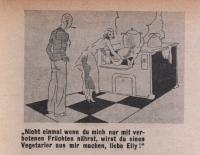
In the early phase of the vegetarian movement, satirists playfully imagined how this diet and worldview affected different aspects of culture. Other cartoons make fun of the fact that vegetarianism quickly became a trend that was seen as sign of the Zeitgeist of the 1880s. Surprisingly, they overlooked the fact that vegetarianism was indeed intended as a sociocultural reform that could contribute to social and gender equality. This is from the German version of “Satirical Glimpses of the Cultural History of Vegetarianism.” For the English-language version of this exhibition, click here.
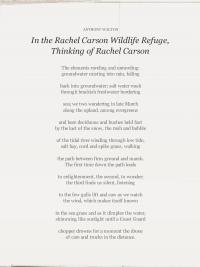
This is Chapter 7 of the exhibition “Rachel Carson’s Silent Spring: A book that changed the world” by historian Mark Stoll.

In 2012, the Environment & Society Portal and Mark Stoll published the virtual exhibition “Rachel Carson’s Silent Spring, a Book That Changed the World.” Version 2 of this virtual exhibition [February 2020] implements the Environment & Society Portal’s new responsive exhibition template and includes minor content updates from author Mark Stoll. This page provides a link to a PDF of the original version.