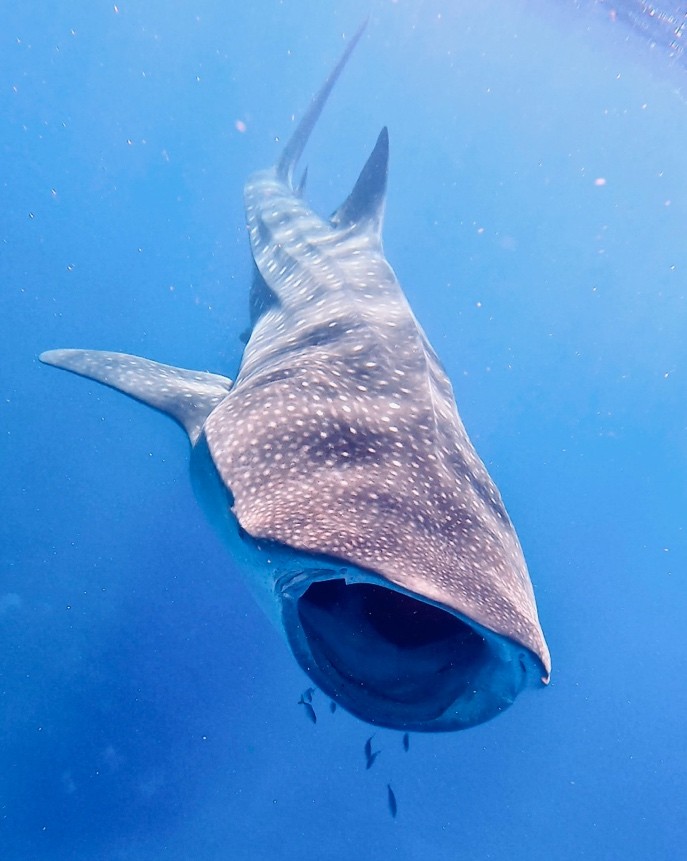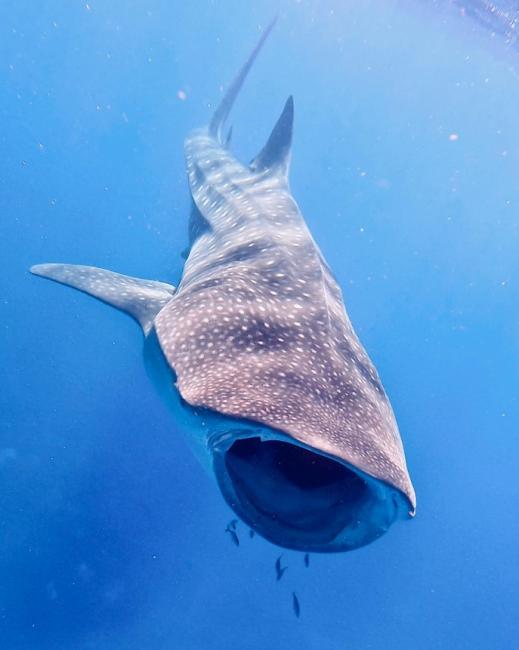
Whale shark feeding at Ningaloo Reef, Western Australia, May 2025.
Whale shark feeding at Ningaloo Reef, Western Australia, May 2025.
Photograph by Laura-Marie Dehne
 This work is licensed under a Creative Commons Attribution-NonCommercial-NoDerivatives 4.0 International License.
Each autumn at Ningaloo Reef in Western Australia, the world’s largest fish gather in numbers that now attract both tourists and researchers from around the world. Yet for many years of post-European settlement, this spectacle was far from common knowledge. On 1 May 1982, Geoff Taylor, a local doctor living in the town of Exmouth, happened to be in the right place at the right time, and he encountered whale sharks (Rhincodon typus) off Ningaloo Reef. At that time, these animals were among the most elusive of the ocean’s megafauna, sought after at some remote dive locations but often observed only as stranded or decaying bodies on shorelines. The following year, from March to May 1983, Taylor was the first to document the seasonal aggregation of whale sharks off the reef front. The news that it was possible to reliably encounter these gentle giants of the sea and safely swim with them in their environment was groundbreaking. In 1985, film-makers Elisabeth and David Parer-Cook asked Taylor to help capture the phenomenon for television. Soon after, international media, including the BBC and National Geographic, rushed to Ningaloo, bringing the Ningaloo whale sharks to the world’s attention.
In the early 1990s, a burgeoning tourism industry emerged, and within a decade whale sharks had become the focus of a profitable, tightly managed eco-tourism sector as well as numerous scientific programs. Since the late 1990s, researchers such as Dr Mark Meekan have traced whale sharks’ movements and ecology at Ningaloo Reef, positioning this location as one of the centres of whale shark science. Together with tourism, these efforts brought whale sharks into the public imagination, transforming them from mysterious rarities into an emblematic icon of Western Australia’s marine systems. Their predictable seasonal presence came to define Ningaloo’s ecological significance and identity.
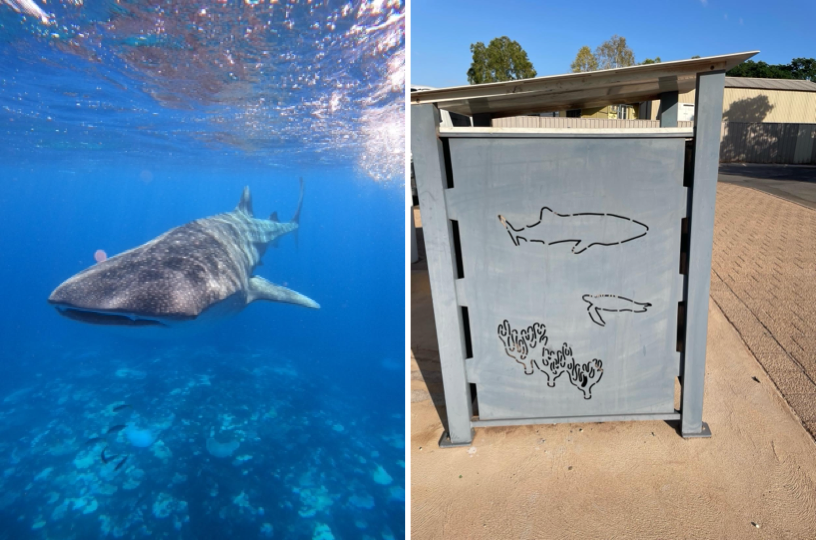
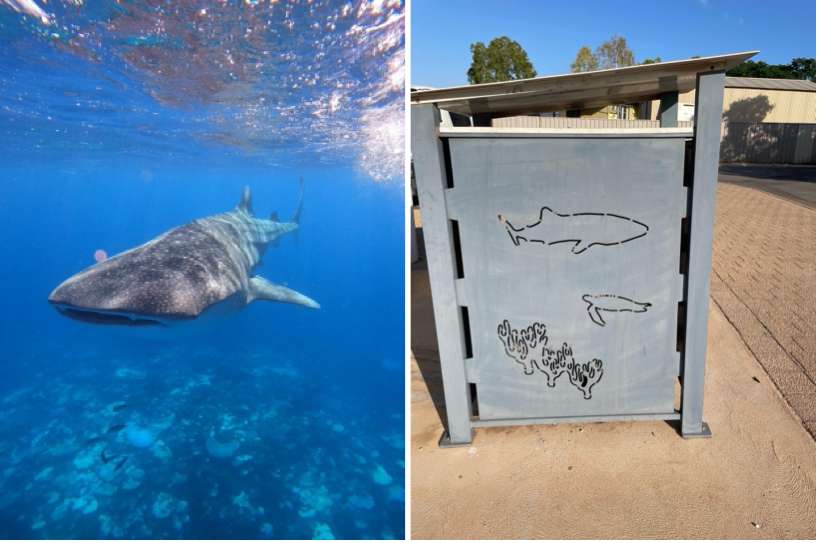
Whale shark with the reef in the background, its image engraved on a trash bin in Exmouth, reflecting how these animals move between ocean life and local identity, May 2025.
Whale shark with the reef in the background, its image engraved on a trash bin in Exmouth, reflecting how these animals move between ocean life and local identity, May 2025.
Photographs by Laura-Marie Dehne
This work is licensed under a Creative Commons Attribution-NonCommercial-NoDerivatives 4.0 International License.
Although Taylor’s observations transformed the status of the Ningaloo whale sharks, this story does not begin with a single observer. Humans have always interacted intimately with animals. The local Yinigudera people, and the greater Baiyungu and Thalanyji tribes, as the Traditional Owners of the area surrounding Ningaloo Coast, first crossed paths with whale sharks millennia ago. For Aboriginal peoples, sharks have always been part of sea country, appearing as creator beings, kin, and markers of seasonal change, as reflected in oral traditions and Indigenous cultural knowledge of the region. Such perspectives highlight that these animals were never absent, and that the turning point cannot be located only in their growing recognition after 1982. From the perspective of more-than-human histories, the turning point arises from the whale sharks´ seasonal presence. By returning each year in large numbers, their behaviour created the conditions that facilitated human attention and the development of new forms of research and encounters.
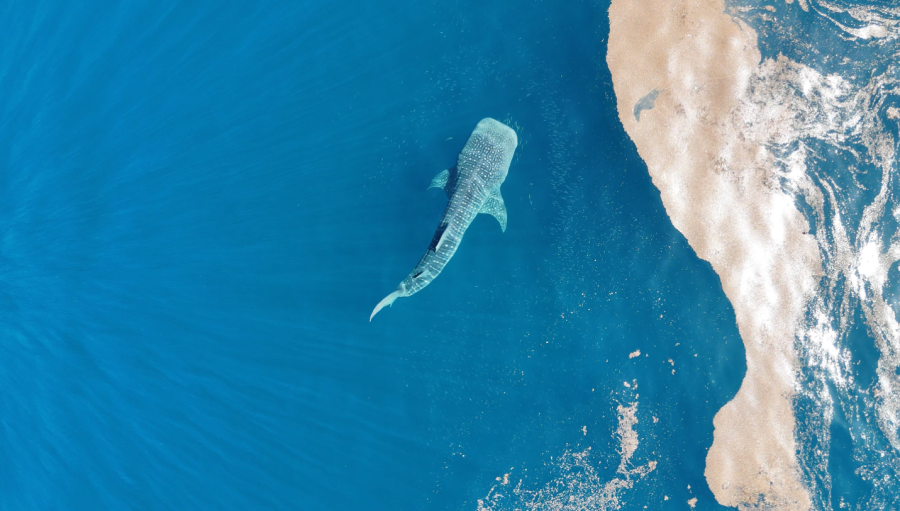
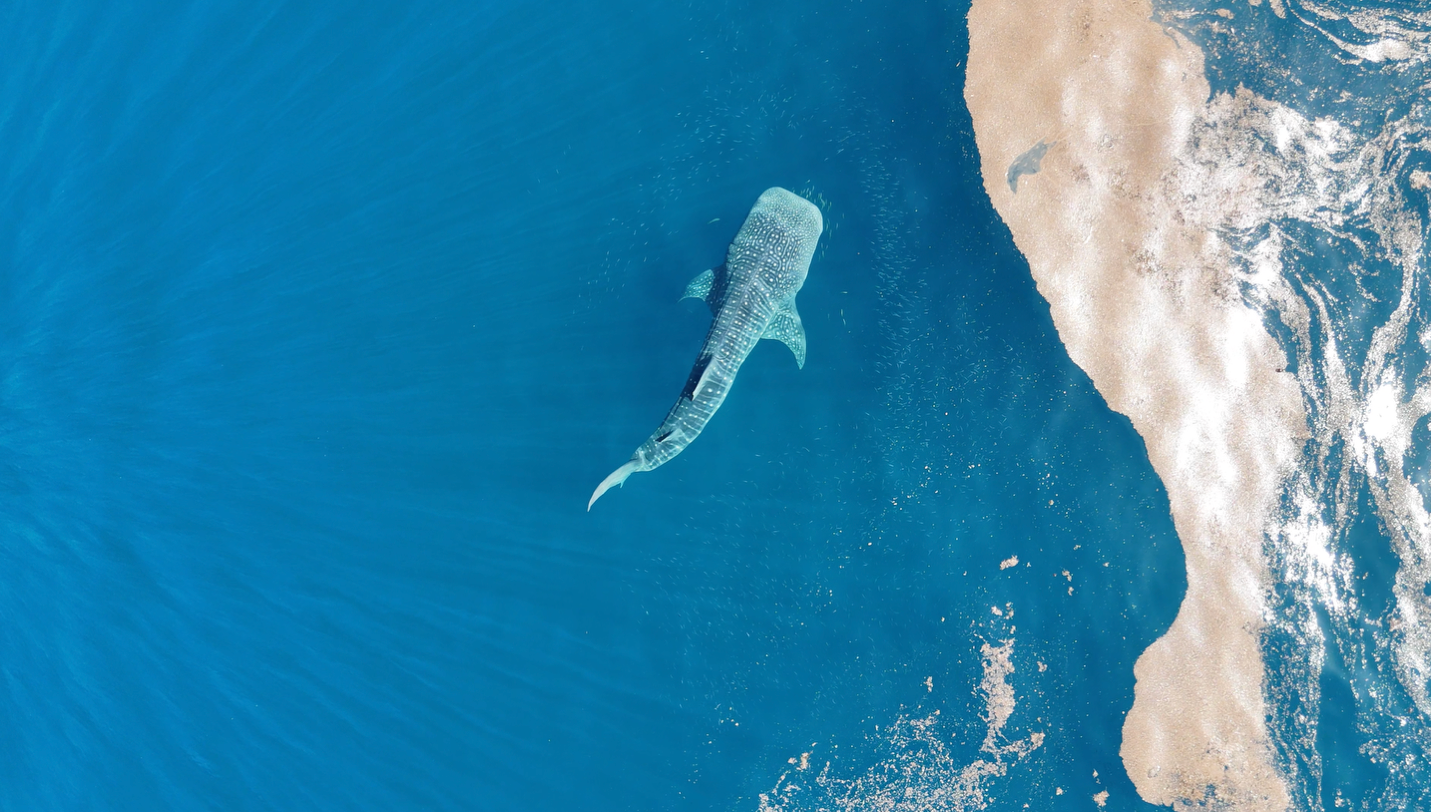
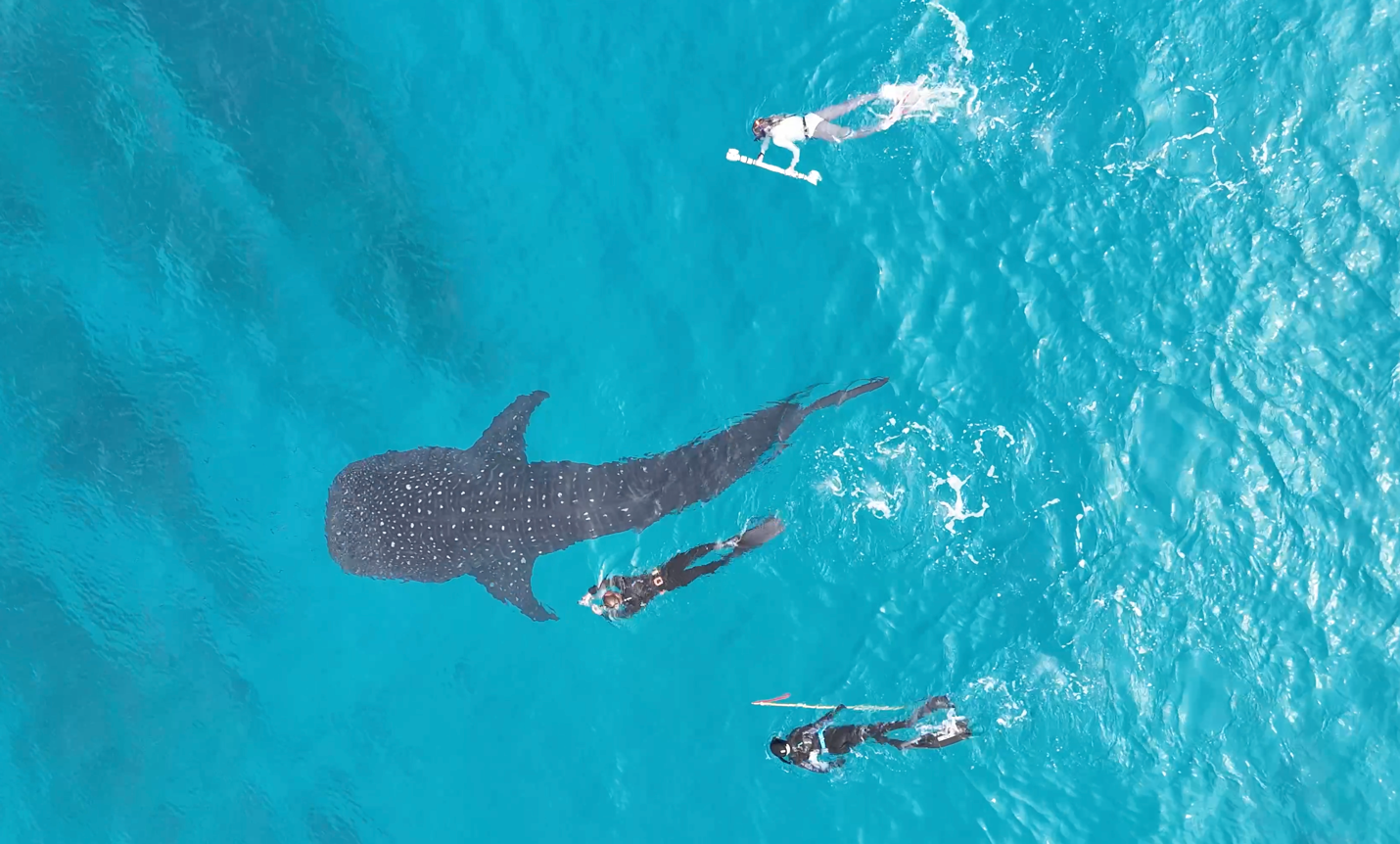
Drone imagery from Ningaloo Reef showing a whale shark swimming close to coral spawn, May 2025.
Drone imagery from Ningaloo Reef showing a whale shark swimming close to coral spawn, May 2025.
Photograph by Laura-Marie Dehne
This work is licensed under a Creative Commons Attribution-NonCommercial-NoDerivatives 4.0 International License.
Whale sharks grow slowly and mature late, making them particularly vulnerable to environmental stressors. Their migrations make it even more challenging to monitor and protect them. More than thirty years of research at Ningaloo has revealed much about these giants. They mostly feed on krill swarms in deeper water, and are often observed in warm surface waters, where they can be seen flushing their gills. Photo-identification has shown the same individuals returning year after year, while satellite tags have traced journeys of thousands of kilometres, connecting Ningaloo to regions such as Timor-Leste. Anthropogenic threats are increasingly evident. Many whale sharks bear scars from boat strikes, while entanglement and disturbance from human activity add further pressure. The impact of other stressors, such as pollutants or microplastics, remains poorly understood. Beyond these, the question grows ever more pressing: how will a changing ocean alter their foraging and survival? New methods and technologies aim to understand not only the whale sharks’ health, but also what the animals themselves may tell us about the ocean. As long-lived animals (up to possibly more than 100 years) whale sharks could act as sentinels: when they thrive, the ecosystem might be resilient; when they struggle, it could signal disruption. In this sense, their bodies track the “stocks” of the ocean, and securing their future means working toward what some now call a nature-positive ocean.
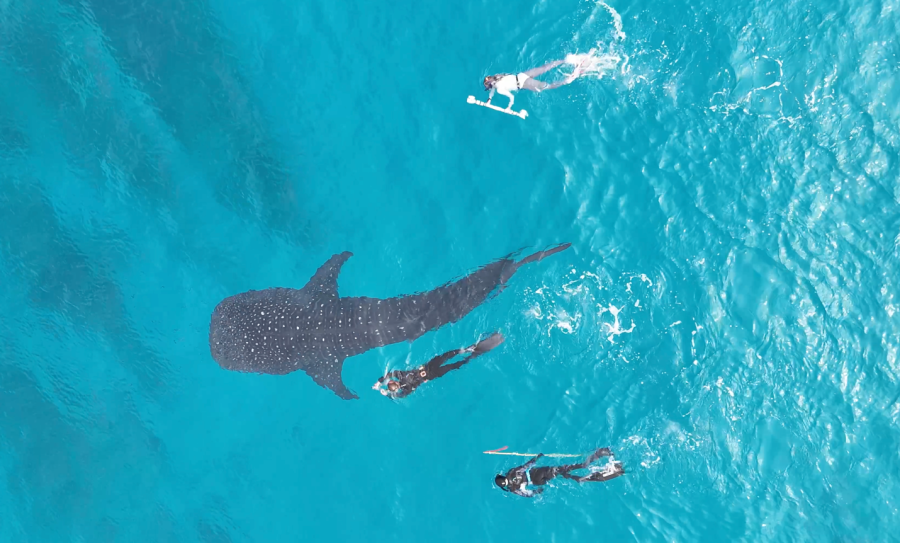
Researchers from the Oceans Institute at the University of Western Australia swim alongside a whale shark to gather data, Ningaloo Reef, May 2025.
Researchers from the Oceans Institute at the University of Western Australia swim alongside a whale shark to gather data, Ningaloo Reef, May 2025.
Photograph by Laura-Marie Dehne
This work is licensed under a Creative Commons Attribution-NonCommercial-NoDerivatives 4.0 International License.
Encounters with whale sharks are not only about scientific discovery. They can spark a sense of wonder and connection that may lead to a greater sense of personal responsibility. This could help explain why we want to approach, understand and protect them. Still, there is a limit to what we can know directly. We cannot simply ask whale sharks what matters to them or how they experience the world. This is why Thomas Nagel’s famous essay, “What Is It Like to Be a bat?”, still matters here. Nagel argued that every organism has its own subjective point of view, one that can never be fully captured from the outside. At Ningaloo, whale sharks invite the same reflection: what is it like to be a whale shark? The question marks a limit to what we can know about their experience. At the same time, care does not exclusively depend on this kind of access. It can also grow out of a practice-based form of understanding: not only understanding-that as a set of facts, but also understanding-with, which comes through shared situations and observation. The latter may be greatly enhanced by technologies that extend our senses, while reminding us that any interpretation we make remains partial.
What began at Ningaloo with a chance encounter on 1 May 1982, has developed into a story of relationships that reveals how encounters with whale sharks can deepen our knowledge of the ocean and how we begin to care for it.
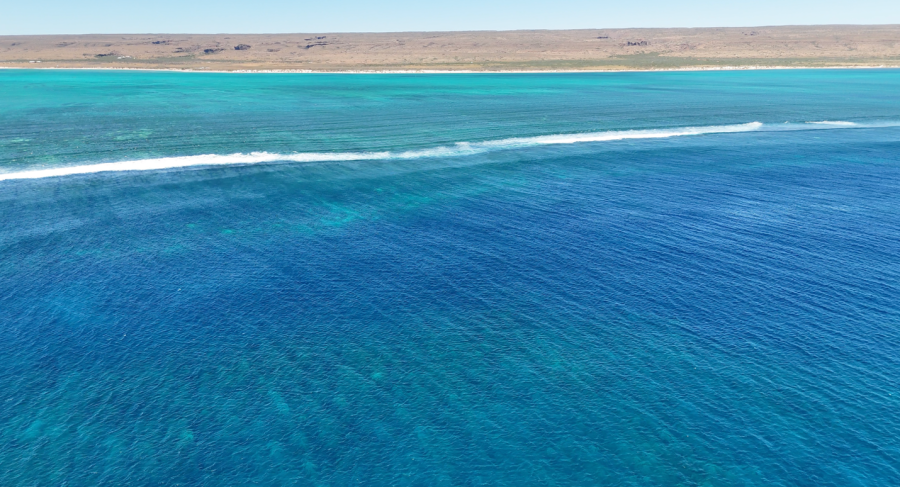
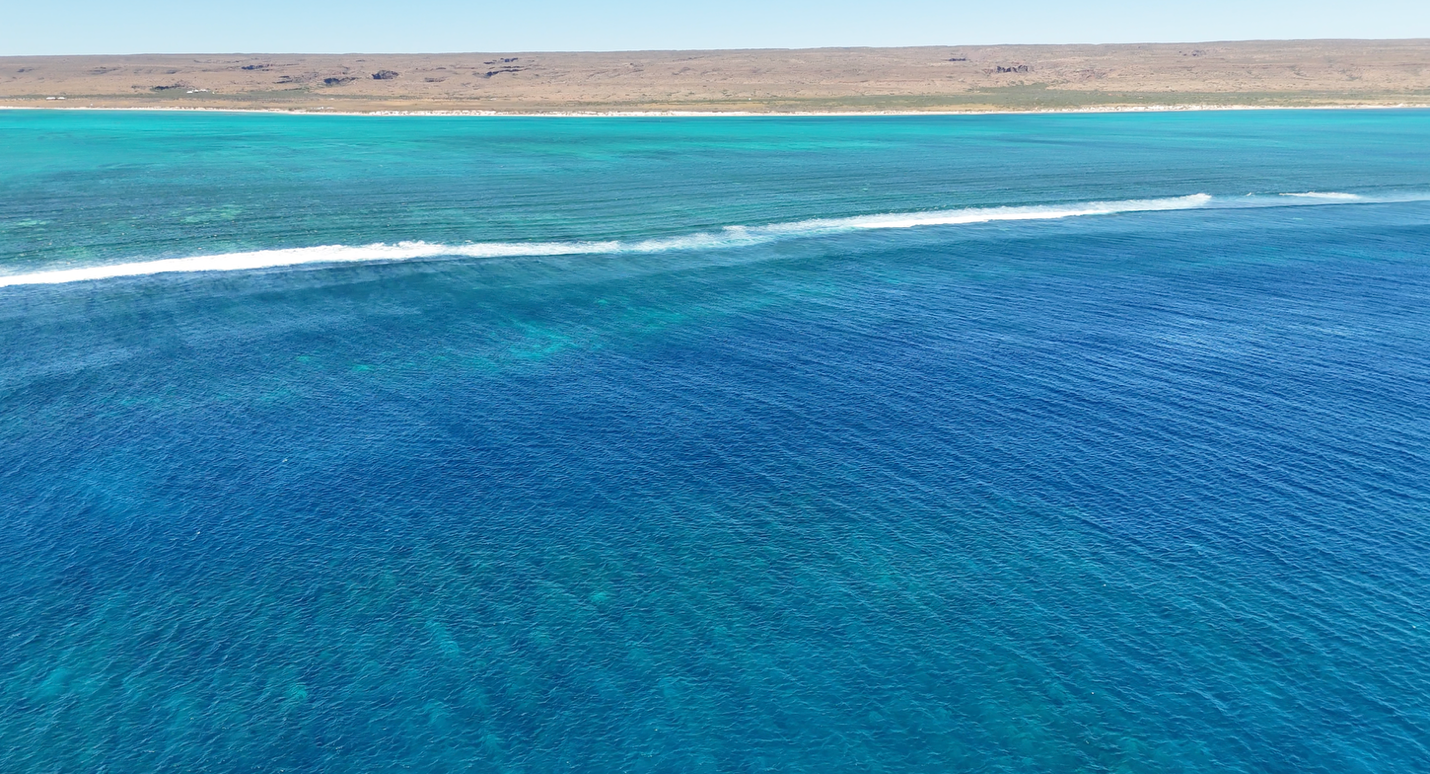
Aerial view of the fringing Ningaloo Reef and Cape Range National Park, May 2025.
Aerial view of the fringing Ningaloo Reef and Cape Range National Park, May 2025.
Photograph by Laura-Marie Dehne
This work is licensed under a Creative Commons Attribution-NonCommercial-NoDerivatives 4.0 International License.
How to cite
Dehne, Laura-Marie. “Whale Sharks: A Window Into the Ocean and Ourselves.” Environment & Society Portal, Arcadia (Spring 2026), no. 6. Rachel Carson Center for Environment and Society. doi:10.5282/rcc/10101.
ISSN 2199-3408
Environment & Society Portal, Arcadia
 This work is licensed under a Creative Commons Attribution 4.0 International License.
2025 Laura-Marie Dehne
This refers only to the text and does not include any image rights.
Please click on an image to view its individual rights status.
- Haraway, Donna J. Staying with the Trouble: Making Kin in the Chthulucene. Durham, NC: Duke University Press, 2016.
- Meekan, Mark G. et al., “Population Size and Structure of Whale Sharks (Rhincodon typus) at Ningaloo Reef, Western Australia.” Marine Ecology Progress Series 319 (2006): 275–285.
- Nagel, Thomas. “What Is It Like to Be a Bat?” The Philosophical Review 83, no. 4 (1974): 435-450.
- O’Gorman, Emily, and Andrea Gaynor. “More-Than-Human Histories”. Environmental History 25, no. 4 (2020): 711-735.
- Sequeira, Ana M. M. et al., “Global Tracking of Marine Megafauna Space Use Reveals How to Achieve Conservation Targets.” Science 388, 1086–1097 (2025).
- Taylor, Geoff. The Giants of Ningaloo. Sydney: Harper Collins, 1994.
- Voigt, Uwe. “‘This World Shares with Us One Fate and One Hope’: With Schelling´s Clara Towards an Environ-Mental Aesthetics for the Anthropocene?” Comparative and Continental Philosophy (2025).