Women and Energy
About this issue
This volume of Perspectives offers a collection of largely untold stories that demonstrate women’s agency in energy transitions.
Content
This volume of Perspectives offers a collection of largely untold stories that demonstrate women’s agency in energy transitions.
Content
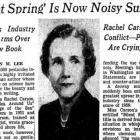
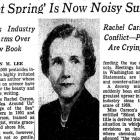
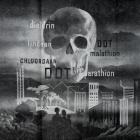
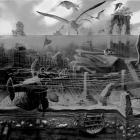
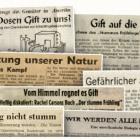
This is Chapter 4 of the exhibition “Rachel Carson’s Silent Spring: A book that changed the world” by historian Mark Stoll.
This virtual exhibition presents the global reception and impact of Rachel Carson’s Silent Spring as well as the book’s legacy in popular culture, music, literature, and the arts.
This version 2, published in 2020, includes minor updates to the original 2012 virtual exhibition (view PDF here) and applies the Environment & Society Portal’s responsive layout.
Mark Stoll
With a focus on global cancer epidemics, Nina Lykke discusses biopolitics in the Anthropocene against the background of a notion of dual governmentality, implying that efforts to make populations live and tendencies to let them die are intertwined.
In this introduction to a special section on toxic embodiment, Olga Cielemęcka and Cecilia Åsberg examine variously situated bodies, land- and waterscapes, and their naturalcultural interactions with toxicity.
The authors draw on empirical experience to assess the extent of the impact of race and social equity in conservation, with the aim of promoting sustainable and more inclusive conservation practices in South Africa. Their findings suggest conservation practices in post-apartheid South Africa are still exclusionary for the majority black population.
Kate Stevens and Angela Wanhalla explore the role of Māori women in nineteenth-century shore-whaling.
This volume provides new histories of Pacific whaling from untold perspectives.
Content
Tracing ticks in two different artworks and Leslie Feinberg’s activist writing, Wibke Straube takes their lead in this article from philosopher Donna Haraway and her suggestion to think about engagement with the environment through an “ethics of response-ability.”
Through ethnographic fieldwork in southern Lebanon, Vasiliki Touhouliotis examines the 2006 Lebanon-Israeli war’s environmental impact.