The Forest History Society
The Forest History Society is a nonprofit library and archive for forest-related literature and photography.
Erik Loomis discusses the production of working-class masculinity in the US Pacific Northwest, highlighting environmental history’s need to reinstate working people in its studies.
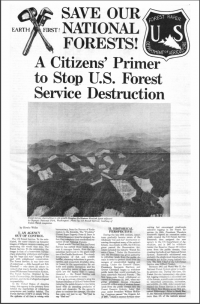
This Earth First! tabloid offers a citizen’s primer to the U.S. Forest Service and its negative impact on national forests, written by Howie Wolke.
The author examines the role of plantation forestry through the shift within the New Zealand State Forest Service from an orthodox state forestry model to one favoring large-scale exotic plantations.
The author examines the advent of native forest conservation in New Zealand’s Colony and the role of Thomas Potts in advocating exotic tree-planting as a response to timber shortage.
This virtual exhibition features, in English translation, short excerpts from German-language literary texts that address human-nature entanglements. The aim is to show how literature can contribute to understanding and problematizing the relation between humans and nonhuman nature. What aspects of human-nature relations are addressed, at what point in literary history, and how are they shaped poetically? For the German-language version of this exhibition, click here.
In this chapter of her virtual exhibition “Human-Nature Relations in German Literature,” Sabine Wilke examines forests and deforestation in works by Adalbert Stifter, Marlen Haushofer, and Elfriede Jelinek. For the German-language version of this exhibition, click here.
This issue of Mendocino Environmental Center Newsletter covers the Wise Use Movement, Coho salmon, companies of the Global Forest Management Group and “pests” of Russian boreal forests. Gary Ball describes the domination of multinational corporations as the outcome of what was effectively “World War III,” with dire consequences for the planet.
In this special issue on Disempowering Democracies, Melis Ece, James Murombedzi and Jesse Ribot show how, though all major agencies intervening in community-based and carbon forestry – such as international development agencies, conservation institutions, and national governments – state that their interventions must engage local participation in decision making, forestry interventions conversely weaken local democracy.
In this special issue on Disempowering Democracies, Manali Baruah scrutinizes elite formation and elite capture through the case of a Community Resource Management Area (CREMA) in western Ghana.