Conservation and the Gospel of Efficiency
This book offers a history of the conservation movement’s origins and provides a context for understanding contemporary enviromental problems and possible solutions.
This paper illustrates, through a series of case-studies, how long-term ecological records (>50 years) can provide a test of predictions and assumptions of ecological processes that are directly relevant to management strategies necessary to retain biological diversity in a changing climate.
Adam Cole-King discusses coastal conservation in Britain and the importance of reappraising tradition perceptions towards addressing British coasts’ diverse needs.

John M. Francis examines the dilemma that arises from the British application of “voluntary principle” legislation to long-term land management strategies in support of nature conservation.
In episode 22 of Nature’s Past, a podcast on Canadian environmental history, Sean Kheraj talks to Claire Campbell, the editor of A Century of Parks Canada, and contributing authors George Colpitts and Gwynn Langemann on Canada’s national parks history from coast to coast.
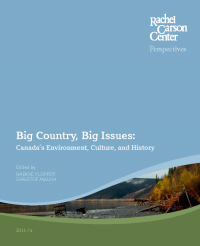
This volume of RCC Perspectives combines a number of essays in Canadian environmental history and related disciplines. The essays are united by a focus on cultural perceptions of Canadian environments, by an analysis of the interrelationship between nature and culture over time, and by a discussion of the human impact on natural environments.
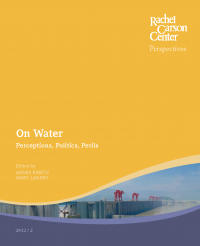
On Water showcases the range of disciplines and methodological approaches that are brought together at the Rachel Carson Center for Environment and Society. In this volume, nine scholars affiliated with the RCC present their research in the fields of history, philosophy, literary studies, geography, and cultural studies.
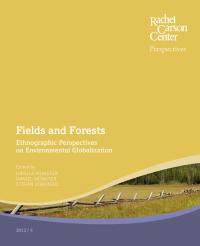
Around the world, fields and forests are increasingly dominated by the market, mediated by science, and subjected to new modes of transnational environmental governance. This volume of RCC Perspectives presents ethnographic insights into the impacts of such environmental globalization.
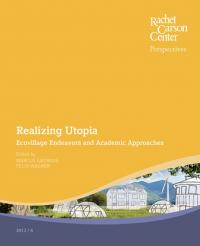
Ecovillages are arguably seen as “pioneers of change.” Yet, thus far, little light has been shed on their potential to effect change beyond their own borders. This issue of RCC Perspectives presents a much needed overview of research on ecovillages, looking at the history and philosophy of utopias and presenting case studies and ongoing research from across the globe.
The concept of biocultural diversity was introduced by ethnobiologists to argue that the variation within ecological systems is inextricably linked to cultural and linguistic differences. In this volume of RCC Perspectives, scholars from a wide range of fields reflect on the definition, impact, and possible vulnerabilities of the concept.