

Arcadia
Wildfire Stories: Framing a Complicated Relationship
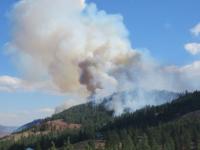
In 2014 and 2015 the Methow Valley in Washington State experienced the largest wildfires in the state’s history.
In 2014 and 2015 the Methow Valley in Washington State experienced the largest wildfires in the state’s history.
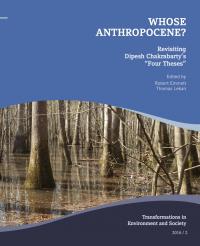
LeCain provides a detailed analysis of Chakrabarty’s “Four Theses” and its implications for humanism. This thinking diverges from that of Western Enlightenment by challenging the humanistic belief that we are separate from, even above, the material world. In fact, human culture is inextricably linked to the natural material world; we are both a force and product of it.
This essay examines what the concept of the Anthropocene means for environmental law and policy. Humans can be viewed as both insider and outsider—as an integral part of nature, which we have a duty to protect, and as lord and master of the natural world, taking what we can for our own survival. Eagle explores how the choice of an insider or outsider view can influence political discussions regarding environmental regulation.
Ziolkowski tackles the problem of defining the Anthropocene from a geologic perspective, and explores how the Earth will record evidence of our existence.
In this essay, Watt recounts discussions with her students regarding lifestyle patterns; she shows how it will be necessary to change such patterns if we are to take climate change seriously from an economic and policy perspective, and to tackle it realistically.
Sideris addresses the challenge of achieving interdisciplinary dialogue to tackle the notion of humans as a geophysical force.
Chakrabarty responds to the contributors of this volume by addressing five issues he considers fundamental to discussions on climate change.
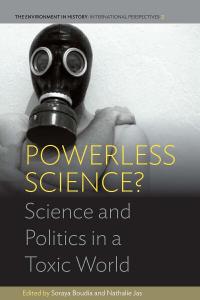
Powerless Science? looks at complex historical, social, and political dynamics, made up of public controversies, environmental and health crises, economic interests, and political responses, and demonstrates how and to what extent scientific knowledge about toxicants has been caught between scientific, economic, and political imperatives.
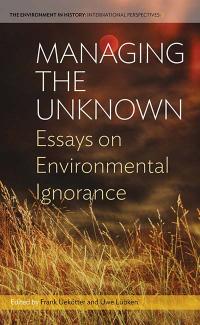
Managing the Unknown offers essays that show that deficient knowledge is a far more pervasive challenge in resource history than conventional readings suggest. Furthermore, environmental ignorance does not inevitably shrink with the march of scientific progress. This volume combines insights from different continents as well as the seas in between and thus sketches outlines of an emerging global resource history.