A Milestone on the Road to Independence? Singapore’s Catastrophic 1954 Floods
Arcadia, Autumn 2016, no. 13
This film captures the rise of China’s influence in Africa and in Zambia in particular, through the lives of three individuals: a Chinese entrepreneur, a project manager for a Chinese multinational and the Zambian Minister for Commerce, Trade and Industry.
This paper examines how natural resources have been an important motive, target, and resource for warfare throughout human history.
Four centuries of colonial extraction lead to severe ecological degradation of the forests and soils of the Atlantic region of Brazil. This article discusses the management of soil fertility and the relationship between agricultural practices and forest stands based on agricultural manuals published in Brazil over a period of more than two centuries.
Recent research on Africa has emphasised conservation and trypanosomiasis control as the major factors, which first motivated colonial officials and scientists to embark on forestry preservation and bush clearing policies. This paper contends that in Chepalungu, Kenya, forestry preservation and bush clearing were implemented with the objective to create a racially and tribally segregated landscape.
This paper explores imperial forestry networks by focusing on a single individual, Sir David Hutchins, who spent the final years of his life in New Zealand extolling the need for scientific forest management in the Dominion.
Using Northern Ghana as a case study, this paper questions the usefulness of regional data for understanding food insecurity, and shows that the supposedly novel ideas of the present in fact have a strong colonial lineage.
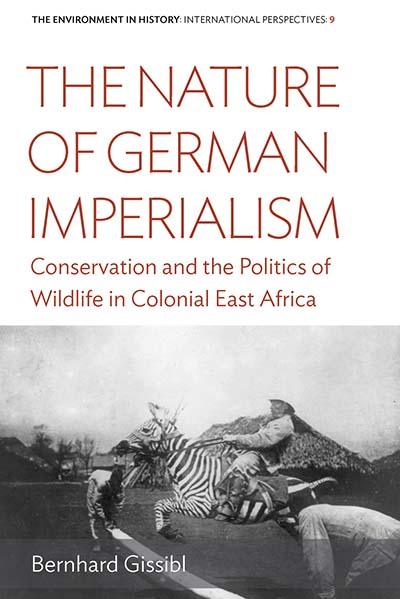
The Nature of German Imperialism: Conservation and the Politics of Wildlife in Colonial East Africa. Cover.
Gissibl, Bernhard. The Nature of German Imperialism: Conservation and the Politics of Wildlife in Colonial East Africa. New York, Oxford: Berghahn Books, 2016.
Looking at the pastoral Toda people of the Wenlock Downs, this paper considers grassland transformations in the Nilgiris, in the South Indian state of Tamil Nadu.
The contributions in this volume of RCC Perspectives address ways in which scarcity (and abundance) have been represented aesthetically and exploited politically in very different contexts.
Content