

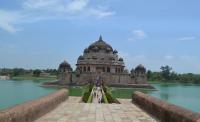
Arcadia
Ecopolitical Space in a Riverine Landscape of South Asia
The article shows how ecological and geographical features influence the configuration of political space within a region.
The article shows how ecological and geographical features influence the configuration of political space within a region.

Melinda Laituri, Carson fellow from February to May 2011, talks about her research project, “Integrated Environmental History of Watersheds,” a comparative, historical-geographical analysis of the Danube and the Colorado rivers.

Anthropologist Paolo Gruppuso and geographer Erika Garozzo ruminate on the life of Sicily’s largest but now disappearing river—the Simeto.
In this podcast episode, Michał Kępski speaks with Anna Barcz about her research on the historiography of rivers focusing on the interdisciplinary study of rivers, both as physical entities and cultural symbols.
Amrita Dasgupta shows how the littoral sex workers of the Mongla brothel struggle to make a livelihood in the face of climate change.

In Wild Earth 5, no. 3 Wendell Berry writes about private property and the Commonwealth, Thomas P. Rooney reflects on global warming, and Paul J. Kalisz analyses sustainable silviculture in the hardwood forests of the eastern United States.
Håvald Hansen of Fanasgieddi in Tana emphasizes that sustaining Sami fishing traditions, local control, and respect for salmon are essential to protecting cultural identity and livelihoods despite legal and environmental challenges.

Zahīr ud-Dīn Muhammad Bābur’s autobiography anticipates an ecological and multispecies way of understanding the environment, highlighting confluence rather than divergence between humans and nonhumans.
Franz-Josef Brüggemeier explores the environmental history of Germany’s Ruhr region, focusing on industrial pollution and ecological restoration.