A blog about the environmental (ecological) arts & humanities
Owain Jones, a Professor of Environmental Humanities at Bath Spa University, offers ideas and resources about environmental humanities in this blog.
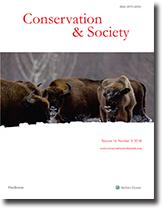
In this article, Monica Vasile discusses the recent reintroduction of bison in the Romanian Carpathians, and the surrounding local narratives and unresolved tensions.
McKenzie F. Johnson, Krithi K. Karanth, and Erika Weinthal evaluate compensation as a mitigation policy for human-wildlife conflict around four protected areas in Rajasthan (Jaisamand, Sitamata, Phulwari, and Kumbhalgarh), finding efforts insensitive to local livelihoods.
Etienne Sabatier and Charlie Huveneers examine media portrayals of human-shark encounters between 2011 and 2013 in the state of Western Australia, arguing that negative framing by media feeds public anxiety.
In episode 56 of Nature’s Past, a podcast on Canadian environmental history, Sean Kheraj joins Joanna Dean and Christabelle Sethna to discuss their new book Animal Metropolis: Histories of Human-Animal Relations in Urban Canada and, more broadly, the history of animals and cities.
Victoria Gonzalez Carman and Maria Carman focus on the interaction between a fishing community and a group of conservation experts in Brazil. They find that although fishers classify species according to their capacity to be exploited as a resource, they may also be willing to become strategic conservationists by negotiating with conservation experts to protect some of these species.
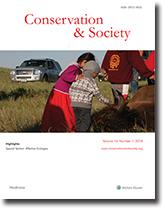
In this special section on affective ecologies, Julia Hobson Haggerty, Elizabeth Lynne Rink, Robert McAnally, and Elizabeth Bird study the restoration of bison/buffalo by the Sioux and Assiniboine tribes to their reservation in Montana in the United States. They argue that ecological restoration can promote and facilitate emergent and dynamic processes of reconnection at the scale of individuals, across species and within communities.

Aimee L. Schmidt and Douglas A. Clark examine the response of local people and agencies to a polar bear-inflicted human injury in Churchill, Manitoba, Canada, showing how human-bear conflict is often widely publicized and controversial, and how it shapes public expectations around bear management.
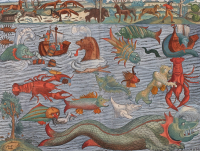
This article looks at changing perceptions of whales along the coasts of Portugal.
Rigby reimagines green cities from an interdisciplinary environmental humanities perspective to see how they can also be sites of more-than-human prosperity.