

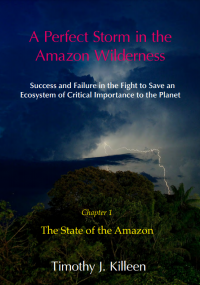
Multimedia | book excerpt
A Perfect Storm in the Amazon Wilderness
Chapters from Timothy J. Killeen’s book A Perfect Storm in the Amazon Wilderness.
Chapters from Timothy J. Killeen’s book A Perfect Storm in the Amazon Wilderness.

Emmanuelle Roth and Gregg Mitman write about how capitalism fragments nature to create value. Such fragments can precipitate biodiversity loss.
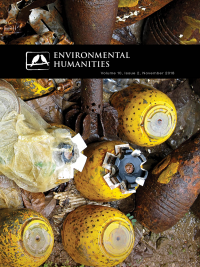
Sophie Chao delves into an unexplored dimension of the agribusiness nexus—the affective attachments of corporate actors to oil palm seeds. Drawing from fieldwork in an oil palm concession in Riau, Sumatra, she highlights the conflicting nature of caring for palm oil seeds.
In this issue of RCC Perspectives, a group of scholars reflect on Ulrich Beck’s influential Risk Society (1986). They seek to critically historicize the concept of risk society, considering how it might be a product of its particular time and place as well as what it means for public debate and scholarship in the early twenty-first century.
Anthropologist Paolo Gruppuso and geographer Erika Garozzo ruminate on the life of Sicily’s largest but now disappearing river—the Simeto.
The work of two biologists in remote forests shows that species recovery depends on both data and human–animal bonds forged in the field, as Monica Vasile writes.

First chapter of the virtual exhibition “Wetland Times,” “Imaginaries.”
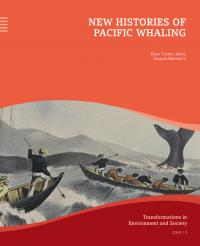
Nancy Shoemaker considers the four main products harvested in the nineteenth-century sperm whale trade.

Short profiles of university and course syllabi, and collaborative syllabi projects on Environment and Society.

An essay by Bron Taylor on Dave Foreman first published in the edited volume Wildeor: The Wild Life and Living Legacy of Dave Foreman (Essex Editions, 2023).