Pursuing Environmental History on India’s Himalayas: Challenges and Rewards
A reflection on the challenges of doing environmental history research in the diverse region of the Himalayas.
This essay addresses the challenges of collecting and interpreting data for environmental history in East Africa’s highlands.
Aldo Leopold’s A Sand County Almanac has enthralled generations of nature lovers and conservationists and is indeed revered by everyone seriously interested in protecting the natural world.
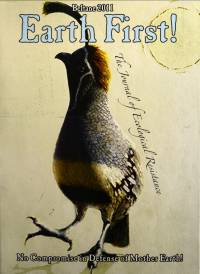
In issue 2 of the second volume of Earth First! the editors discuss EF!’s core issues, contributions, and accomplishments within the environmental grassroots movement in the US.
This issue of Earth First! focuses on Dave Foreman’s well-discussed article also entitled “Earth First!,” previously published in the American political magazine The Progressive in October 1981.
In this issue of Earth First! Benjamin Read interviews one of the United States’ most admired conservationists, Mardy Murie.
This issue of Earth First! is filled with news regarding various environmental issues as well as letters from dedicated readers.
In this issue of Earth First!, Peter Dustrud states: “We are not, and the Earth is not, alive because of power first, greed first, progress first or war first—we are alive due to the Earth First—always have been, always will be. We are Earth First!ers! The survival of this one and only planet we have is what counts.”
In this issue of Earth First!, Peter Dustrud steps down as editor of EF!, effectively leaving the Earth First! movement.
In this issue of Earth First! Dave Foreman guides readers through “An Environmental Strategy for the ’80s,” Chim Blea discusses “The Ethics of Vegetarianism,” and Foreman states that Earth First! will begin featuring “provocative and challenging material on Deep Ecology and reviews of the other intellectual currents” in order to win the environmental battle against the neo-conservatives and their “economic views of Earth and life.”