"Medicinal Plants in New Zealand: Bridging the Gap between Medical and Environmental History"
Joanna Bishop explores the story of the introduction and use of medicinal plants in New Zealand and their botanical, medical, and environmental histories.
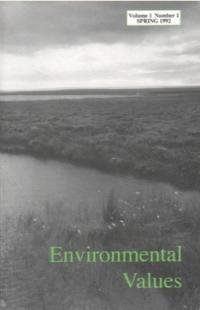
Emily O’Gorman examines the ways in which ducks as well as people negotiated the changing water landscapes of the Murrumbidgee River caused by the creation of rice paddies.
Should environmental philosophers—or practical conservationists—focus their attentions on particular living creatures, or on the community of which they, and we, are part?
This paper illustrates, through a series of case-studies, how long-term ecological records (>50 years) can provide a test of predictions and assumptions of ecological processes that are directly relevant to management strategies necessary to retain biological diversity in a changing climate.
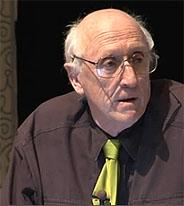
Stewart Brand talks about cities, nuclear power, genetic modification, and geo-engineering.
A leader in the study of the ecology and evolution of marine organisms, Jeremy Jackson is known for his deep understanding of geological time.
Nalini Nadkarni explores the rich, vital world found in the tops of trees and communicates what she finds to non-scientists.
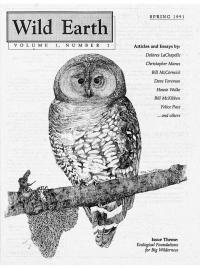
Wild Earth 1, no. 1, with the theme “Ecological Foundations for Big Wilderness,” discusses ecosystem restoration in Florida, corridors in the Klamath Mountains, and a Yellowstone ecosystem Marshall Plan.
The book explores the cultural and religious significance of James Cameron’s film Avatar (2010).
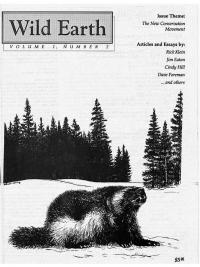
Wild Earth 1, no. 2, with the issue theme “The New Conservation Movement,” on reforming the Sierra Club, grizzly hunting in Montana, and an Ancient Forest Reserve proposal for the Mendocino National Forest.