

Show search results for
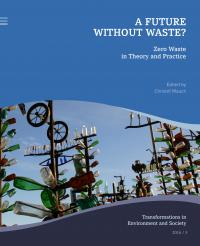
A Future without Waste? Zero Waste in Theory and Practice
Is a world without waste truly achievable? The essays in this volume of RCC Perspectives discuss zero waste as a vision, as a historical concept, and as an international practice. Going beyond the motto of “reduce, reuse, recycle,” they reflect on the feasibility of creating closed material cycles and explore real-world examples of challenges and successes on the way to zero waste.
Learning to Celebrate Our Human Footprint
Society’s approach to environmental protection has so far relied on certain prevailing, but perhaps specious, beliefs—that we cannot impact the environment positively, or that environmental protection is incompatible with economic growth. Braungart explores how, rather than making ineffective changes to an already broken system, it would be more beneficial to rethink that system entirely.
Upcycling in History: Is the Past a Prologue to a Zero-Waste Future? The Case of Aluminum
The history of aluminum not only illustrates how upcycling has helped producers increase profitability since the 1950s by turning low value materials into high value products; it also shows how the transformation processes involved in a circular system of reuse can challenge its environmental sustainability.
Waste Utopias: Lessons from Socialist Europe for the Twenty-First Century
This essay examines practices in socialist Hungary in the 1950s that can be considered a historical antecedent to contemporary zero-waste programs. The experiences and challenges of implementing waste collection and reuse programs can offer lessons for us today.
Why Wait for the Future? There Could Be a Present without Waste
Taking on the big players in media technology, whose business choices are dictating the changes and transitions in our society and environment, Köpnick questions the economics and ethics behind mobile phone production. He envisions a situation where company strategies are turned around to reduce waste and wastage, and thereby begin to benefit the environment, consumer and company alike.
Working for Zero Waste in Germany: A Discussion across Disciplines
The participants in a roundtable discussion that took place in May 2013 at LMU’s Center for Advanced Studies draw on their collective experience in engineering, anthropology, environmental justice, and city politics, in order to explore the impact of waste, and the strategies we should, and currently do, employ as we work towards zero waste in the world.
Ways Out of the Waste Dilemma: Transforming Communities in the Global South
Inspiration for sustainable waste policies and management will likely come from countries in the Global South, where consumerism and discard-oriented production are not yet fully established, where economies are less fixated on growth, and people’s lifestyles are not yet “cocooned in the consumption bubble.” Drawing on examples of informal and cooperative recyclers in Brazil, Gutberlet argues that these workers have developed effective practices and policies supporting circular economy, sufficiency, and solidarity.
“Artificial Apple Production in Fraiburgo, Brazil, 1958–1989”
This article, “Artificial Apple Production in Fraiburgo, Brazil, 1958–1989,” by Jó Klanovicz explores connections between the “domestication” of apples in Southern Brazil, the polemic on contaminated apples in 1989, and the reactions of the apple industry to the news published in the press on the use of pesticides in Brazilian orchards.