Mexico’s Environmental Revolutions
Mexico’s liberal political revolution of 1854, the social revolution of 1910, and the Green Revolution that began in 1943 each left ecological and political footprints that influenced the subsequent one.
The current mining “boom” in Latin America is the latest reincarnation of a colonial era business that intensified with industrialization in the nineteenth century. The continuities in the practice are as striking as the breaks are remarkable.
This article looks at the discovery and storming of the Americas in relation to narratives of sustainability.
Michael Adams reviews initial research exploring non-Indigenous hunting participation and motivation in Australia, as a window into further understanding connections between humans, non-humans, and place.
Hagood looks at Rachel Carson’s earlier popular publications on the natural history of the oceans and their impact on Silent Spring (1962).
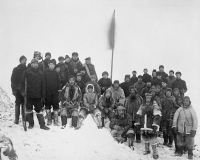
To whom does the Northwest Passage belong? Historian Elene Baldassarri writes about the politics of the Far North. This is a chapter of the virtual exhibition “The Northwest Passage: Myth, Environment, and Resources.”
Apart from a diverse and previously unknown fauna, explorations and receding ice caps have uncovered a sought-after abundance of natural resources in the Arctic region. Historian Elena Baldassarri argues that the exploitation of these resources not only constitutes a threat to the non-human world, but also to the Inuit people. This is a chapter of the virtual exhibition “The Northwest Passage: Myth, Environment, and Resources.”
The exploitation of the cheap manual labor provided by Adivasis and the appropriation of their indigenous environmental knowledge has enabled and equally influenced environmental governance at the Wayanad Wildlife Sanctuary since colonial times.
This is a chapter of the virtual exhibition “Welcome to the Anthropocene: The Earth in Our Hands”—written and curated by historian Nina Möllers.