

Arcadia
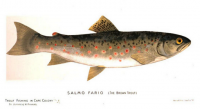
Naturalizing Trout? Fish Farming in German Southwest Africa
Efforts to naturalize trout in German Southwest Africa capture German ambitions within its first and only settler colony.
Efforts to naturalize trout in German Southwest Africa capture German ambitions within its first and only settler colony.

In this commentary, Stefan Helmreich considers how Hokusai’s famous woodblock print, The Great Wave, has recently been leveraged into commentaries upon the Anthropocene, and how the image has been adapted to speak to the contemporary human-generated global oceanic crisis.
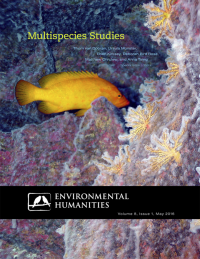
In this special issue on Multispecies Studies, Cary Wolfe and Maria Whiteman discuss the changing notions of landscape and nature at work in the video installation Mountain Pine Beetle and explores some of the forces that eventuated in the devastated landscapes of the Rocky Mountain West brought on by the infestation of the mountain pine beetle beginning in the early 2000s—an infestation caused, in no small part, by what some scientists have called a perfect storm of circumstances created by global warming.
Alessandro Antonello and Mark Carey examine how the practices involved in drilling, analyzing, discussing, and using ice cores for both science and broader climate or environmental policies and cultures take part in constituting the temporalities of the global environment.
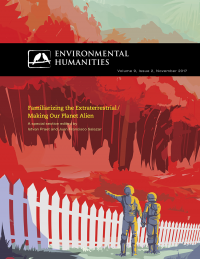
In this Special Section on Familiarizing the Extraterrestrial / Making Our Planet Alien, edited by Istvan Praet and Juan Francisco Salazar, Jessica O’Reilly compares the paramilitary practicalities of Antarctic research station and field camp life with the visions of the Antarctic as a place of sublime wild nature, violent death, and climate disaster.
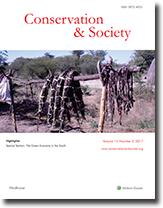
Kimberly R. Marion Suiseeya draws attention to the persistent justice debates in Reduced Emissions from Deforestation and Degradation plus the enhancement of carbon stocks (REDD+) and the role of norms in constraining and shaping policy designs and outcomes.
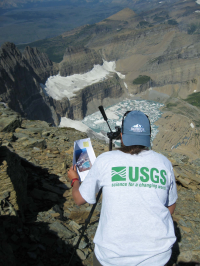
Detailing the converging human and geological histories of Glacier National Park, US, this article traces the demise of the park’s primary attraction, the glaciers.
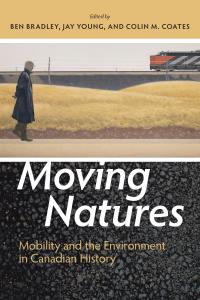
This collection highlights three quintessentially Canadian themes: seasonality, links between mobility and natural resource development, and urbanites’ experiences of the environment through mobility. It divides the intersection of environmental and mobility history into two approaches. The chapters in the first section deal primarily with the construction and productive use of mobility technologies and infrastructure, as well as their environmental constraints and consequences. The chapters in the second section focus on consumers’ uses of those vehicles and pathways: on pleasure travel, tourism, and recreational mobility.
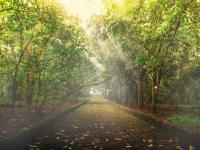
This German-language version of Sabine Wilke’s virtual exhibition features short excerpts from German-language literary texts that address human-nature entanglements. The aim is to show how literature can contribute to understanding and problematizing the relation between humans and nonhuman nature. What aspects of human-nature relations are addressed, at what point in literary history, and how are they shaped poetically? For the English-language version of this exhibition, click here.

In this chapter of the German-language version of her virtual exhibition, “Mensch und Natur in der deutschen Literatur (Human-Nature Relations in German Literature),” Sabine Wilke examines mountains and glacial environments in German-language literary descriptions. Whereas the German Romantic poets still highlighted mountainous nature as deeply ambiguous, Goethe’s Faust tried to understand mountainous nature in its materiality through scientific studies. Modernism focuses on the more often destructive results of human-nature entanglements. For the English-language version of this exhibition, click here.