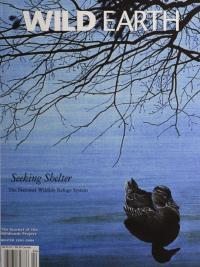
Wild Earth 13, no. 4
Wild Earth 13, no. 4, focuses on the National Wildlife Refuge System with essays on its history, the wildlife refuge in Southeastern Oregon, wildlands ofthe Great Plains, and pronghorn extinction in the Sonoran Desert.
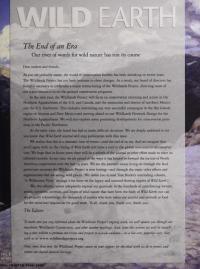
Wild Earth 14, no. 3/4, is the last issue of the Wild Earth Journal. It presents essays on connectivity and long-distance migration in human-fragmented landscapes, the Great Bear Rainforest archipelago, and rewilding Patagonia.
A cultural and historical analysis of the recent past of the Nile Valley shows how interpretations and perceptions of territory, space, and nature are not necessarily indisputably “true” and definitive principles. On the contrary, they are constructed and, therefore, changeable.
Using Yung Chang’s 2007 documentary film Up the Yangtze, Weik von Mossner unravels the power struggles accompanying the construction of the world’s largest hydroelectric power plant—the Three Gorges Dam in China.
In 1969, the Georgian resort of Pitsunda and its beach were severely damaged by a storm. This was largely due to an ongoing process of coastal erosion caused by anthropogenic influences.
This issue of RCC Perspectives offers insights into similarities and differences in the ways people in Asia have tried to master and control the often unpredictable and volatile environments of which they were part
This paper traces the journey of sand carried by China’s Yellow River to Lankao County, one of the locales most affected by sandification.
Bengal’s essential character as a fluid landscape was changed during the colonial times through legal interventions that were aimed at creating permanent boundaries between land and water, with land given priority.
The Gangetic basin, traditionally famous for huge crop production and rice farming, has witnessed gradual alteration in the land-use pattern over the last hundred years.
In 1975, construction began for the Thames Barrier, a moveable flood defense located on the River Thames, downstream of central London in the United Kingdom.