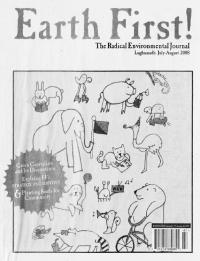
“Eagles, Marmots, Humans: Knowing Wildlife Through Fieldwork”
The work of two biologists in remote forests shows that species recovery depends on both data and human–animal bonds forged in the field, as Monica Vasile writes.
Earth First! 29, no. 1 reports on the movement’s victory against the Pacific Lumber Company, the climate and anti-racist camp in Germany, the Northeast Climate Confluence, the international movement of camps and convergences for climate action, and repression against animal activists in Austria.
Earth First! 28, no. 5 looks at topics such as the legacies of race and colonialism, strategies for disrupting the Democratic and Republican National Conventions, and the shortcomings of “green” capitalism.
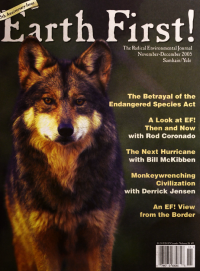
Earth First! 26, no. 1 features reports about climate change and climate justice, looks into the future of civilization, and fights for the rights of animals.
In Earth First! 24, no. 5 Abigail reflects on the nuclear policy of the Bush administration, Lenny determines that “institutions of higher learning are coming to resemble police and surveillance states,” and Pippi the Rat describes how leaders of African nations reject GM food aid.
Earth First! Journal 23, no. 1 is dedicated to the topic of direct action: it feature a report on the 2002 Round River Rendezvous and the Eco-Bloc against the World Bank and IMF, both in Washington, and presents the Rupert Reverence, a group of dissident Cree, French Canadian locals and eco-tourist companies.
Earth First! Journal 22, no. 5 features articles on the end of old growth logging in New Zealand, law collectives against “a harassing” legal system, the revival of the archaic and the wilderness of mind, and the EF! battle front against the Federal Bureau of Investigation.
Earth First! Journal 22, no. 2 features essays on the Gorleben nuke protest, insects as sustainable food, an analysis of the events of 9.11, and Afghanistan wildlife.
In this issue of Earth First! Journal Ron Coronado discusses the politics of protest, Kris Maenz gives an update on the hunger strike of jailed English animal rights activist Barry Horne, and Jimmy Demos explores the reaches and pollution of the Mississippi.
In Wild Earth 5, no. 3 Wendell Berry writes about private property and the Commonwealth, Thomas P. Rooney reflects on global warming, and Paul J. Kalisz analyses sustainable silviculture in the hardwood forests of the eastern United States.