


“Not Every Kid Is WEIRD: A Conversation with Francesca Mezzenzana”
One of our editors, Brady Fauth, sits down with anthropologist Francesca Mezzenzana to discuss her developing research into children’s human–nonhuman relationships across cultures.

This essay examines how military, technology, and nature converge in the Israeli griffon vulture project and what politics stand behind it.
Joseph Adeniran Adedeji shows how the cultural meaning of Yoruba heritage sites signify hope for a harmonious coexistence between society and the nonhuman world.
This artistic contribution explores sensory engagement with contamination caused by oil-waste pits in the Ecuadorian Amazon.
The entwined history of legends, literature, limnology, and a Cold War nuclear power plant at Lake Stechlin in northeastern Germany.
Alison Pouliot writes about the pejorative language that has been used to describe fungi and how it has shaped our understanding of them.
Jenny Price argues the efficacy of alt-institution public art projects for environmental humanities practitioners and uses examples from her own practice and beyond.
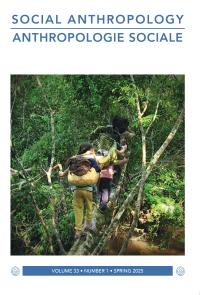
Chapters from the Social Anthropology/Anthropologie Sociale special issue “Child Socialisation and Environmental Transformation in Indigenous South America,” edited by Jan David Hauck and Francesca Mezzenzana.
Short profiles of university and course syllabi, and collaborative syllabi projects on Environment and Society.
Judi Bari’s lecture on Revolutionary Ecology, with two songs at the outset, which illuminates her nature spirituality and biocentrism, her critiques of capitalism as inherently antithetical to environmental sustainability, and her strategic efforts to forge alliances between workers and environmentalists in defense of the redwood biome in Northern California.