"Down to Earth: Geosocialities and Geopolitics"
Palsson and Swanson’s article explores the relationship between geology and social life in the Anthropocene, using the notion of “geosocialities.”
Gremaud’s article analyses representations of nature as brand and resource in current Icelandic society, through an interdisciplinary approach involving cultural geography and visual methodologies.
In his article for the special “Living Lexicon for the Environmental Humanities Section,” Mike Hulme goes beyond traditional, institutional definitions to view climate as an idea which mediates between the human experience of ephemeral weather and the cultural ways of living which are animated by this experience.
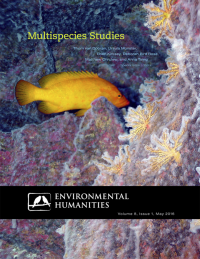
In this introduction to the special issue on Multispecies Studies, Thom van Dooren, Eben Kirksey, and Ursula Münster provide an overview of the emerging field of multispecies studies. Unsettling given notions of species, the article explores a broad terrain of possible modes of classifying, categorizing, and paying attention to the diverse ways of life that constitute worlds.
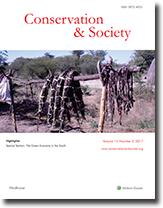
In this special issue on Multispecies Studies, Vinciane Despret and Michel Meuret discuss how humans and animals are making their own contributions to a new cosmoecology, creating cosmoecological connections and contributing to what Ghassan Hage has called alter-politics.
In this special issue on Multispecies Studies, Eben Kirksey, Dehlia Hannah, Charlie Lotterman, and Lisa Jean Moore conduct a performative experiment which blurs the boundaries between performance art, science, and ethnography. They conduct an outmoded pregnancy test with live Xenopus frogs to probe the contours of the gap between the biochemistry of being pregnant and the experience of recognizing oneself as pregnant.
Alison Lullfitz, Joe Dortch, Stephen D. Hopper, Carol Pettersen, Ron (Doc) Reynolds, and David Guilfoyle use the lens of Human Niche Construction theory to examine Noongar (an indigenous people of southwestern Australia) relationships with southwestern Australian flora, and suggest influences of these relationships on contemporary botanical patterns in this global biodiversity hotspot.
The European Association for the Study of Literature, Culture, and Environment (EASLCE) promotes research and education in the fields of literary, cultural and environmental studies, and aims to cultivate a better understanding of the interrelationship between natures and cultures for a more sustainable future.
This article examines how issues of representation and aesthetics have impacted the environmental history of early modern Europe.
Native American Church members need steady access to peyote, but demand for the plant has been outstripping supply.