

Arcadia
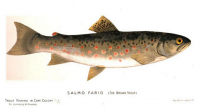
Naturalizing Trout? Fish Farming in German Southwest Africa
Efforts to naturalize trout in German Southwest Africa capture German ambitions within its first and only settler colony.
Efforts to naturalize trout in German Southwest Africa capture German ambitions within its first and only settler colony.

This article focuses on the loss of the Sambisa Forest as a game reserve due to the conflict between the Nigerian army and the terrorist group Boko Haram.
Berros describes some of the first cases in which Rights of Nature was directly referenced in the courts of Ecuador.
Kalantzakos describes how flawed policy decisions damaged Greece’s Archeloos river, and how Rights of Nature could have mitigated the damage.
Shannon Cram explores the slippery subjectivities of nuclear waste and nature at Washington State’s Hanford Nuclear Reservation, examining how this space is framed as both pristine habitat and waste frontier. She examines Hanford’s biological vector control program through the fruit fly and discusses how vector control uses instances of nuclear trespass to articulate the boundary between contaminated and uncontaminated. She concludes that nature is being recruited to do what the U.S. Department of Energy cannot: solve Hanford’s nuclear waste problem.
Affrica Taylor, Veronica Pacini-Ketchabaw, Sandrina de Finney, and Mindy Blaise edit and introduce a special section on “Inheriting the Ecological Legacies of Settler Colonialism.” The three essays that follow ponder the question of ecological inheritance in the settler colonial contexts of Canada and Australia, cognizant of the fact that settler colonialism remains an incomplete project.
In this article for a special section on “Inheriting the Ecological Legacies of Settler Colonialism,” Lesley Instone and Affrica Taylor engage with the figure of the Anthropocene as the impetus for rethinking the messy environmental legacies of Australian settler colonialism.
In this article for a Special Section on “Inheriting the Ecological Legacies of Settler Colonialism,” Alexander R. D. Zahara and Myra J. Hird explore the ways in which western and Inuit cosmologies differentially inform particular relationships with the inhuman, and “trash animals” in particular. They compare vermin control practiced in Canada’s waste sites with the freedom of ravens to explore waste sites within Inuit communities, arguing that waste and wasting exist within a complex set of historically embedded and contemporaneously contested neo-colonial structures and processes.
In this review essay, Jennifer Hamilton responds to Michael Marder’s book, Plant-Thinking: A Philosophy of Vegetal Life (2013), exploring three of Marder’s concepts, plant “nourishment,” “desire” and “language,” through readings of Gabrielle de Vietri’s installation The Garden of Bad Flowers (2014), the story of Daphne from Ovid’s Metamorphoses (8 CE) and Alice’s encounter with talking flowers in Lewis Carroll’s Through the Looking Glass, and What Alice Found There (1871).
Yonten Nyima Yundannima provides an empirical analysis of rangeland use rights privatization through an empirical case study from Pelgon county in the Tibet Autonomous Region in China. She criticizes the applicability of the tragedy of the commons model to Tibetan pastoralism, arguing that this has led to a disruption of the essence of pastoralism in the region.