

Multimedia | journal
Wild Earth 4, no. 1
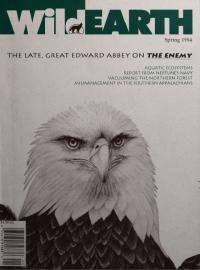
Wild Earth 4, no. 1 discusses aquatic ecosystems, vacuuming the Northern Forest, mismanagement in the Southern Appalachians, and lessons from the Vermont wilderness.
Wild Earth 4, no. 1 discusses aquatic ecosystems, vacuuming the Northern Forest, mismanagement in the Southern Appalachians, and lessons from the Vermont wilderness.

Wild Earth 4, no. 2 features Wendell Berry on “A Walk Down Camp Branch,” Howie Wolke’s “Butchering the Big Wild,” and William R. Catton, Jr., on “Carrying Capacity and the Death of a Culture.”
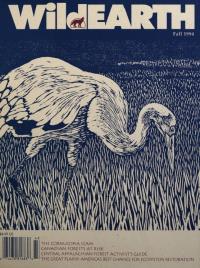
Wild Earth 4, no. 3 features Canadian forests at risk, an activist’s guide to Central Appalachian forests, citizen involvement in mining issues, a proposal for a Thoreau Regional Wilderness in northern Maine.
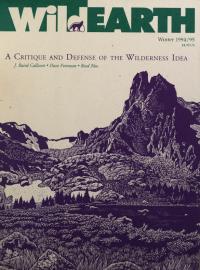
This issue of Wild Earth celebrates the third year of the Wildlands Project featuring the theme “A Critique and Defense of the Wilderness Idea,” as well as essays on: falcons in urban environments, state complicity in wildlife losses, and common lands recovery.
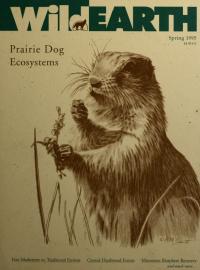
Wild Earth 5, no. 1 focuses on prairie dog ecosystems and includes a Minnesota biosphere recovery strategy.

Wild Earth 6, no. 2 features Bill McKibben on nature writing and common ground, Laura Westra writes about ecosystem integrity, sustainability, and the “Fish Wars”, and W. O. Pruitt explains “The Caribou Commons.”
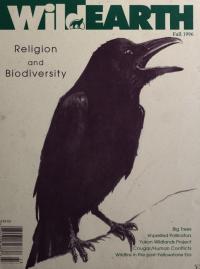
In Wild Earth 6, no. 3 Max Oelschlaeger discusses religion and the conservation of biodiversity, Christopher Genovali reflects on the Alberta oil rush, Joseph P. Dudley writes about biodiversity in Southern Africa, and A. Kent MacDougall considers thinking of humans as a cancer.
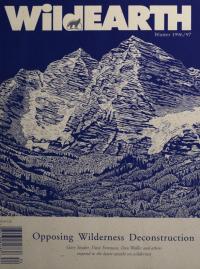
Wild Earth 6, no. 4 features essays opposing wilderness deconstruction. Gary Snyder writes on nature as a social construction, Dave Foreman contributes a piece on the conservation opposition’s underlying views, and Don Waller discusses the evolution of wilderness concepts.
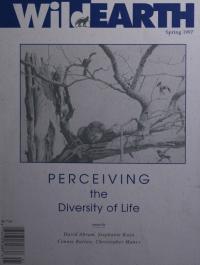
In Wild Earth 7, no. 1 David Abram rediscovers our animal senses, Stephanie Kaza analyzes assumptions and stereotypes about human-nature relations, Connie Barlow reflects on the epic of evolution, and Christopher Manes reflects on a meaningful relationship with the wild.
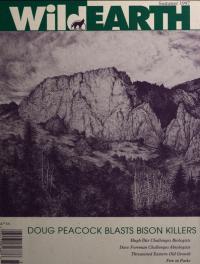
In Wild Earth 7, no. 2 Doug Peacock presents his field report on the Yellowstone bison slaughter, Reed Noss writes about endangered major ecosystems of the United States, and Virginia Abernethy analyzes if and how population growth discourages environmentally sound behavior.