

Perspectives Article
Whale Peoples and Pacific Worlds
Joshua L. Reid concludes that the history of Pacific whaling has undergone a scholarly renaissance.
Joshua L. Reid concludes that the history of Pacific whaling has undergone a scholarly renaissance.
In Wild Earth 5, no. 4 Reed F. Noss reflects on what endangered ecosystems should mean to The Wildlands Project, and preliminary results of a biodiversity analysis in the Greater North Cascades ecosystem and a biodiversity conservation plan for the Klamath/Siskiyou region are presented.

In Wild Earth 5, no. 3 Wendell Berry writes about private property and the Commonwealth, Thomas P. Rooney reflects on global warming, and Paul J. Kalisz analyses sustainable silviculture in the hardwood forests of the eastern United States.

In this “Industrial Civilization Collapse!” First Pre-anniversary issue of Live Wild Or Die! Jerry Mander asks readers to smash their computers, and Ward Churchill debunks pacifism as pathology.
Håvald Hansen of Fanasgieddi in Tana emphasizes that sustaining Sami fishing traditions, local control, and respect for salmon are essential to protecting cultural identity and livelihoods despite legal and environmental challenges.
In Live Wild or Die! no. 3 an unnamed contributor gives an update from the revolutionary eco-terrorist Pie Brigade, held to save the redwoods in northern California’s Headwaters forest. In addition, Simon Moon calls for help with sabotaging buffalo hunting, and Anders Corr discusses the environmental impact of land ownership.
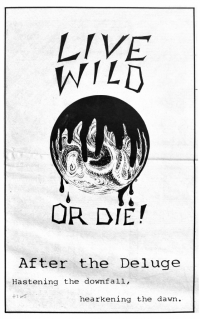
In Live Wild or Die! no. 2 C. J. Hinke takes an extreme stand for saving trees; Dumpsterman, son of Waste King, describes the logic of dumpster diving; Vic Vac Sectomy and Tutti Toob Tyed argue for reproductive choice; and an unknown TV smasher offers tips on how to destroy televisions with steel pipes wrapped in duct tape.
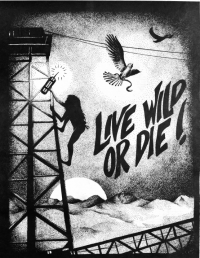
In this first issue of Live Wild or Die! the editors ask, “why be modest in the face of impending doom? Live wild or die!” Toby discusses how biocentrism can lead to destruction of nature; Feral Faun explains why there is more to the Earth First! movement and why the name should be left behind; Sneaky Driller sheds light on tree spiking; and Sheriff Jim Weeds explains the deeper meaning of ecoterrorism.
Carmel Finley reflects on her developing interest in fish and fisheries, particularly in postwar fisheries science.
This volume provides new histories of Pacific whaling from untold perspectives.