

Klassen, Lijuan, and Christof Mauch. “Imagining Planetary Health,Wellbeing and Habitability: Perspectives from the Environmental Humanities.” Global Environment: A Journal of Transdisciplinary History 19, no. 2 (2026): 263–77.
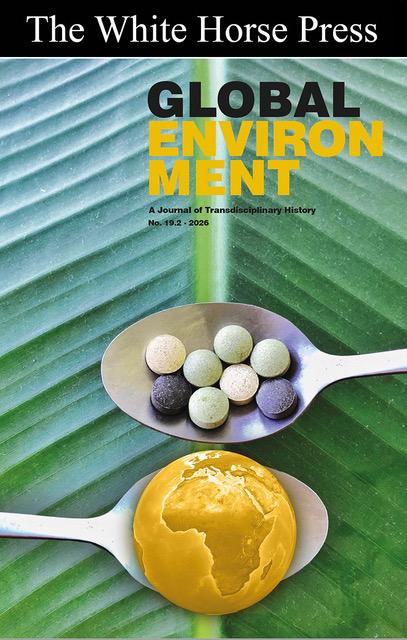
Global Environment. Cover.
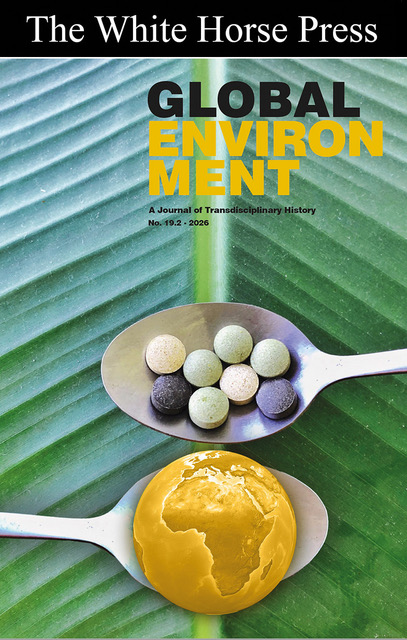
Global Environment. Cover.
2026 The White Horse Press
This work is licensed under a Creative Commons Attribution 4.0 International License.
The planet is under increasing stress, significantly impacting the health and wellbeing of human and more-than-human life on Earth. There is abundant scientific evidence today that the burning of fossil fuels and the emission of CO2 into the atmosphere not only contribute to climate change globally, but also produce air pollutants that are responsible for rising rates of respiratory diseases and millions of premature deaths each year. It is equally evident that increasing global temperatures have led to more frequent and intense heatwaves, resulting in higher rates of heatstroke, dehydration and cardiovascular diseases. Moreover, the continuous deforestation of rainforests for monoculture agro-industries and mining operations, devastating wildlife habitats worldwide, has been linked to an increased likelihood of the transmission and dissemination of novel zoonotic diseases. These examples speak to the planetary character of health and disease, where ecological degradation and pollution in one part of the world may shape geographies of life and death elsewhere. (From the article)
© 2026 The authors. This work is licensed under CC BY 4.0.

