Everyday Futures: Australia in the Age of Humans
The project Everyday Futures explores the role museums can play in helping to make sense of Australia’s experiences during a time of rapid planetary change and global disruption.

Erin Ryan argues that environmental law is uniquely prone to federalism discord because it inevitably confronts the core question with which federalism grapples—who gets to decide?—in contexts where state and federal claims to power are simultaneously at their strongest.
Literary scholar Hsu Hsuan writes about the relation between the content of monster movies like Godzilla and US military activity in the Pacific. This is a chapter of the virtual exhibition “Representing Environmental Risk in the Landscapes of US Militarization.”
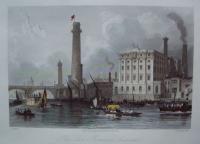
Making more beer for eighteenth-century London’s growing population increased the need for clean water. Efforts to guarantee supplies to the brewers had an effect on both urban and rural landscapes.
This article looks at how a fossil-fuel-based artificial ice producer challenged a competitor using renewable and sustainable resources.
The urbanization of Bangalore transformed the once-strong relationship between communities and the lakes that they once created and maintained.
Once an environment in which the notion of nations was unheard of, the Arctic region is now a disputed space among superpowers. This is a chapter of the virtual exhibition “The Northwest Passage: Myth, Environment, and Resources”—written and curated by historian Elena Baldassarri.
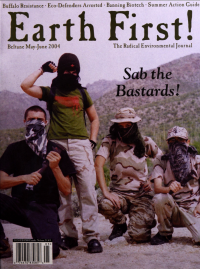
In Earth First! 24, no. 4 Chuk’Shon EF! reports on the sabotage of a mountain lions hunt in the Sonoran Desert, Abigail is pleased about Bayer’s withdrawal from growing GE maize in Britain, and Kim Antieu reflects on the annual pesticide spraying by US county and state departments, farmers and homeowners.