


Exhibition chapter
Structures of Inequality | Toxic Relationships
Chapter 3 of the virtual exhibition Toxic Relationships: Uncovering the Worlds of Hazardous Waste.
Chapter 3 of the virtual exhibition Toxic Relationships: Uncovering the Worlds of Hazardous Waste.
In this commentary, Bejoy Thomas, Soumyajit Bhar, and Shoibal Chakravarty caution against optimistic narratives of environmental revival.
Sir Crispin Tickell scans what industrial countries can and have to do in order to give a lead in global arrangements to alleviate economic and ecological problems.

In this episode from the New Books Network podcast, Nadia Y. Kim is interviewed on her recent book, Refusing Death: Immigrant Women and the Fight for Environmental Justice in LA.
The first part of the paper discusses the social, economic and legal history of the copper smoke problem, and the technology employed to control emissions. The second part deals with the chemical composition of copper smoke and estimates the output and dispersion of copper smoke and other metal fumes from the Llanelli Copper Company’s works in the 1860s.

Michael Marder interprets the “toxic flood” we are living or dying through as a global dump. On his reading, multiple levels of existence—from the psychic to the physiological, from the environmental-elemental to the planetary—are being converted into a dump, a massive and still growing hodgepodge of industrial and consumer by-products and emissions; shards of metaphysical ideas and theological dreams; radioactive materials; light, sound, and other modes of sensory pollution; pesticides and herbicides; and so forth.
Two broad themes taken up in the literature will be the focus of this essay: how far colonialism was an ecological watershed, and how producers responded to new pressures. The third issue is of what we can or should learn (or unlearn) from the colonial experience.
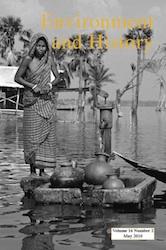
This editorial note introduces the four major conference themes of the 5th International Water History Association (IWHA) Conference ‘Pasts and Futures of Water’ in June 2007: (i) water, health and sanitation; (ii) water, food and economy; (iii) water and the city; and (iv) water governance and policy.
Gremaud’s article analyses representations of nature as brand and resource in current Icelandic society, through an interdisciplinary approach involving cultural geography and visual methodologies.
In this episode from the New Books Network podcast, David B Williams is interviewed on his recent book, A Human and Natural History of Puget Sound.