

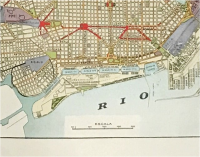
Arcadia
Memory and the Origins of the Reserva Ecológica Costanera Sur in Buenos Aires
A constructed park’s history clashes with how citizens see and use that space.
A constructed park’s history clashes with how citizens see and use that space.

The project Everyday Futures explores the role museums can play in helping to make sense of Australia’s experiences during a time of rapid planetary change and global disruption.
The authors base this critique of the North American Model of Wildlife Conservation (NAMWC) on its narrow stakeholder focus and limited ideological representation.
The authors explore the implementation of Traditional Ecological Knowledge (TEK) and Indigenous knowledge (IK) in mapping efforts, taking cues from previous spatio-temporal visualization work in the Geographic(al) Information System(s)/Science(s) GIS community, and from temporal depictions extant in existing cultural traditions.
Through a quantitative questionnaire survey conducted in villages around the Nouabalé-Ndoki National Park in northern Congo, the authors assess local attitudes towards conservation and elephant conservation in particular.
The authors delve into the social reasons behind illegal turtle egg harvesting in the La Flor Wildlife Refuge in Nicaragua, based on a survey conducted among 180 households living in Ostional, the largest village in the vicinity of the Refuge.
The authors assess the governance of the Hin Nam No National Protected Area in central Laos to understand the possibilities of supporting fruitful collaborative governance of protected areas.
Stephan Hochleithner argues that multi-dimensional resistance to Virunga National Park’s conservation strategies ties in with general conflict dynamics in eastern DRC, while at the same time reproducing them within the realm of nature conservation, tightly interwoven with global dynamics.
The article explores the complex socio-environmental relations of small-scale inland fishing by using the Pantanal wetland in Brazil as a case study and attempts to deconstruct environmental narratives behind top-down fishing management practices.
Douglas Sheil reviews the book Traditional Forest-Related Knowledge Sustaining Communities, Ecosystems and Biocultural Diversity by John A. Parrotta and Ronald L. Trosper.