


Arcadia
From Pulley to Pipe: The Decline of the Wells of Bangalore
This article investigates the transition of water supply in Bangalore, where wells were gradually replaced by piped water.
This article investigates the transition of water supply in Bangalore, where wells were gradually replaced by piped water.

In 1966, a stray beluga whale swimming up and down the polluted Lower Rhine caught the media’s attention in West Germany.
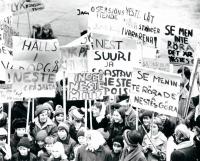
This article studies the “Neste war,” 1970–1972, the first major victory of the environmental movement in Finland.
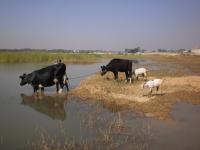
The urbanization of Bangalore transformed the once-strong relationship between communities and the lakes that they once created and maintained.

Matthew MacLellan argues that Garrett Hardin’s primary object of critique in his influential “The Tragedy of the Commons” is not the commons or shared property at all—as is almost universally assumed by Hardin’s critics—but is rather Adam Smith’s theory of markets and its viability for protecting scarce resources.
Martin’s article explores the rise of the line graph and an associated statistical method, linear regression, in ecology, contending that not only has ecologists’ use of linear regression shaped understandings of nature, but ecologists’ understandings of nature have also shaped their use of linear regression.
Shannon Cram explores the slippery subjectivities of nuclear waste and nature at Washington State’s Hanford Nuclear Reservation, examining how this space is framed as both pristine habitat and waste frontier. She examines Hanford’s biological vector control program through the fruit fly and discusses how vector control uses instances of nuclear trespass to articulate the boundary between contaminated and uncontaminated. She concludes that nature is being recruited to do what the U.S. Department of Energy cannot: solve Hanford’s nuclear waste problem.
Greear examines the contemporary trend toward de-industrialized and decentralized production and its implications for ecological sustainability. He suggests we can understand the potential positive ecological implications of such trends by reconceptualizing “incomplete information” in markets, which is often understood as a key way in which markets fail to solve or forestall environmental problems.
Affrica Taylor, Veronica Pacini-Ketchabaw, Sandrina de Finney, and Mindy Blaise edit and introduce a special section on “Inheriting the Ecological Legacies of Settler Colonialism.” The three essays that follow ponder the question of ecological inheritance in the settler colonial contexts of Canada and Australia, cognizant of the fact that settler colonialism remains an incomplete project.
In this article for a special section on “Inheriting the Ecological Legacies of Settler Colonialism,” Lesley Instone and Affrica Taylor engage with the figure of the Anthropocene as the impetus for rethinking the messy environmental legacies of Australian settler colonialism.